Principles of Biochemistry Volume 3 - A. Lehninger 1985
Molecular Mechanisms of Genetic Information Transfer
DNA: Structure of Chromosomes and Genes
DNA and RNA nucleotide units contain specific bases and pentoses
As we recall (Chapter 3), NUCLEOTIDES consist of three components: a nitrogenous base, a pentose sugar, and phosphoric acid, linked together (Fig. 27-1) such that the base is joined by an N-glycosidic bond to the 1' carbon of the pentose, and the phosphoric acid by an ester bond to the 5' carbon of the pentose. Nitrogenous bases are derivatives of two parent heterocyclic compounds: pyrimidine and purine (Fig. 27-2). DNA contains two pyrimidine bases—cytosine (C) and thymine (T)—and two purine bases—adenine (A) and guanine (G). RNA also contains two Pyrimidines—cytosine (C) and uracil (U)—and two Purines—adenine (A) and guanine (G). The only major difference in the bases of DNA and RNA is that thymine—one of the primary pyrimidines of DNA—occurs very rarely in RNA; conversely, uracil—one of the main pyrimidines of RNA—is extremely rare in DNA. Pyrimidine and purine bases are nearly planar molecules that are relatively poorly soluble in Water (Fig. 27-3).
Class="center">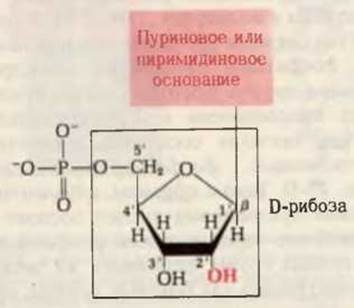
Fig. 27-1. Generalized Structure of Nucleotides. The figure shows The structure of a ribonucleotide. In deoxyribonucleotides, the —OH group (highlighted in red) is replaced by an —H atom. The pentose carbon atoms are numbered with primed numerals (1', 2', etc.) to distinguish them from the carbon atoms of the bases.

Fig. 27-2. Main pyrimidine and purine bases found in DNA and RNA.
Two Types of pentoses are found in Nucleic Acids. The repeating deoxyribonucleotide units of DNA contain 2-deoxy-D-ribose, whereas the ribonucleotide units of RNA contain D-ribose. Both pentoses occur in nucleotides in the ß-furanose form.
Figure 27-4 illustrates the structural formulas and names of the four principal deoxyribonucleotides (deoxyribonucleoside-5'-monophosphates), which function as the structural and coding units of DNA, and the four principal ribonucleotides (ribonucleoside-5'-monophosphates), which serve as the coding units of RNA. Specific, lengthy sequences of the bases A, T, G, and C in DNA encode Genetic information. In addition to the major bases, DNA also contains a small fraction of so-called minor bases. Typically, minor bases are methylated forms of the major bases; however, in certain viral DNAs, some bases may be hydroxylated or glucosylated. In many cases, these modified or unusual bases within DNA molecules act as specific signals that play a crucial role in the expression or preservation of genetic information. Minor bases have also been discovered in RNA, predominantly in tRNA.
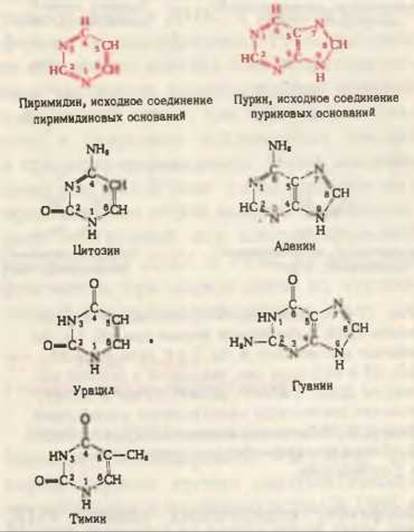
Fig. 27-3. Parent compounds pyrimidine and purine, alongside the principal pyrimidine and purine bases of nucleic acids.

Fig. 27-4. A. Deoxyribonucleotide components of DNA in free form at pH 7.0. They are commonly designated as A, G, T, and C (or less frequently dA, dG, dT, and dC) when incorporated into a DNA molecule, and as dAMP, dGMP, dTMP, and dCMP when present as free nucleotides. B. Ribonucleotide components of RNA. In both cases, the phosphate group is located at the 5' position.
Last update: 06/08/2026
Editorial and Educational Adaptation: This material has been compiled based on the primary/original source text. The project team performed an editorial review, corrected technical inaccuracies, structured sections, and adapted the content for an educational format.
What was processed:
- elimination of formatting defects (OCR errors, structural breaks, corrupted characters);
- editorial organization of content;
- standardization of terminology in accordance with academic sources;
- verification of factual statements against the original source text.
All mentions of the author, publication year, and origin of the primary text have been preserved in accordance with the source.