Principles of Biochemistry Volume 3 - A. Lehninger 1985
Molecular mechanisms of genetic information transmission
DNA: structure of chromosomes and genes
Consecutive nucleotides are linked by phosphodiester bonds
Sequentially arranged NUCLEOTIDES in DNA and RNA molecules are covalently linked together via phosphate "bridges." The 5'-hydroxyl group of the pentose of one nucleotide is joined to the 3'-hydroxyl group of the pentose of the neighboring nucleotide through a phosphodiester bond (Fig. 27-5). Thus, the covalent backbones of Nucleic Acids consist of alternating, repeating units of phosphate and pentose groups; the bases can be viewed as side groups attached to the backbone at regular intervals. It is also worth noting that the sugar-phosphate backbones of both DNA and РНК carry a net charge, because the phosphate groups are acidic and negatively charged at physiological Cell pH. At the same time, the purine and pyrimidine bases, which are sparingly soluble in Water, are hydrophobic. Furthermore, DNA and RNA chains possess a distinct polarity, or directionality, because all internucleotide phosphodiester bonds are oriented identically along the chain (Fig. 27-5). As a result of this polarity, every polynucleotide chain has a 5'-end and a 3'-end.
Class="center">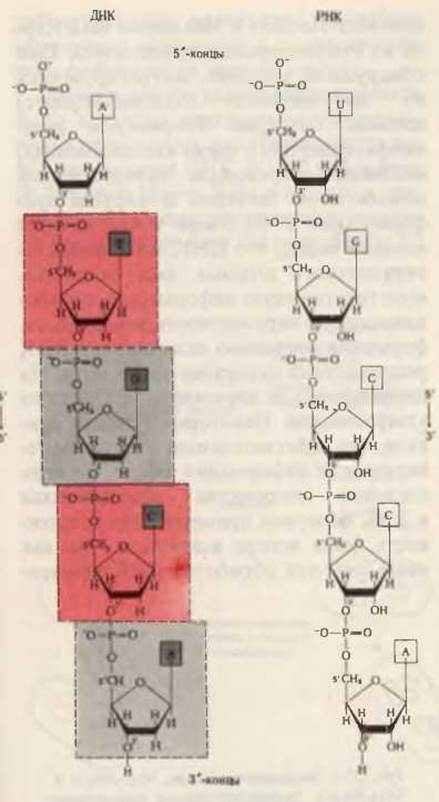
Fig. 27-5. Structure OF THE covalent backbone of DNA and RNA, in which successive nucleotide units (shaded in the DNA) are linked together by phosphodiester bridges. Note that the backbone, composed of alternating pentose residues and phosphate groups, represents the strongly polar part of the molecule, whereas the bases are the nonpolar, hydrophobic components.
The nucleotide sequence of nucleic acids can be represented schematically, as illustrated below for a five-nucleotide DNA fragment:

The bases are designated by the symbols A, T, G, and C, each deoxyribose is represented by a vertical line, and the phosphate groups are denoted by (p). Circled numbers indicate the positions on the deoxyribose to which the phosphate groups are attached. The structure of a single DNA strand is conventionally depicted with the 5'-end on the left and the 3'-end on the right, i.e., in the 5'→3' direction. The pentadeoxyribonucleotide shown above can also be written as:
pApTpGpCpA or even more simply pATGСА.
Internucleotide bonds in DNA and RNA can be cleaved chemically by Hydrolysis, as well as enzymatically by Enzymes called Nucleases. Some nucleases are capable of cleaving bonds between two adjacent nucleotides located within a DNA or RNA chain; such enzymes are termed endonucleases. Nucleases of another class catalyze the hydrolysis of only the terminal nucleotide bond—at either the 5'- or the 3'-end of the molecule; these enzymes are known as exonucleases. Deoxyribonucleases, which specifically cleave certain internucleotide bonds in DNA, and ribonucleases, which are specific for RNA, are found in all living Cells. For example, they are secreted by the Pancreas into the intestinal tract, where they participate in the Digestion and hydrolysis of nucleic acids. As we will see later, various types of endonucleases serve as essential biochemical tools for the controlled Cleavage of DNA and RNA into smaller fragments during nucleotide sequencing.
Last update: 06/08/2026
Editorial and Educational Adaptation: This material has been compiled based on the primary/original source text. The project team performed an editorial review, corrected technical inaccuracies, structured sections, and adapted the content for an educational format.
What was processed:
- elimination of formatting defects (OCR errors, structural breaks, corrupted characters);
- editorial organization of content;
- standardization of terminology in accordance with academic sources;
- verification of factual statements against the original source text.
All mentions of the author, publication year, and origin of the primary text have been preserved in accordance with the source.