HUMAN MEDICAL BIOLOGY, ANATOMY, PHYSIOLOGY, AND PATHOLOGY - Ya.I. Fedonyuk 2010
BIOLOGY
CHAPTER 1. BIOLOGICAL FOUNDATIONS OF HUMAN VITAL ACTIVITY
1.3. MOLECULAR-GENETIC AND CELLULAR LEVELS OF LIFE ORGANIZATION
1.3.3. Hereditary Apparatus of Eukaryotic Cells and Its Functioning: Molecular Level
Regulation of Gene Expression IN Prokaryotes and Eukaryotes
All somatic Cells of an Organism contain an identical set of Chromosomes and genes, carrying the complete Genetic information characteristic of a given species. However, cells within the same organism vary in Structure, function, and protein-enzyme composition. These differences are primarily based on the differential expression (activity) of various Regions of the genome. There are two main groups of genes within a Cell. Some of these (constitutive genes) are expressed continuously because the products they encode are constantly required by The Cell (ribosomal Proteins, RNA polymerases, tRNA and rRNA molecules, etc.). Other genes "operate" only under specific conditions—whenever the cell requires the Enzymes encoded by them. The expression of these genes is regulated by both genetic and non-genetic factors. The Mechanism of gene expression regulation was first elucidated in 1961 by French microbiologists F. Jacob and J. Monod, who studied ENZYME SYNTHESIS REGULATION in the bacterium Escherichia coli. This mechanism is known as The Operon hypothesis (Nobel Prize, 1968).
An operon is the genetic unit of METABOLISM/31.html">Transcription regulation in prokaryotes. It is a DNA nucleotide sequence that combines structural genes, a promoter, an operator, and a terminator. Structural genes are tightly clustered together, positioned adjacent to one another, and carry the information for synthesizing enzymes
catalyzing sequential reactions of a single metabolic pathway. The structural genes of a single operon function as a unified whole. The control regions of the operon include the promoter, operator, and terminator. The promoter is a DNA region of the operon where RNA polymerase initially binds and from which transcription of structural genes begins. The operator is a DNA region of the operon located between the promoter and structural genes, capable of binding to a repressor protein. Structural genes synthesize Messenger RNA when the operator is switched on, and cease synthesis when it is switched off. The operator is switched on or off by the repressor protein. The Synthesis of the repressor protein is encoded by a regulator gene, which may be located adjacent to the operon or at a distance from it. The repressor protein can exist in two forms: active and inactive. In its active form, the repressor binds to the operator and switches it off, thereby inactivating the entire operon (transcription does not occur). The operon is switched on when the repressor protein is in its inactive form and unable to bind to the operator. Non-genetic factors known as effectors also participate in regulating gene expression. Effectors are low-molecular-weight substances that interact with repressor proteins and alter their ability to bind to the operator. If the complex (operator + regulatory protein) inhibits transcription, such control is termed negative; if it activates transcription, it is positive. Operons function via Induction and Repression mechanisms.
A classic example of an operon functioning via induction is the lactose operon (lac operon) model in the bacterium Escherichia coli. The lac operon contains three structural genes encoding the synthesis of three enzymes required for lactose metabolism (Fig. 1.47). The operation of the operon is controlled by a regulator gene that directs the synthesis of an active repressor protein. In the absence of lactose, the repressor protein binds to the operator, preventing transcription (negative control). When lactose appears in the culture medium (replacing glucose), it enters the cell and binds to the repressor protein, rendering it inactive and incapable of binding to the operator. The operator is thus freed from the repressor protein, allowing the structural genes to function (transcription proceeds). As long as lactose is present in the medium, the operon remains active, producing the enzymes necessary for its Cleavage. Thus, lactose acts simultaneously as a cleavage substrate and as an inducer of its own degradation. Negative control of lac operon function explains the core of the induction phenomenon: no inducer (lactose) means the operon is inactive; the presence of an inducer (lactose) means the operon is actively functioning.
Class="center">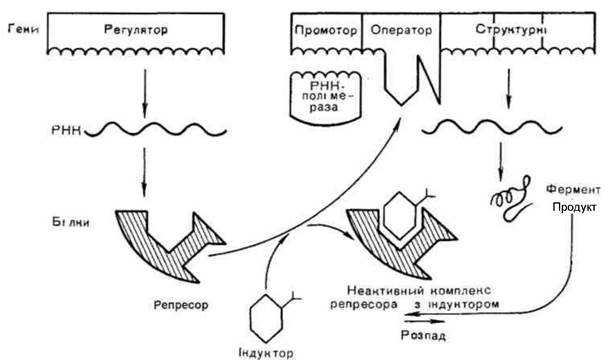
Fig. 1.47. Scheme of transcription regulation of structural genes in a Introduction/4.html">Prokaryotic Cell via induction.
The phenomenon of enzyme repression is illustrated by the Tryptophan operon model.
Tryptophan—and consequently the enzyme required for its synthesis (tryptophan synthetase)—is normally required by the cell at all times.
The tryptophan operon is predominantly switched on, and structural gene transcription proceeds because the regulator gene encodes an inactive repressor protein that cannot attach to the operator to switch it off. If an excess of tryptophan accumulates in the cell (creating a need to eliminate it), a portion of the tryptophan acts as a corepressor. The corepressor binds to the inactive repressor, activating it. The resulting complex (repressor + corepressor) attaches to the operator and switches it off, thereby silencing the entire operon and halting tryptophan synthetase synthesis (negative control).
A distinctive feature of the tryptophan operon is the presence of a leader DNA nucleotide sequence (the attenuator) located between the promoter-operator region and the first structural gene. The phenomenon of attenuation lies in the fact that even a slight excess of tryptophan causes RNA polymerase to prematurely terminate transcription at the attenuator region. Thus, attenuators provide a more economical regulation of operon activity. The tryptophan operon operates via a feedback mechanism.
The described systems of structural gene regulation are adaptive in nature. In the first case, enzyme synthesis is triggered by the influx of a cleavage substrate into the cell; In the second, enzyme production ceases as soon as the demand for a specific substance disappears. In addition to transcription, the Regulation of Protein Biosynthesis occurs at the stages of Translation, post-translational modification, and The formation of organismal traits.
The control of Gene expression in eukaryotes is significantly more complex and remains less understood. Eukaryotes lack operons analogous to those found in Bacteria. Genes encoding sequential steps of a biosynthetic pathway may be located in different regions of the same chromosome or even on different chromosomes. The primary transcript (pre-mRNA) undergoes post-translational modification (Processing). The Genome of higher eukaryotes is considerably more complex (prokaryotes have a single chromosome, whereas humans have 46). In Eukaryotic cells, the nuclear envelope spatially separates the processes of transcription (in The Nucleus) and translation (in the Cytoplasm). EUKARYOTIC GENE EXPRESSION is influenced by gene Amplification—the multiple Replication of identical gene copies. Unlike prokaryotes, eukaryotic genes contain introns. Another characteristic feature of the eukaryotic genome is the presence of specialized DNA-enhancing segments known as enhancers. Gene activity in eukaryotes is regulated by the Endocrine System. Many Hormones function as genetic inductors, possessing The ability to switch various genes on and off.
Last update: 08/08/2026
Editorial and Educational Adaptation: This material has been compiled based on the primary/original source text. The project team performed an editorial review, corrected technical inaccuracies, structured sections, and adapted the content for an educational format.
What was processed:
- elimination of formatting defects (OCR errors, structural breaks, corrupted characters);
- editorial organization of content;
- standardization of terminology in accordance with academic sources;
- verification of factual statements against the original source text.
All mentions of the author, publication year, and origin of the primary text have been preserved in accordance with the source.