Genetics - A. V. Sivolob 2008
Gene Expression
Gene Expression in Prokaryotes
Regulation of Transcription
It is clear that genes are not transcribed continuously, but are turned on and off at specific moments depending on external conditions, Cell Cycle stages, and so forth. The main elements whose interaction determines the activation or repression of METABOLISM/31.html">Transcription are cis- and trans-elements. Cis-elements are DNA sequence regulatory elements that are physically linked to a given Gene; in prokaryotes, they are often called operators and are located in the immediate vicinity of promoters. Trans-elements are protein transcription factors that freely diffuse (transport) within the cellular space in search of their cis-element, for which they have a specific affinity. If the binding of a trans-element to the operator leads to transcription activation (often through direct Protein-Structure/156.html">Protein Interactions of the transcription factor with RNA polymerase that increase its affinity for the promoter), the factor is said to be an activator and exerts positive regulation. If the factor blocks RNA polymerase binding (often by reducing promoter accessibility), it is called a repressor and the regulation is negative.
These general regulatory principles, which become more complex and are also conserved in eukaryotes, are implemented at the initiation stage. In addition, other Stages of the transcription process are utilized for regulation. In particular, the antitermination mechanism is employed for The regulation of certain genes, where transcription activators prevent RNA polymerase from recognizing termination signals located within the coding part of the gene. If these factors are absent, the gene is inactive: the presence of the termination signal causes transcription termination and the release of a non-functional RNA product.
An essential feature of the prokaryotic genome is that although approximately 3/4 of transcription units (e.g., in E. coli) contain a single gene, the rest exhibit the Operon principle of genetic material Organization characteristic of Bacteria. An operon is a cluster of so-called structural genes from which a single mRNA molecule is synthesized, possessing multiple (one for each structural gene) consecutive open reading frames for the Introduction/27.html">Translation of the corresponding Proteins. Grouped within an operon are structural genes responsible for the synthesis of proteins involved in a single pathway of biochemical transformations (Enzymes for the synthesis or degradation of a specific compound). In addition to structural genes, the operon contains regulatory regions through which the Transcription of the operon as a whole is regulated. The E. coli genome contains ~650 such transcription units.
The following two Examples illustrate the most typical mechanisms of transcription regulation in prokaryotic systems.
The lactose operon (lac operon) of E. coli, thanks to the research of François Jacob and Jacques Monod, historically became the first studied transcription regulation system in detail. The operon (Fig. 2.8) includes three structural genes encoding enzymes involved in the utilization (Catabolism) of lactose. Transcription of all three genes is driven from a single promoter (yielding a single polycistronic mRNA molecule with three consecutive open reading frames). The promoter is flanked by two identical operator regions (lac operators) that have an affinity for the lac repressor, and a CAP (Catabolite Activator Protein) binding site.
Class="center">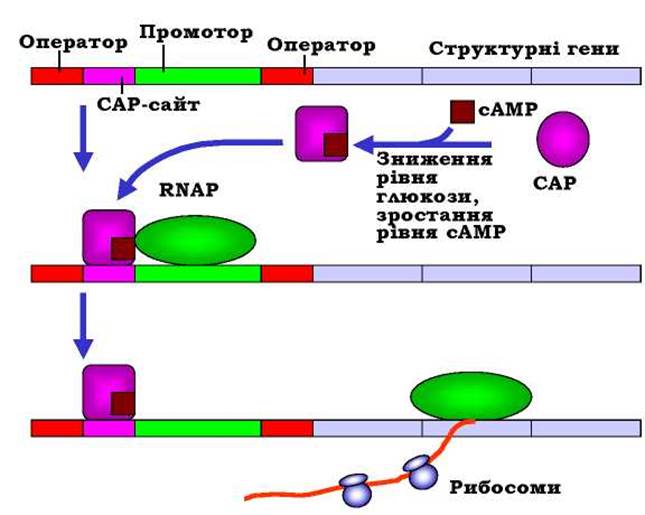
Fig. 2.8. Positive Regulation of the lac operon by the catabolite activator protein CAP
The lac operon promoter is weak—it has a relatively low intrinsic affinity for RNA polymerase. Even if lactose is present in the medium, but glucose (a preferred nutritional substrate for bacteria) is also present, transcription of the lac operon hardly occurs. A decrease in glucose levels leads to an increase in the intracellular concentration of cAMP (cyclic adenosine monophosphate), the binding of which to CAP induces a conformational rearrangement of the protein and The Emergence of its specific affinity for the corresponding site on DNA (see The structure of the complex in Fig. 1.7, c). The interaction of CAP with RNA polymerase enhances its affinity for the promoter—CAP recruits the polymerase, which then initiates mRNA synthesis (Fig. 2.8).
The described scenario of positive regulation is implemented only if the lac operators do not interact with the lac repressor. In the absence of lactose (when the respective enzymes for its utilization are certainly not needed), repressor homodimers (regardless of the possible presence of CAP) bind to both operators and interact with each other: a tetrameric complex is formed that holds a DNA loop (Fig. 2.9). The promoter is located inside the loop, which completely prevents RNA polymerase from binding to it. When lactose appears, a small amount of it is converted into allolactose, which acts as an inducer of the lac operon: the binding of allolactose to the repressor induces structural Changes in the protein and the loss of its affinity for the operator. As a result of the loop's disruption, RNA polymerase binds to the promoter, and the operon becomes active.
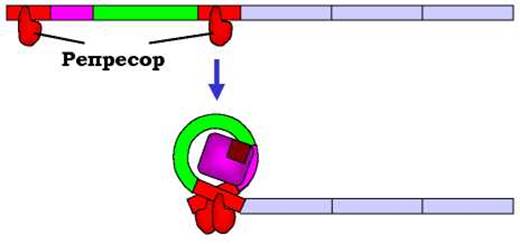
Fig. 2.9. Negative regulation of the lac operon by the lac repressor
Attenuation. The attenuation system, used in particular to regulate The activity of the Tryptophan operon (trp operon) of E. coli, involves The Use of termination signals and the fact that Prokaryotic Transcription is tightly coupled with translation. The tryptophan operon contains five structural genes responsible for the Synthesis of the amino acid Trp, preceded by a promoter, an operator, and a leader sequence where transcription initiates (Fig. 2.10, a).
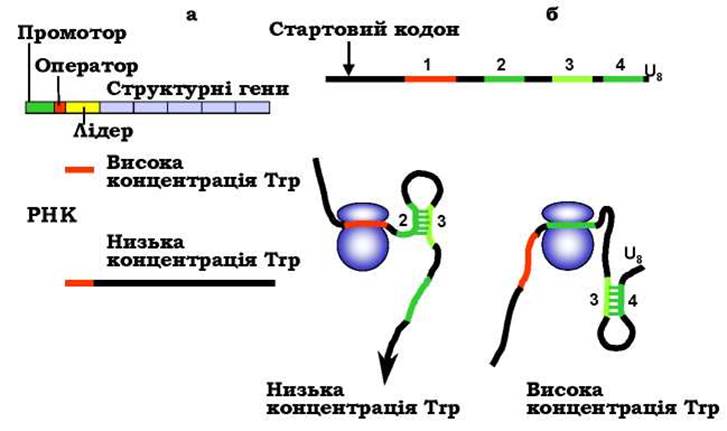
Fig. 2.10. (a): Scheme of the trp operon, which synthesizes two RNA products depending on the intracellular concentration of Trp. (b): Leader RNA and two variants of base pairing within it depending on ribosome positioning
The leader region of RNA contains a start codon recognized by The Ribosome and four sequence elements: region 1 contains two consecutive tryptophan codons, regions 2-3 and 3-4 are pairwise mutually complementary, and an oligo-U sequence is located downstream of region 4. The 3-4 hairpin, flanked by oligo-U, thus serves as a transcription termination signal. When the Trp concentration is low (Trp is needed and therefore the operon must be active), the ribosome stalls at the tryptophan codons of region 1 (due to the lack of Trp-tRNA). In this case, the 2-3 hairpin forms (region 3 is not involved in forming the terminating hairpin), and RNA polymerase continues the synthesis of full-length mRNA. Ribosomes bind to the start codons corresponding to the structural genes, and the corresponding proteins are synthesized.
At a high level of Trp, the ribosome quickly passes through region 1 to region 2 and stops at the stop codon. As a result, the 3-4 hairpin forms—meaning a termination signal is generated—and RNA polymerase halts transcription after synthesizing a short, non-functional leader RNA.
The trp operon is also under the control of the trp repressor. The regulator of the repressor's affinity for the operator is Trp itself: in a complex with it, the repressor adopts a conformational state with high affinity. If the Trp concentration drops, the repressor dissociates, and the efficiency of Transcription initiation increases approximately 70-fold. Attenuation is an additional, less efficient regulatory mechanism: in the absence of Trp, transcription efficiency increases about 10-fold due to attenuation (in the presence of Trp, about 10% of RNA polymerases overcome the termination signal and continue working, whereas in the absence of Trp, virtually all do). Thus, the combined action of attenuation and negative control by the repressor allows the activity of the operon to be varied nearly 700-fold depending on the intracellular concentration of Trp.
Last update: 11/08/2026
Editorial and Educational Adaptation: This material has been compiled based on the primary/original source text. The project team performed an editorial review, corrected technical inaccuracies, structured sections, and adapted the content for an educational format.
What was processed:
- elimination of formatting defects (OCR errors, structural breaks, corrupted characters);
- editorial organization of content;
- standardization of terminology in accordance with academic sources;
- verification of factual statements against the original source text.
All mentions of the author, publication year, and origin of the primary text have been preserved in accordance with the source.