Fundamentals of Molecular Biology - V.I. Rezyapkin 2009
Transcription
Prokaryotic Transcription
Prokaryotes contain a single RNA polymerase consisting of multiple subunits. The RNA polymerase of E. coli is the most thoroughly studied. This enzyme is composed of subunits designated by the Greek letters α, β, β’, and σ. RNA polymerase can exist in two forms: a holoenzyme, whose subunit composition is represented by the formula α2ββ’σ, and a core enzyme, α2ββ’. Only the holoenzyme is capable of initiating RNA Synthesis. Following METABOLISM/31.html">Transcription initiation, the σ-subunit dissociates, and elongation is carried out by the core enzyme. Thus, the σ-subunit—also referred to as the σ-factor—is essential for promoter recognition. The β-subunit is involved in NTP binding, the β’-subunit interacts with DNA, and the α2β’ complex specifically binds to promoter nucleotide sequences. Upon interacting with DNA, RNA polymerase “covers” a region approximately 60 bp in size.
The E. coli Cell contains several σ-factors responsible for the recognition of various promoters by RNA polymerase. Typically, σ-factors recognize consensus blocks located approximately 10 and 35 NUCLEOTIDES upstream of the transcription start site (Fig. 4.3). These blocks feature conserved nucleotide sequences (common to all promoters within a given group).
Class="center">
Fig. 4.3. Organization of a promoter. The number +1 designates the nucleotide of the template strand where transcription begins. Nucleotides preceding it are numbered with negative values, while those following it are positive. The TATAAT sequence is called the TATA box or Pribnow box. The TTGACA sequence is referred to as the -35 box.
Different σ-factors are responsible for recognizing distinct groups of promoters and ensuring the transcription of specific genes (Table 1).
Table 4.1.
Sequences Recognized by σ-Factors
|
E. coli σ-factors |
-35 Sequence |
-10 Sequence |
|
σ70 |
TTGACA |
TATAAT |
|
σ32 |
TCTC-CCCTTGAA |
CCCCAT-TA |
|
σ54 |
(-24) CTGG-A |
(-12)TTGCA |
Transcription initiation involves The formation of a closed binary complex, followed by the generation of an open binary complex and the subsequent synthesis of short oligoribonucleotides. Once an RNA fragment exceeding 9 nucleotides is synthesized, the σ-factor dissociates irreversibly, and transcription enters the elongation stage. Elongation is performed by the core enzyme α2ββ’ (Fig. 4.4).
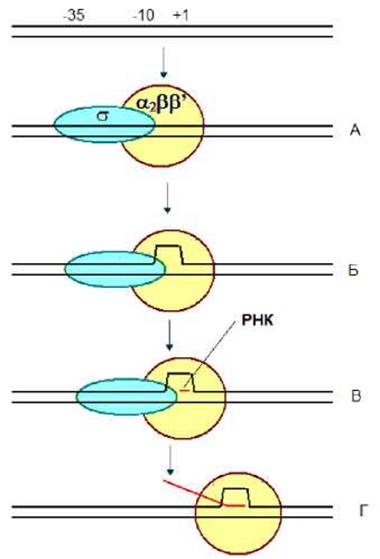
Fig. 4.4. Transcription initiation. A – closed binary complex, B – open binary complex, C – open ternary complex, D – transcription elongation.
During transcription elongation, an RNA–DNA duplex is formed, which is approximately 12 Base Pairs in length.
The core enzyme is capable of synthesizing RNA at a rate of about 40 nucleotides per second.
Upon reaching a terminator, the core enzyme halts RNA synthesis. Prokaryotes possess Two Types of terminators: ρ-dependent and ρ-independent. At ρ-dependent terminators, termination takes place in the presence of the protein ρ-factor, a process known as ρ-dependent termination. Conversely, transcription termination at terminators that do not require the ρ-factor is termed ρ-independent termination. ρ-Independent termination is driven by the formation of an RNA hairpin Structure during transcription, followed by an oligouridylate stretch. The hairpin causes a transcriptional pause, during which the oligouridylate–oligoadenylate duplex, being the least stable, dissociates (Fig. 4.5).
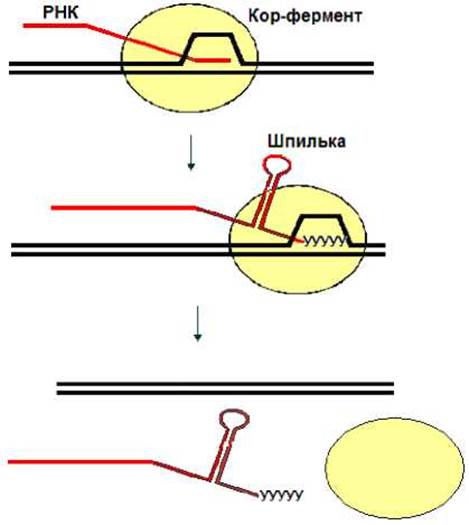
Fig. 4.5. ρ-Independent termination.
In the case of ρ-dependent termination, a specific site is located on the nascent RNA molecule to which the ρ-factor binds (Fig. 4.6). The ρ-factor Functions as an NTPase, utilizing the energy of NTP Hydrolysis to translocate along the RNA molecule from its initial loading site near the 5′ end toward the 3′ end. As soon as the ρ-factor “catches up” to the actively transcribing RNA polymerase, transcription termination is triggered (Fig. 4.6).

Fig. 4.6. ρ-Dependent termination.
Last update: 12/08/2026
Editorial and Educational Adaptation: This material has been compiled based on the primary/original source text. The project team performed an editorial review, corrected technical inaccuracies, structured sections, and adapted the content for an educational format.
What was processed:
- elimination of formatting defects (OCR errors, structural breaks, corrupted characters);
- editorial organization of content;
- standardization of terminology in accordance with academic sources;
- verification of factual statements against the original source text.
All mentions of the author, publication year, and origin of the primary text have been preserved in accordance with the source.