Fundamentals of Molecular Biology - V.I. Rezyapkin 2009
Transcription
METABOLISM/31.html">Transcription is the synthesis of RNA on a DNA template, proceeding in accordance with THE PRINCIPLE OF complementarity. As a result of transcription, an RNA molecule is formed that is complementary to one of the DNA strands (the template strand):
Class="center">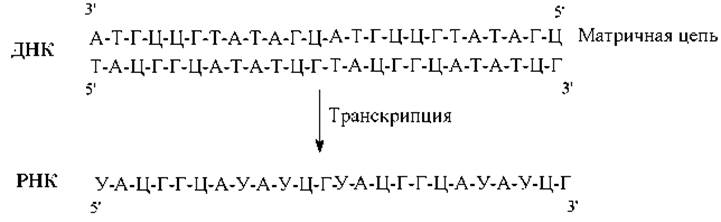
During transcription, Genetic information is "rewritten" from a DNA molecule to an RNA molecule.
Template-directed RNA Synthesis is catalyzed by the enzyme DNA-dependent RNA polymerase, which copies not the entire DNA template strand, but only a specific portion of it. The transcribed DNA region is bounded at the 3’-end by a promoter&mdasha specific sequence to which RNA polymerase binds before initiating synthesis&mdashand at the 5’-end by a terminator, the region where RNA synthesis ceases. The DNA sequence bounded by the promoter and terminator constitutes the unit of transcription, known as a transcripton (Fig. 4.1).
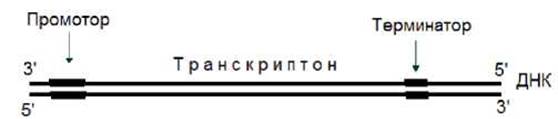
Fig. 4.1. Structure OF THE transcripton
The prokaryotic transcripton is also referred to as an Operon. Eukaryotic transcriptons typically contain only a single Gene, whereas prokaryotic operons generally comprise multiple genes.
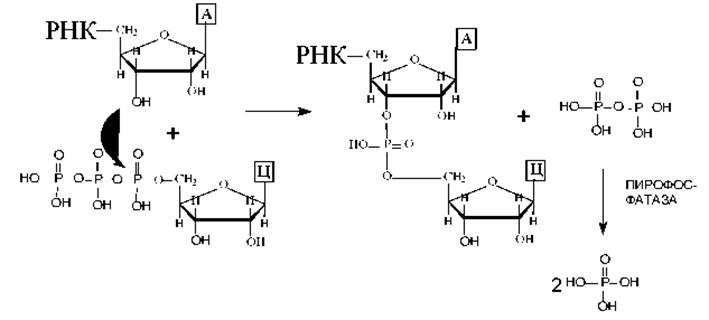
For RNA synthesis, RNA polymerase utilizes ribonucleoside 5’-triphosphates (NTPs)&mdashATP, GTP, CTP, and UTP&mdashas substrates. The enzyme elongates the chain by adding NUCLEOTIDES to the 3’-end, meaning that chain growth proceeds in the 5’ to 3’ direction. Like DNA polymerase, RNA polymerase requires a template, using one of the DNA strands for this purpose. However, unlike DNA polymerase, RNA polymerase does not require a primer.
The elongation of the RNA chain, catalyzed by RNA polymerase, is described by the equation:

RNA polymerase sequentially adds nucleotides to the 3’-end of the polynucleotide chain:
Transcription proceeds in three main stages: initiation, elongation, and termination (Fig. 4.2).
During the initiation stage, RNA polymerase interacts with the promoter to form a closed binary complex (Fig. 4.2), so called because it consists of two components: RNA polymerase and the DNA duplex, whose strands remain hydrogen-bonded via complementary base pairing within the complex. Next, the DNA melts locally over a short stretch to form an open binary complex, after which RNA synthesis begins. Following The formation of the initial phosphodiester bonds between ribonucleotides, the binary complex transitions into a ternary complex, marking the completion of the initiation stage.
During the subsequent elongation stage, the RNA chain is extended. As this occurs, the newly synthesized RNA strand forms short segments of a DNA-RNA hybrid double helix (Fig. 4.2), which are essential for the accurate copying of the template DNA strand.
As soon as RNA polymerase approaches the terminator, The final stage&mdashtermination&mdashbegins, resulting in the dissociation of the ternary complex and the release of the newly synthesized RNA molecule, or transcript.
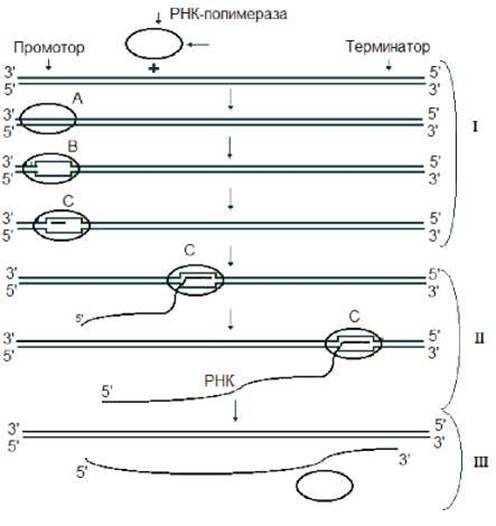
Fig. 4.2. Stages of Transcription. I - Transcription initiation, II - transcription elongation, III - transcription termination, A - closed binary complex, B - open binary complex, C - ternary complex.
Last update: 12/08/2026
Editorial and Educational Adaptation: This material has been compiled based on the primary/original source text. The project team performed an editorial review, corrected technical inaccuracies, structured sections, and adapted the content for an educational format.
What was processed:
- elimination of formatting defects (OCR errors, structural breaks, corrupted characters);
- editorial organization of content;
- standardization of terminology in accordance with academic sources;
- verification of factual statements against the original source text.
All mentions of the author, publication year, and origin of the primary text have been preserved in accordance with the source.