Military Hygiene and Hygiene in Emergencies - K.O. Pashka 2005
Occupational hygiene of military personnel during the mitigation of emergency consequences and in wartime
Toxic effects of chemical factors on the body
Chemical environmental factors pose a primary hazard to the body, as they trigger toxic effects not only upon direct exposure but can also cause long-term pathological changes.
To maintain an adequate level of combat readiness and efficiency among personnel while preserving their health inside sealed facilities, the concentration of airborne contaminants is strictly regulated and, under normal operating conditions, must not exceed the maximum allowable concentration (MAC). However, modern sealed military equipment and weaponry do not always fully meet hygienic requirements for completely removing toxic agents from the air, meaning that the concentrations of certain Chemical factors can reach significant levels and adversely affect the personnel's health.
The toxic impact of elevated oxygen concentrations on humans depends primarily on the pressure during inhalation. For instance, at oxygen pressures up to 2 atmospheres, the Respiratory system is predominantly affected, whereas at pressures exceeding 2 atmospheres, The Nervous system is also impacted.
Severe oxygen toxicity is accompanied by specific symptoms such as irritation of all sections of the respiratory tract, a reduction in vital lung capacity, substernal chest pain, paresthesias, convulsions, weakness, lethargy, and suppressed enzyme activity. The severity of human intoxication depends on the concentration, partial pressure, duration of oxygen inhalation, and the General condition of the Organism.
Breathing air with a reduced oxygen content is also hazardous to health, leading to hemic Hypoxia. Low oxygen levels in inhaled air, combined with an elevated carbon dioxide concentration, are tolerated better by humans than in the total absence of the latter.
Special and general physical training helps military specialists better adapt to low-oxygen environments and maintain the required level of combat readiness for longer periods. In individuals with poor physical conditioning, mental performance deteriorates significantly when the oxygen content drops to 8.5%, compared to trained personnel.
At an air concentration of 0.5–0.8% carbon dioxide, humans exhibit virtually no pronounced adaptive disorders; at 0.9–1.5%, acidosis occurs without disrupting basic physiological Functions; while at 3% or more, disturbances in behavior and core physiological functions are observed, including a sharp spike in Heart rate and increased Blood pressure. At concentrations of 1.0–3.0% СО2, adaptive processes are strained and latent pathology manifests. Exceeding a 5% carbon dioxide content in inhaled air leads to facial flushing, bradycardia, dizziness, and headache, culminating in apathy, complete loss of performance, and a life-threatening hazard.
Xenobiotics can exist in various aggregate states within the air of sealed military equipment and weaponry. Furthermore, depending on the intended purpose and power supply system of each specific group of equipment, the air composition features a distinct complex of chemical substances, several of which play a pivotal role in The Development of intoxication (Diagram 5.1).
A significant portion of xenobiotics consists of propellant and explosive gases, which contain large amounts of carbon monoxide (up to 50%), carbon dioxide (up to 25%), nitrogen oxides (tens of percent), as well as hydrogen, hydrogen sulfide, methane, cyanide, and Other Compounds. The concentration of propellant gases in enclosed air during firing depends on the caliber and number of weapons, charge power, rate of fire, internal volume of the equipment, and the efficiency of ventilation systems. Explosive gases can pose a hazard to personnel when mines, shells, and bombs strike shelters or sealed mobile military equipment.
Class="center">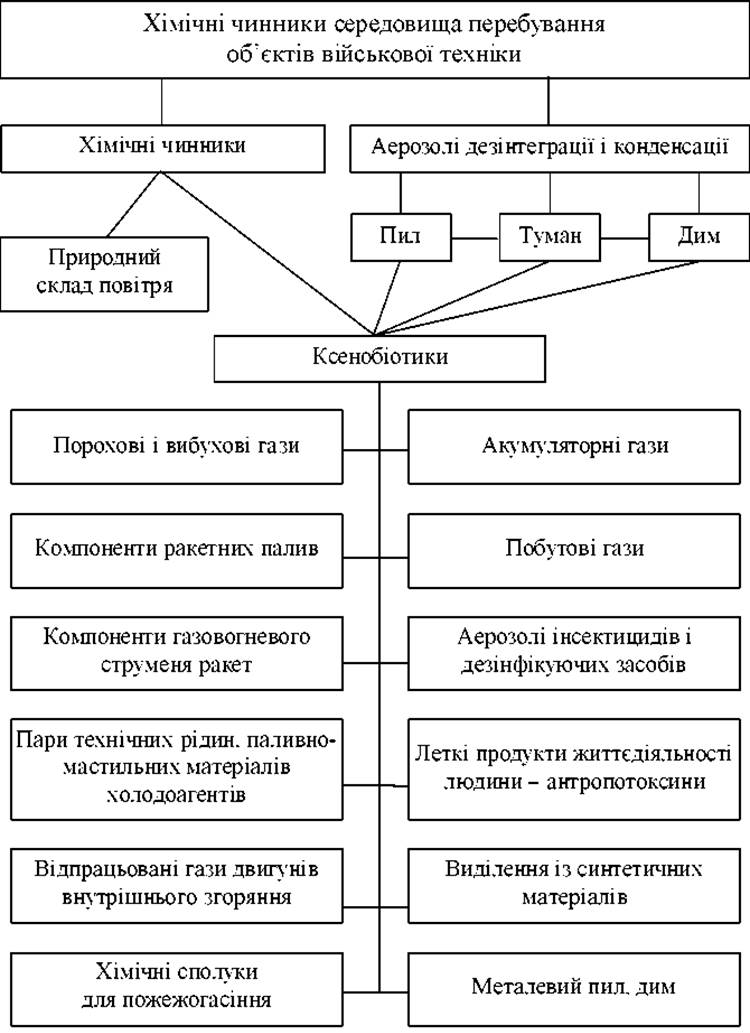
Diagram 5.1. Classification of main chemical factors in the airborne environment of military equipment and weaponry.
Once inside the body, carbon monoxide binds to blood Hemoglobin and blocks it, causing oxygen deprivation (hemic hypoxia), which leads to a rapid decline in body systems—especially the Central Nervous System. Carbon monoxide directly affects intracellular oxidation processes by activating Lipid Peroxidation. The first clinical signs of acute intoxication appear when carbon monoxide blocks 20–25% of hemoglobin, while The formation of 40–50% carboxyhemoglobin results in a loss of consciousness.
There are dozens of chemical substances and compounds used as rocket propellants (liquid, solid, and mixed). They comprise fuels (hydrazine and its derivatives) and oxidizers (nitric acid and its derivatives). Liquid oxygen and concentrated hydrogen peroxide may also be used as oxidizers.
Liquid rocket propellants pose the greatest environmental pollution hazard. Their high reactivity leads to the degradation of container seams and walls, as well as technological equipment, resulting in environmental spills. Solid rocket propellants can also serve as sources of volatile toxic components released into the air of sealed military equipment during prolonged storage. The chemical composition of combustion products from rocket propellant components (rocket gas-fire jet components) depends on the COMPOSITION OF THE fuel, oxidizers, and combustion conditions. They may include carbon and nitrogen oxides, hydrogen fluoride and chloride, metal oxides and hydroxides (aluminum, magnesium, lithium, etc.), styrene, gaseous sulfur oxides, cyanide compounds, and many others. The hazardous impact of rocket propellant combustion products can significantly exceed the effects of blast and thermal factors on The Human Body.
The majority of military specialists who maintain and operate combat vehicles can be exposed to a significant group of xenobiotics, such as technical fluid vapors, fuels, lubricants, and refrigerants. Technical fluids categorized as chemical factors primarily include antidetonators, antifreezes, Solvents, varnishes, paints, and hydraulic mixtures. Antifreezes, hydraulic fluids, or anti-icing fluids accidentally or otherwise spilled can cause poisonings due to the glycols they contain. Thermal degradation of glycerins—components of antifreezes—produces acrolein, which exhibits strong irritant properties. Organic solvents with high evaporation rates (ethyl ether, acetone, dichloroethane, carbon disulfide, trichloroethylene, dioxin, methyl alcohol, etc.) are the most hazardous and can cause acute and inhalational poisonings. Contact of freons, used as refrigerants in air conditioners, with glowing metal surfaces produces toxic fluorophosgene.
Air pollution by exhaust gases in most military equipment with internal combustion engines (tanks, armored personnel carriers) occurs due to leaky bulkheads separating the engine compartment, when vehicles move in columns, and during malfunctions of liquid-fuel air heaters. These gases consist of Carbon Monoxide and dioxide, nitrogen oxides, aldehydes, and Hydrocarbons in various ratios, creating a poisoning hazard. The course of exhaust gas poisoning is predominantly characterized by carbon monoxide-type injury.
Fire suppression systems in military equipment are equipped with carbon dioxide and foam-Water systems, meaning their deployment can cause personnel poisoning by СО2. The Use of ethyl bromide (С2H5Вr2) generates toxic bromine and bromophosgene, while the use of freons, such as Halon 1211 (СР2СlВr), leads to the formation of highly toxic hydrogen chloride (HCl), hydrogen fluoride (HF), and hydrogen bromide (HBr). Phosgene and bromophosgene can also be produced during smoking in enclosed spaces where freons (halons) have leaked from fire extinguishing systems for any reason.
The release into the air of military equipment of certain amounts of aerosols, acids, and alkalis during the charging and recharging of acid and alkaline batteries, as well as highly toxic hemolytic poisons (stibine and arsine), can likewise cause personnel poisoning.
The use in military equipment of synthetic structural, thermal, acoustic, electrical insulating, decorative finishing, and other Materials based on high-molecular-weight compounds (polyurethanes, polyamides, polyacrylates, epoxy, phenol-formaldehyde, and polyester resins, etc.) results in the release into the air—especially at elevated temperatures—of a range of compounds, among which styrene, aldehydes, phenol, isopropylbenzene hydroperoxide, carbon monoxide, and several others hold toxicological and hygienic significance. Even minor concentrations of these substances, accumulating under normal conditions alongside other adverse factors, can significantly reduce the combat readiness (performance) of personnel.
Gaseous combustion products (thermal degradation of polymeric materials during a fire) are extremely hazardous due to the formation of A number of highly toxic substances in the air: hydrocyanic acid, phosgene, carbon monoxide, hydrogen fluoride, aldehydes, and others.
It is necessary to account for the sensitizing effect of certain gaseous substances released into the air from synthetic materials (dinitrochlorobenzene, resin emissions), which should be considered when analyzing the occupational morbidity of military specialists.
The use of disinfectants and insecticides during anti-epidemic measures in military equipment can also create a hazard of air contamination (especially in sealed facilities) with toxic substances.
Last update: 10/08/2026
Editorial and Educational Adaptation: This material has been compiled based on the primary/original source text. The project team performed an editorial review, corrected technical inaccuracies, structured sections, and adapted the content for an educational format.
What was processed:
- elimination of formatting defects (OCR errors, structural breaks, corrupted characters);
- editorial organization of content;
- standardization of terminology in accordance with academic sources;
- verification of factual statements against the original source text.
All mentions of the author, publication year, and origin of the primary text have been preserved in accordance with the source.