Biochemistry, Vol. 1 - A. Lehninger 1985
Biomolecules
The Composition of Living Matter: Biomolecules
The chemical composition of living matter differs from that of the Earth's crust
We have already seen that animals and plants of diverse species share many similarities in their chemical composition. For example, all protein molecules across every species of living Organism are built from the same set of 20 different Amino Acids. Similarly, Nucleic Acids in all species are constructed from the same set of NUCLEOTIDES. We will now find that, in terms of chemical composition, living matter differs profoundly from the inanimate matter of the Earth's crust. Therefore, before embarking on The Study of Biomolecules and their interactions, several important questions must be addressed: Which chemical elements are found in Cells, and in what proportions? How did they get there? And how have the molecules discovered in living cells become adapted to perform their specific Functions?
In attempting to answer these questions, we must examine biomolecules from the same perspective as non-biological molecules, applying the principles and approaches of classical chemistry. At the same time, biomolecules should also be characterized from a biological viewpoint, bearing in mind that various types of molecules in living matter combine and interact in ways governed by the principles we collectively refer to as the molecular logic of life.
Only 27 of the 92 natural chemical elements present in the Earth's crust are essential for Various Forms of life; these are listed in Table 3-1. Most of the elements found in living matter have relatively low atomic numbers, with only three having atomic numbers exceeding 34. Furthermore, the proportions of these Elements in Living organisms differ markedly from those in the Earth's crust (Table 3-2). Hydrogen, oxygen, carbon, and nitrogen are the most abundant elements in living organisms, accounting for over 99% of total mass in most cells. The relative Abundance of three of these elements—hydrogen, nitrogen, and carbon—is vastly higher in living matter than in the Earth's crust. The differences in elemental composition between the Earth's crust and living matter become even more pronounced when we compare only the dry weight of organisms, excluding Water, which accounts for over 75% of their total weight. In living cells, carbon constitutes 50–60% of the dry weight, nitrogen 8–10%, oxygen 25–30%, and hydrogen 3–4%. By contrast, in the Earth's crust, carbon, hydrogen, and combined nitrogen account for less than 1% of total mass. At the same time, eight of the ten most abundant elements in The Human Body are also among the ten most abundant elements found in seawater.
Class="center">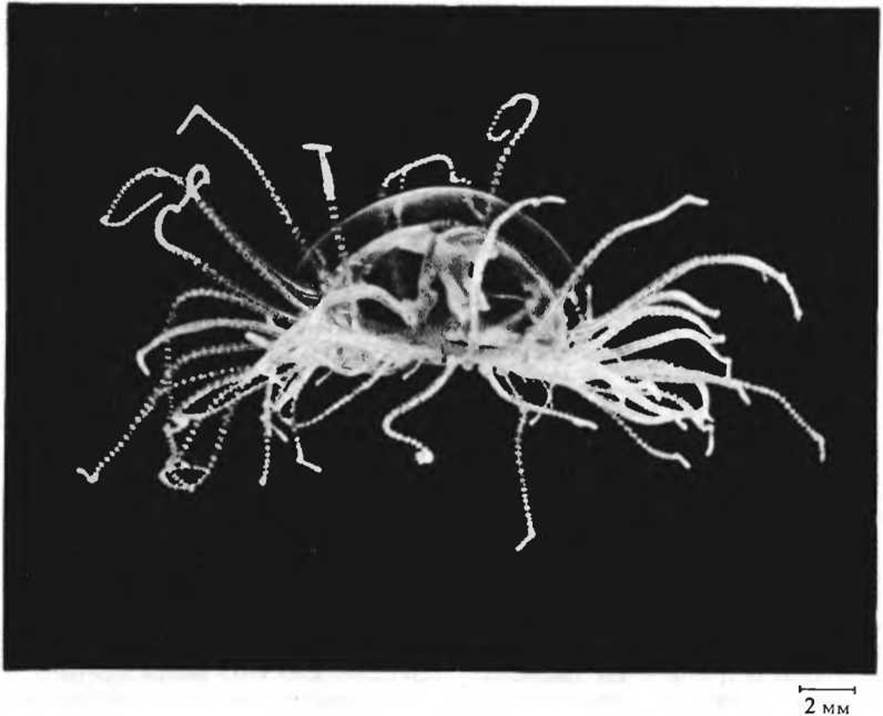
Living organisms, such as this jellyfish Gonionemus murbachii, differ in their chemical composition from their surrounding environment (in this case, seawater).
Table 3-1. Bioelements
The elements listed below have been shown to be essential for the maintenance of living matter; however, not all of these Trace Elements are necessarily required by every species of organism.
|
Major Elements of Organic Matter |
|||
|
Carbon |
С |
Nitrogen |
N |
|
Hydrogen |
Н |
Phosphorus |
Р |
|
Oxygen |
О |
Sulfur |
S |
|
Elements Present as Ions |
|||
|
Sodium |
Na+ |
Calcium |
Са2+ |
|
Potassium |
К+ |
Chlorine |
Сl- |
|
Magnesium |
Mg2+ |
||
|
Trace Elements |
|||
|
Iron |
Fe |
Nickel |
Ni |
|
Copper |
Cu |
Chromium |
Cr |
|
Zinc |
Zn |
Fluorine |
F |
|
Manganese |
Mn |
Selenium |
Se |
|
Cobalt |
Co |
Silicon |
Si |
|
Iodine |
I |
Tin |
Sn |
|
Molybdenum |
Mo |
Boron |
В |
|
Vanadium |
V |
Arsenic |
As |
Table 3-2. The Eight Most Abundant Elements in the Earth's Crust and the Human Body (% of Total Atoms)
|
Earth's crust Human body |
|||
|
Element |
% |
Element |
% |
|
O |
47 |
H |
63 |
|
Si |
28 |
O |
25,5 |
|
Al |
7,9 |
C |
9,5 |
|
Fe |
4,5 |
N |
1,4 |
|
Ca |
3,5 |
Ca |
0,31 |
|
Na |
2,5 |
P |
0,22 |
|
K |
2,5 |
Cl |
0,08 |
|
Mg |
2,2 |
K |
0,06 |
Based on these data, two working hypotheses can be proposed. The first is that chemical compounds containing carbon, hydrogen, oxygen, and nitrogen—the most widespread elements in the living world—were selected during evolution owing to their unique suitability for supporting vital life processes. The second hypothesis is that seawater served as the aqueous medium in which living organisms first emerged during the Cytology/cytology/16.html">Early stages of Earth's history.
Last update: 06/08/2026
Editorial and Educational Adaptation: This material has been compiled based on the primary/original source text. The project team performed an editorial review, corrected technical inaccuracies, structured sections, and adapted the content for an educational format.
What was processed:
- elimination of formatting defects (OCR errors, structural breaks, corrupted characters);
- editorial organization of content;
- standardization of terminology in accordance with academic sources;
- verification of factual statements against the original source text.
All mentions of the author, publication year, and origin of the primary text have been preserved in accordance with the source.