Principles of Biochemistry Volume 1 - A. Lehninger 1985
Biomolecules
The composition of living matter: biomolecules
Most biomolecules contain carbon
The chemical properties of living organisms rely heavily on carbon, which accounts for over half of their dry weight. Like hydrogen, oxygen, and nitrogen, carbon can form covalent bonds—that is, bonds created by pairs of electrons shared between the two bonding atoms (Fig. 3-1). To fill its outer electron shell, a hydrogen atom requires one additional electron, an oxygen atom two, a nitrogen atom three, and a carbon atom four. Thus, when a carbon atom interacts with four hydrogen atoms, four electron pairs are shared, resulting in The formation of methane (CH4), where each shared electron pair corresponds to a single bond. Carbon can also form single bonds with oxygen and nitrogen atoms. However, of paramount biological importance is the capacity of carbon atoms to share electron pairs with one another, leading to the formation of highly stable single carbon-carbon bonds. Each carbon atom can form a single bond with one, two, three, or four other carbon atoms. Furthermore, two carbon atoms can share two pairs of electrons to form a double carbon-carbon bond (Fig. 3-2). Owing to these properties, covalently bonded carbon atoms can assemble into a vast array of structures, including linear and branched chains, rings, networks, and various combinations thereof. These structures form the backbones of numerous organic molecules of diverse types (Fig. 3-3). Other atomic groups can attach to these carbon skeletons, driven by carbon's ability to form covalent bonds with oxygen, hydrogen, nitrogen, and sulfur. Substances featuring skeletons of covalently linked carbon atoms are referred to as Organic compounds, and their diversity is virtually limitless. Since the majority of Biomolecules are organic compounds, it is reasonable to suggest that carbon's unique capacity to participate in diverse chemical bonding played a decisive role in the Selection of carbon-based compounds to build the molecular machinery of Cells during the ORIGIN AND EVOLUTION of living organisms.
Class="center">
Fig. 3-1. Formation of covalent bonds. Covalent bonds can form between two atoms possessing unpaired outer-shell electrons through the sharing of electron pairs (molecular orbitals). Atoms involved in forming covalent bonds tend to fill their outer electron shells.
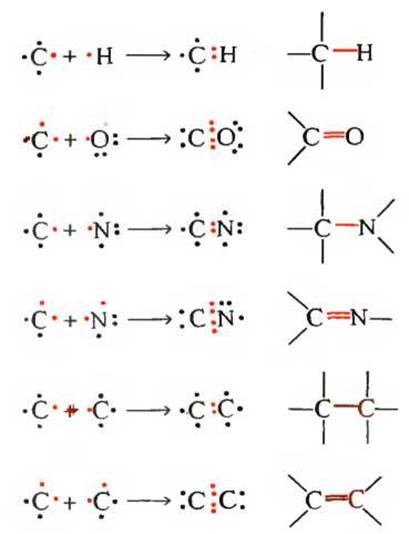
Fig. 3-2. The ability of carbon atoms to participate in forming various single and double covalent bonds. Triple bonds are extremely rare in organic biomolecules.
Last update: 06/08/2026
Editorial and Educational Adaptation: This material has been compiled based on the primary/original source text. The project team performed an editorial review, corrected technical inaccuracies, structured sections, and adapted the content for an educational format.
What was processed:
- elimination of formatting defects (OCR errors, structural breaks, corrupted characters);
- editorial organization of content;
- standardization of terminology in accordance with academic sources;
- verification of factual statements against the original source text.
All mentions of the author, publication year, and origin of the primary text have been preserved in accordance with the source.