Principles of Biochemistry Volume 1 - A. Lehninger 1985
Biomolecules
Fibrous proteins
The terms "configuration" and "conformation" have different meanings
Proteins can be divided into two major classes: Fibrous proteins, which consist of elongated polypeptide chains aligned parallel to one another to form long filaments or sheets, and Globular proteins, in which The polypeptide chains are tightly folded into compact, spherical structures known as globules. In this chapter, we examine the three-dimensional Introduction/13.html">Structure of Fibrous proteins. From a biological standpoint, fibrous proteins play a crucial role related to animal anatomy and physiology. In large vertebrates, these proteins account for one-third (or more) of the total protein content. Fibrous proteins serve as the primary organic material for the protective outer coverings of both animal and human bodies—acting as the Main Components of the outer Skin layer, Hair, feathers, claws, and horns. They are also involved in forming supportive and structural elements, as they constitute the principal organic matrix of Connective Tissue, including Cartilage, tendons, bones, and the deeper layers of the skin.
There is another reason why we discuss fibrous proteins first. They possess a simpler structure than globular proteins, and consequently, their three-dimensional architecture was determined via X-ray crystallography slightly earlier than that of globular proteins. The results of these pioneering studies not only shaped new concepts regarding the Structure and function of fibrous proteins but also served as an important
milestone on the path toward elucidating the structure and function of globular proteins using X-Ray Diffraction Analysis.
In this and the following chapter, we explore the spatial arrangement of polypeptide chains. First, however, we must clearly define two terms frequently used when discussing the Spatial Structure of molecules: configuration and conformation. These words are not synonyms. Configuration refers to the Spatial Organization of an organic molecule determined by 1) double bonds around which free rotation is impossible, and 2) chiral centers with substituent groups arranged around them in a specific sequence. Figure 7-1 illustrates the configuration of fumaric acid—an intermediate in Carbohydrate METABOLISM—and that of its isomer, maleic acid, which is found in certain plants. These compounds are geometric, or cis-trans isomers; they differ in the spatial orientation of their substituent groups relative to the double bond. Fumaric acid is the trans isomer, whereas maleic acid is the cis isomer; in both cases, we are dealing with a strictly defined compound that can be isolated in pure form. Figure 7-1 also depicts the L- and D-isomers of Alanine (see Figs. 3-8 and 5-4), in which the substituent groups possess two distinct configurations relative to the chiral center. The distinguishing feature of configurational isomers is that they cannot be interconverted without breaking one or more covalent bonds.
Class="center">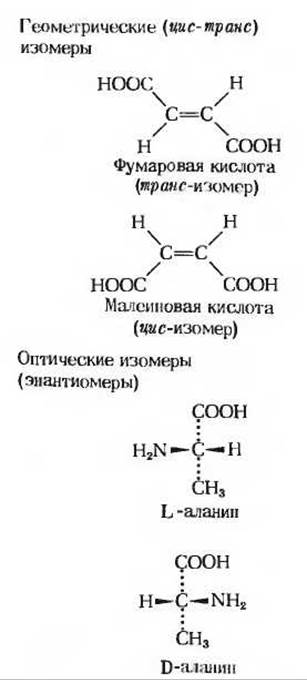
Fig. 7-1. Configuration of stereoisomers. Such isomers cannot be interconverted without breaking covalent bonds.
The term conformation is used to describe the spatial arrangement of substituent groups in an organic molecule that are capable of freely altering their position in space without breaking any bonds, owing to free rotation about single carbon-carbon bonds. For instance, the simple hydrocarbon ethane exhibits complete freedom of rotation around the single C—C bond. Consequently, the ethane molecule can adopt a multitude of different Conformations depending on the angle of rotation of one carbon atom relative to the other; however, all these conformations readily interconvert as the substituent groups rotate around the C—C bond. The staggered conformation of ethane (Fig. 7-2) is more stable than all others and therefore occurs most frequently, whereas the eclipsed conformation is the least stable. Neither of these conformational forms of ethane can be isolated in a pure state, as an equilibrium exists between them and they interconvert freely. Nevertheless, as one might infer from the models presented in Fig. 7-2, if one or more hydrogen atoms bonded to the two carbon atoms in ethane were replaced by larger or electrically charged functional groups, the freedom of rotation around the single C—C bond would be severely restricted, significantly reducing the number of possible conformations for the molecule.

Fig. 7-2. Two extreme conformations of the ethane molecule. Many other conformations are also possible due to free rotation about the single C—C bond. The various conformational forms readily interconvert and cannot be separated from one another. The staggered conformation is the most stable and predominates over all others.
Last update: 06/08/2026
Editorial and Educational Adaptation: This material has been compiled based on the primary/original source text. The project team performed an editorial review, corrected technical inaccuracies, structured sections, and adapted the content for an educational format.
What was processed:
- elimination of formatting defects (OCR errors, structural breaks, corrupted characters);
- editorial organization of content;
- standardization of terminology in accordance with academic sources;
- verification of factual statements against the original source text.
All mentions of the author, publication year, and origin of the primary text have been preserved in accordance with the source.