Biochemistry: The Chemical Reactions of Living Cells, Volume 1 - D. Metzler 1980
The Molecules We Are Made Of
Principles of Small Molecule Construction
Conformations: The Various Shapes a Molecule Can Adopt
In addition to the specific arrangement of covalently linked atoms (configuration), molecular conformation is equally crucial in biochemistry. It is determined by the spatial orientation of chemical groups resulting from their rotation around single bonds [3]. Many groups rotate freely even at room Temperature; for instance, a —CH3 group can be pictured as a windmill blade spinning randomly back and forth. However, even the simplest molecules favor a specific preferred conformation, whereas in more complex structures, rotation is generally severely restricted.
Let us consider a molecule in which two groups, A and B, are connected by a bridge of two CH2 (methylene) groups. Maximizing the distance between these groups results in a fully extended, or anti conformation:
Class="center">
In such a molecule, not only groups A and B, but all hydrogen atoms are kept as far apart from one another as possible. This is easily visualized by looking down the carbon-carbon bond axis (Newman projection). Rotating the second carbon atom by 180° around the single bond converts the molecule into the eclipsed conformation. If groups A and B are sufficiently large, they will "clash" during this rotation, making the eclipsed conformation practically unattainable—rotation around the given bond will be heavily hindered. Even when A and B are simply hydrogen atoms (as in ethane), transitioning to the eclipsed conformation requires overcoming a rotational barrier of up to ~13 kJ mol-1, which arises from steric hindrance as the hydrogen atoms approach each other [3] (this can be readily demonstrated using space-filling models).
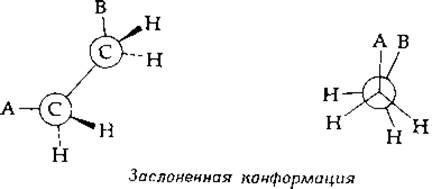
When A and B are methyl groups (such as in the butane molecule), steric clashes create a rotational barrier of about 25 kJ mol-1 (~6 kcal mol-1). For this very reason, chains of CH2 groups in many biological molecules tend to adopt a fully extended conformation. This characteristic zigzag carbon-chain Structure is found in polyethylene, which consists of long chains of CH2 groups.
In addition to the fully extended conformation, two gauche (skew) conformations are also possible. These are nearly as stable as the anti conformation and only present steric conflicts if groups A and B are exceptionally bulky. In one of these two conformations, group B lies to the right of A when viewed along the
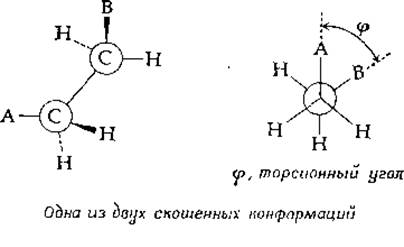
molecular axis, whereas in the other, B lies to the left of A. These conformations can be compared to right-handed and left-handed screws (in a standard right-handed screw, the thread, viewed from either end along the axis, runs away from the observer from left to right; the transition from group A to group B is depicted in the exact same manner in the figure). The angle φ represents the torsional angle. For right-handed conformations, this angle is positive (the right-handed conformation is also referred to as the P- or "+" conformation, as opposed to the M- or "—" conformation, which denotes the left-handed form). Gauche conformations play a major role among the possible conformations of numerous biological molecules; for example, the sugar alcohol ribit in crystalline form adopts a sickle-like shape [4]—the chain initially forms a zigzag (on the left), but starting from the fourth carbon atom, it shifts into a gauche conformation, thereby minimizing steric hindrance caused by interactions between the OH groups at the C-2 and C-4 positions.

Many molecules contain rings made of 3, 4, 5, 6, or more carbon atoms. While rings containing two or more double bonds are generally nearly planar, five- and six-membered rings formed by single bonds behave quite differently. Six-membered single-bonded rings, such as those found in cyclohexane and sugars, typically adopt a chair conformation, as seen in the example of glucose.
Additionally, six-membered rings can form the less stable boat conformation [3, 5, 6]. The six possible Variants of the boat conformation readily interconvert through intermediate skew conformations.

Since the interior angle of a regular pentagon is 108° (which is very close to the tetrahedral angle), one might expect five-membered rings to form planar structures. However, in a planar geometry, the hydrogen atoms on adjacent carbons would sterically hinder one another; consequently, one of the carbon atoms is displaced out of the plane of the other four by approximately 0.05 nm, resulting in an envelope conformation (see Fig. 2-14, which illustrates this and other conformational types).
Last update: 06/08/2026
Editorial and Educational Adaptation: This material has been compiled based on the primary/original source text. The project team performed an editorial review, corrected technical inaccuracies, structured sections, and adapted the content for an educational format.
What was processed:
- elimination of formatting defects (OCR errors, structural breaks, corrupted characters);
- editorial organization of content;
- standardization of terminology in accordance with academic sources;
- verification of factual statements against the original source text.
All mentions of the author, publication year, and origin of the primary text have been preserved in accordance with the source.