BIOLOGY Volume 1 - A Guide to General Biology - 2004
3. CHEMICAL COMPONENTS OF LIVING ORGANISMS
3.1. Introduction to Biochemistry
The Study of the chemistry of living organisms, i.e., biochemistry, is closely linked to the overall rapid development of biology in the 20th century. The Significance of biochemistry lies in the fact that it provides a fundamental understanding of physiology—in other words, an understanding of how biological systems work. This, in turn, finds application in agriculture (the creation of pesticides, herbicides, etc.); in medicine (including the entire pharmaceutical industry); in various Fermentation industries that supply us with a wide range of products, including bakery items; and finally, in everything related to food and Nutrition, i.e., dietetics, food production technology, and food storage science. Biochemistry has also given rise to A number of promising New directions in biology, such as Introduction/32.html">Genetic Engineering, biotechnology, and the molecular approach to the study of genetic diseases.
Biochemistry also plays a vital unifying role in biology. When examining living organisms at the biochemical level, what often stands out is not so much their differences as their similarities.
3.1.1. Elements Found in Living Organisms
About 100 chemical elements occur in the Earth's crust, but only 16 of them are essential for life (Table 3.1). The most abundant elements in living organisms (in order of decreasing number of atoms) are hydrogen, carbon, oxygen, and nitrogen. They account for more than 90% of both the mass and the number of atoms making up All living organisms. However, in the Earth's crust, the top four most abundant elements are oxygen, silicon, aluminum, and sodium. The biological importance of hydrogen, oxygen, nitrogen, and carbon is mainly related to their valencies—equal to 1, 2, 3, and 4, respectively—as well as their ability to form stronger covalent bonds than other elements of the same valency. Appendix 1 introduces the basics of chemistry, including METABOLISM/2.html">THE CONCEPT OF the "covalent bond" (Appendix I, Vol. 3). It is useful to consult it before proceeding with this chapter.
Class="center">Table 3.1. Elements found in living organisms*
Major elements of organic molecules |
Ions |
||
Н (hydrogen) |
Na+ (sodium) |
Мn (manganese) |
В (boron) |
С (carbon) |
Mg2+ (magnesium) |
Fe (iron) |
Аl (aluminum) |
N (nitrogen) |
Cl- (chlorine) |
Со (cobalt) |
Si (silicon) |
О (oxygen) |
K+ (potassium) |
Сu (copper) |
V (vanadium) |
Р (phosphorus) |
Са2+ (calcium) |
Zn (zinc) |
Мо (molybdenum) |
S (sulfur) |
I (iodine) |
||
* The order of atoms in each Column is determined by their atomic numbers rather than their relative Abundance. The elements listed in the first three columns are found in all organisms. (After A. L. Lehninger, Biochemistry, Worth, N.Y., 1970.) |
|||
Structure/19.html">The Importance of Carbon
It is sometimes said that carbon forms The basis of life on our planet. This element is found in all organic molecules. The term "organic" in the sense of "living" was originally used because at that time only living creatures were thought to possess The ability to form Organic compounds. This belief was disproven by the German chemist Wöhler, who in 1828 synthesized the organic substance urea from inorganic starting Materials. This forced scientists to recognize that synthesizing the Cell/6.html">Chemical Components of life requires no magic, no special "vital force." Today, we are theoretically ready to synthesize even DNA—the genetic material—from inorganic starting materials, and thus we are ready to "create" life.
But why is carbon so important? Carbon forms strong covalent bonds with other elements, meaning it shares electrons with them. It forms four covalent bonds; its valency is therefore 4. A simple example of such electron sharing is methane, which has the empirical formula CH4. The structural formula of methane is shown in Fig. 3.1. (See also Appendix 1, Vol. 3.) Box 3.1 outlines the rules for writing structural formulas.

Fig. 3.1. Structure of a methane molecule (one of the simplest organic molecules). A. Structural formula. Carbon atoms bond with each other or with atoms of other elements by forming covalent bonds. Each carbon atom is capable of forming four covalent bonds. B and C. Two ways of depicting molecular Spatial Models. The top ball-and-stick model illustrates the tetrahedral arrangement of carbon bonds; the bottom model shows that the atoms are actually located much closer to one another.
Box 3.1. Methods for Writing Structural Formulas
Structural formulas are often depicted in a simplified form to allow attention to be focused on the most important chemical groups. As a simple example, Fig. 3.2 shows the formula of ethanoic (acetic) acid. In its simplified representation, all carbon atoms and the hydrogen atoms directly bonded to them are omitted. The empirical formula of acetic acid is CH3COOH. It can also be written as C2H4O2, but the first option is preferable because it provides insight into the relative arrangement of the groups present in the molecule. It is precisely this arrangement that determines The properties of the molecules.
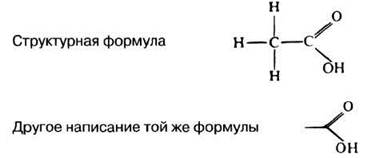
Fig. 3.2. Two ways of depicting the structural formulas of ethanoic (acetic) acid, CH3COOH.
3.1. Based on what you have read, state the difference between empirical and structural formulas.
The importance of carbon is determined by the ability of its atoms to bond with one another, forming chains or rings, as shown in Fig. 3.3. These chains and rings serve as the backbone of organic molecules—the framework of living matter. They are highly stable because the covalent bonds linking the carbon atoms together are exceptionally strong. Atoms or groups of atoms of other elements (simply called groups) can attach to the carbon Skeleton at various positions. The most common groups are listed in Table 3.2. Each of them is characterized by its own specific properties. For example, the acidic nature of Fatty acids and Amino Acids depends on the carboxyl group, —COOH.

Fig. 3.3. A chain (A) and a ring (B) constructed from carbon atoms through C–C bonds.
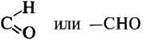
Note the simplified notation for formulas in Table 3.2. For instance, the group  can also be written as —CHO.
3.2. Fig. 3.3 shows the structural formulas of octane (A) and benzene (B). Propose simplified notations for these compounds, following the rules outlined in Box 3.1 (see Fig. 3.2).
MULTIPLE BONDS. As can be seen from Table 3.2 and Fig. 3.3, carbon atoms are capable of forming multiple bonds. They form such bonds with each other, as well as with oxygen and nitrogen:
Double bonds: 
Triple bonds (rare in nature): 
Table 3.2. Some chemical groups most frequently found in organic compounds
Aldehyde group |
|
Keto group (oxo group) |
|
Hydroxyl group Carboxyl group |
|
Carbonyl group |
|
Amino group |
|
Sulfhydryl group |
-S-H |
Phosphate group |
|


 (part of the aldehyde, oxo, and carboxyl groups)

Compounds containing double (=) or triple (≡) carbon-carbon bonds are termed unsaturated. A saturated compound contains only single carbon-carbon bonds.
3.3. Draw the structural formula of the unsaturated organic compound ethene (Ethylene) C2H4.
Let us summarize the key Chemical properties of carbon.
1. Its atoms are relatively small and have a low atomic mass.
2. It is capable of forming four strong covalent bonds.
3. It forms carbon-carbon bonds, thereby building long carbon skeletons of molecules in the form of chains and/or rings.
4. It can form multiple covalent bonds with other carbon atoms, as well as with oxygen and nitrogen.
This unique combination of properties accounts for the enormous diversity of organic molecules. This diversity is manifested in 1) molecular size, determined by the number of carbon atoms in the backbone; 2) chemical properties, which depend on the elements and chemical groups attached to the skeleton, as well as the degree of saturation of the backbone; and finally, 3) the various molecular shapes determined by geometry, i.e., Bond Angles.
Last update: 06/08/2026
Editorial and Educational Adaptation: This material has been compiled based on the primary/original source text. The project team performed an editorial review, corrected technical inaccuracies, structured sections, and adapted the content for an educational format.
What was processed:
- elimination of formatting defects (OCR errors, structural breaks, corrupted characters);
- editorial organization of content;
- standardization of terminology in accordance with academic sources;
- verification of factual statements against the original source text.
All mentions of the author, publication year, and origin of the primary text have been preserved in accordance with the source.