BIOLOGY Volume 1 - A Guide to General Biology - 2004
3. CHEMICAL COMPONENTS OF THE LIVING
3.1. Introduction to Biochemistry
3.1.2. Biological Molecules
Living organisms consist of a limited number of elements (listed above in Table 3.1); combined, these elements form molecules—the Building Blocks of life. Molecules vary greatly in size, ranging from very small ones, such as carbon dioxide or Water, to massive structures like protein molecules (macromolecules). Small molecules are soluble and typically participate in the general Chemical Activity of Cells, known as METABOLISM. Larger molecules serve as energy reserves or perform structural Functions, while some can be called "informational": they carry Genetic information (DNA and RNA) or participate in its expression (Proteins).
Among small molecules, water is the most abundant in the Organism, accounting for 60 to 95% of total fresh mass. In all organisms, we also find certain simple Organic compounds that act as "building blocks" from which larger molecules are constructed (Fig. 3.4). According to biologists, these few types of molecules could have been synthesized in the "primordial soup" (i.e., a concentrated solution of chemical substances) in the global ocean during the Cytology/cytology/16.html">Early stages of Earth's existence, even before life appeared on it (Ch. 26). These simple molecules, in turn, are built from even simpler inorganic molecules, namely carbon dioxide, nitrogen, and water.
Class="center">
Fig. 3.4. "Building blocks" of Biomolecules.
The Vital Role of water
Without water, life on our planet could not exist. Water is essential for living organisms for two reasons. First, it is an indispensable component of living cells, and second, for many organisms, it also serves as a habitat. Therefore, a few words should be said about its chemical and physical properties.
These properties are quite unusual and are mainly due to The small size of water molecules, their polarity, and their ability to bond with one another via Hydrogen Bonds. Polarity refers to the uneven distribution of charges within a molecule. In water, one end of the molecule ("pole") carries a slight positive charge, while the other carries a negative one. Such a molecule is called a dipole. The oxygen atom has a stronger affinity for electrons than hydrogen atoms do, so the oxygen atom in a water molecule tends to draw the electrons of the two hydrogen atoms toward itself. Since electrons are negatively charged, this gives the oxygen atom a slight negative charge and the hydrogen atoms a positive charge.
As a result, weak Electrostatic Interactions arise between water molecules, and since opposite charges attract, the molecules effectively "glue" together (Fig. 3.5, A). These interactions, which are weaker than regular ionic or covalent bonds, are called hydrogen bonds. Hydrogen bonds are constantly formed, broken, and reformed within the bulk of water (Fig. 3.5, B). Although these are weak bonds, their cumulative effect accounts for many of the unusual Physical Properties of water. Keeping this feature of water in mind, we can now move on to examine its properties that are biologically significant.
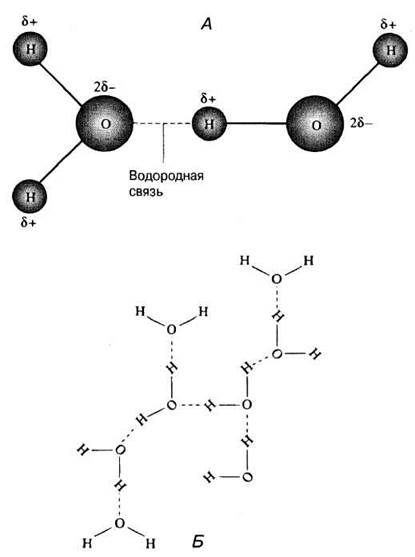
Fig. 3.5. Hydrogen bonds between water molecules. A. Two water molecules connected by a Hydrogen bond. δ+ — very small positive charge; δ- — very small negative charge. B. A network of water molecules held together by hydrogen bonds. Such structures are constantly formed, broken, and reformed in liquid water.
Biological Significance of Water
WATER AS A SOLVENT. Water is an excellent solvent for polar substances. These include ionic compounds, such as salts containing charged particles (ions), and certain non-ionic compounds, such as sugars, whose molecules contain polar (weakly charged) groups (in sugars, this is the slightly negatively charged hydroxyl group, —OH). When a substance dissolves in water, water molecules surround the ions and polar groups, separating the ions or molecules from one another (Fig. 3.6).
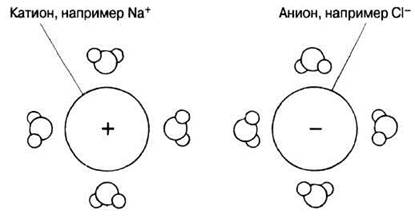
Fig. 3.6. Distribution of water molecules around ions in a solution. Note that the more electronegative oxygen atoms of the water molecules face toward the cation, while around the anion they are directed outward instead. Water molecules separate the ions and keep them at a certain distance from each other because the collective attraction between them and the ions is stronger than that between cations and anions. Were it not for this, ions would form a solid crystal, like the crystal of familiar table salt. In water, however, salt dissolves.
In solution, molecules or ions gain The ability to move more freely, so the reactivity of the substance increases. For this reason, the majority of Chemical Reactions in The Cell occur In aqueous solutions. Non-polar substances, such as Lipids, are repelled by water and in its presence usually attract one another; in other words, non-polar substances are hydrophobic (hydrophobic = water-repelling). Such hydrophobic interactions play a crucial role in membrane formation, as well as in determining the three-dimensional Structure of many protein molecules, Nucleic Acids, and other cellular components.
Water's inherent solvent properties also mean that it serves as a medium for The transport of various substances. It performs this role in the Blood, lymphatic and excretory systems, the digestive tract, and in plant phloem and xylem.
HIGH HEAT CAPACITY. The specific heat capacity of water is The amount of heat required to raise the Temperature of 1 kg of water by 1 °C. Water has a high heat capacity. This means that a substantial increase in thermal energy causes only a relatively small rise in its temperature. This phenomenon is explained by the fact that a significant portion of the energy is consumed in breaking hydrogen bonds, which restrict the mobility of water molecules—that is, in overcoming the aforementioned "stickiness" of its molecules.
Water's high heat capacity minimizes temperature fluctuations within it. As a result, biochemical processes occur within a narrower temperature range, at a more constant rate, and are much less threatened by disruption from sudden temperature deviations. For many cells and organisms, water serves as a habitat that provides a fairly high degree of environmental constancy.
HIGH HEAT OF VAPORIZATION. Latent heat of vaporization is a measure of the thermal energy that must be supplied to a liquid for it to transition into vapor—that is, to overcome the intermolecular cohesive forces within the liquid. The evaporation of water requires quite substantial amounts of energy. This is due to the existence of hydrogen bonds between its molecules. For this very reason, the boiling point of water—a substance with such small molecules—is unusually high.
The energy required for water molecules to evaporate is drawn from their surroundings. Thus, evaporation is accompanied by cooling. Animals utilize this phenomenon during sweating, as well as through panting in mammals or in certain reptiles (e.g., crocodiles) that sit with open mouths in the scorching sun; it likely also plays a prominent role in cooling transpiring leaves. A high heat of vaporization means that the release of even large amounts of heat by an organism is accompanied by minimal water loss, i.e., it does not necessarily lead to dehydration.
HIGH HEAT OF FUSION. Latent heat of fusion is a measure of the thermal energy required to melt a solid substance (in our case, ice). A relatively large amount of Energy is required to melt (thaw) ice. The reverse is also true: upon freezing, water must release a large amount of thermal energy. This reduces the likelihood of freezing for the contents of cells and the fluid surrounding them. Ice crystals are especially destructive to living matter when they form inside cells.
DENSITY AND BEHAVIOR OF WATER NEAR THE FREEZING POINT. The density of water decreases from +4 to 0 °С, which is why ice is less dense than water and floats rather than sinks. Water is the only substance that is denser in its liquid state than in its solid state.
Because ice floats on water, it forms first at the surface and only later in bottom layers. If ponds froze in the reverse direction, from the bottom up, life in freshwater habitats would be entirely impossible in regions with temperate or cold climates. Ice blankets the water body like a quilt, increasing the survival chances of aquatic organisms. This is critical in cold climates and during cold seasons, but it undoubtedly played an especially vital role during the ice age. Furthermore, by remaining at the surface, ice melts much faster. The fact that layers of water whose temperature has dropped below 4°С rise to the surface drives water mixing in large bodies of water. Nutrients circulate along with the water, enabling organisms to colonize water bodies to greater depths.
HIGH SURFACE TENSION AND COHESION. Cohesion is the binding together of molecules of a physical body by attractive forces. Surface tension exists at the liquid's surface as a result of inward-directed cohesive Forces acting between molecules. Due to surface tension, a liquid tends to adopt a shape that minimizes its surface area (ideally, a sphere). Of all liquids, water has the highest surface tension. The significant cohesion characteristic of water molecules plays a crucial role in living cells and in the transport of water through xylem vessels in plants (ch. 13). Many small organisms benefit from surface tension: it allows them to stay afloat or glide across the water's surface.
WATER AS A REACTANT. The biological significance of water stems from the fact that it is a vital metabolite, meaning it participates in metabolic reactions. For example, water serves as a source of hydrogen in Photosynthesis (sec. 7.6) and takes part in Hydrolysis reactions.
Several biologically important functions of water are listed in Table 3.3.
Table 3.3. Selected important BIOLOGICAL FUNCTIONS OF water
In all organisms Maintains structural integrity (high cellular water content, 70–95%) Acts as a solvent and medium for diffusion Participates in hydrolysis reactions Serves as a habitat for aquatic organisms Provides a medium for Fertilization Facilitates the dispersal of seeds, Gametes, and larval stages of aquatic organisms, as well as the seeds of certain terrestrial plants, such as the coconut palm |
In plants Drives osmosis and turgor, which underpin numerous processes: growth (cell enlargement), structural support, stomatal mechanics, etc. Participates in photosynthesis Drives Transpiration and the transport of inorganic ions and organic molecules Facilitates seed germination—imbibition, seed coat rupture, and subsequent development |
In animals Drives the Transport of substances via the circulatory, lymphatic, and excretory systems Mediates osmoregulation AIDS in body cooling (sweating, panting) Acts as a component of lubricants, such as in joints Provides structural support (e.g., the hydrostatic Skeleton of Annelids) Serves a protective function, for example in tears and mucus Facilitates migration (ocean currents) |
Last update: 06/08/2026
Editorial and Educational Adaptation: This material has been compiled based on the primary/original source text. The project team performed an editorial review, corrected technical inaccuracies, structured sections, and adapted the content for an educational format.
What was processed:
- elimination of formatting defects (OCR errors, structural breaks, corrupted characters);
- editorial organization of content;
- standardization of terminology in accordance with academic sources;
- verification of factual statements against the original source text.
All mentions of the author, publication year, and origin of the primary text have been preserved in accordance with the source.