Human Biochemistry Volume 1 - Murray R. 1993
Bioenergetics and Carbohydrate and Lipid Metabolism
Physiologically Important Lipids
Lipid Peroxidation
Lipid peroxidation (autooxidation) upon contact with oxygen not only ruins food products (rancidity) but also causes tissue damage in vivo, contributing to The Development of tumor diseases. This damaging action is initiated by free radicals (ROO•, RO•, OH•) generated during The formation of fatty acid peroxides containing double bonds alternating with methylene bridges (such alternation is characteristic of natural polyunsaturated Fatty acids) (Fig. 15.28). Lipid peroxidation is a chain reaction that ensures the expanded reproduction of free radicals, which in turn initiate the further propagation of peroxidation. The entire process can be represented as follows.
1) Initiation: formation of R from a precursor
Class="center">
2) Propagation (chain development):

3) Termination:

Since the hydroperoxide ROOH• acts as a precursor in the initiation process, lipid peroxidation is a branched chain reaction with the potential to cause significant damage. Both nature and humankind employ antioxidants to regulate the fat peroxidation process. Propyl gallate, butylated hydroxyanisole, and butylated hydroxytoluene are added to food products for this purpose. Natural antioxidants include the fat-soluble vitamin E (tocopherol), as well as Water-soluble urates and Vitamin C. ß-Carotene acts as an antioxidant only at low PO2 values. Antioxidants are divided into two classes: 1) preventive antioxidants, which reduce The rate of chain initiation, and 2) chain-breaking (quenching) antioxidants, which inhibit the Propagation of the chain reaction. The former include catalase and other peroxidases that degrade ROOH•, as well as metal-chelating agents such as DTPA (diethylenetriaminepentaacetate) and EDTA (ethylenediaminetetraacetate). Phenols or aromatic amines frequently serve as chain-breaking antioxidants. Under in vivo conditions, the primary chain-breaking antioxidants are superoxide dismutase (see p. 126), which scavenges superoxide free radicals (O-2) in the aqueous phase, as well as vitamin E, which scavenges ROO• free radicals in the lipid phase, and possibly uric acid.

Fig. 15.27. Dolichol (C95 alcohol).

Fig. 15.28. Lipid peroxidation. The reaction is initiated by light or Metal Ions. Malondialdehyde, which is formed exclusively from fatty acids with three or more double bonds, is used as an indicator of lipid peroxidation along with ethane (formed by the Cleavage of the terminal two-carbon fragment of ω 3-fatty acids) and pentane (formed by the cleavage of the terminal five-carbon fragment of ω 6-fatty acids).
Peroxidation in vivo is also catalyzed by heme compounds and lipoxygenases present in platelets, leukocytes, etc.

Fig. 15.29. a-Tocopherol.
Vitamin E (a-tocopherol)
Several natural tocopherols exist. All of them are 6-hydroxychromans or tocols with isoprenoid substituents (Fig. 15.29). a-Tocopherol is the most widespread and exhibits the highest biological activity as a vitamin.
Vitamin E performs at least two metabolic Functions. First, it serves as the most potent natural fat-soluble antioxidant and, second, it plays a specific, albeit not fully understood, role in selenium METABOLISM.
Vitamin E appears to be the first line of defense for cellular and subcellular membrane Phospholipids against peroxidation. Phospholipids of Cell/35.html">Mitochondria, The Endoplasmic reticulum, and Plasma Membranes possess a specific affinity for a-tocopherol; therefore, the vitamin is seemingly concentrated within these membranes. Tocopherols act as chain-breaking antioxidants due to their ability to transfer phenolic hydrogen to the peroxy radical (Fig. 15.30). The phenoxy radical is a Resonance-stabilized and relatively unreactive Structure, except for its interaction with other peroxy radicals. Thus, a-tocopherol is rarely consumed in the chain oxidation process; oxidation of the chroman ring and side chain of a-tocopherol yields a non-radical product (Fig. 15.31). This product forms a conjugate with glucuronic acid and is excreted in the Bile. The antioxidant effect of a-tocopherol is preserved at high oxygen concentrations, which is why it is unsurprising that vitamin E accumulates in lipid-rich regions in contact with environments maintaining a high partial pressure of oxygen—specifically in the membranes of erythrocytes and respiratory tract Cells.

Fig. 15.30. Chain-breaking antioxidant action of tocopherols (TocOH) towards peroxy radicals (ROO).
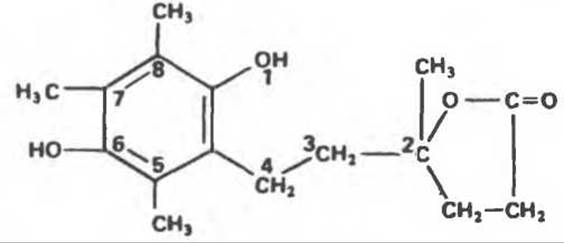
Fig. 15.31. Oxidation product of a-tocopherol. Atom numbering allows for comparing their positions in the product and the parent compound.
However, even in the presence of adequate amounts of vitamin E, a certain amount of peroxides is still formed. The second line of defense for membranes against the damaging action of peroxides (see p. 204) is selenium-containing Glutathione peroxidase. Thus, the function of vitamin E and selenium apparently consists in protecting cellular and subcellular components from peroxide damage, thereby ensuring organelle integrity and preventing the development of pathological states induced by physical, chemical, or other stressors.
Last update: 06/08/2026
Editorial and Educational Adaptation: This material has been compiled based on the primary/original source text. The project team performed an editorial review, corrected technical inaccuracies, structured sections, and adapted the content for an educational format.
What was processed:
- elimination of formatting defects (OCR errors, structural breaks, corrupted characters);
- editorial organization of content;
- standardization of terminology in accordance with academic sources;
- verification of factual statements against the original source text.
All mentions of the author, publication year, and origin of the primary text have been preserved in accordance with the source.