Biological Membranes - A. N. Ogurtsov 2012
Electrogenesis of Biomembranes
Mechanisms of Action Potential Generation
Propagation of the Action Potential
If an Action Potential is generated in any region of an excitable membrane, the membrane becomes depolarized, and the excitation begins to spread to adjacent Regions of the membrane.
Local currents arise in both the axoplasm and the surrounding solution between patches of the membrane surface with a higher potential (positively charged) and patches with a lower potential (negatively charged). These local currents are formed both inside the axon and on its outer surface (Figure 129).
Class="center">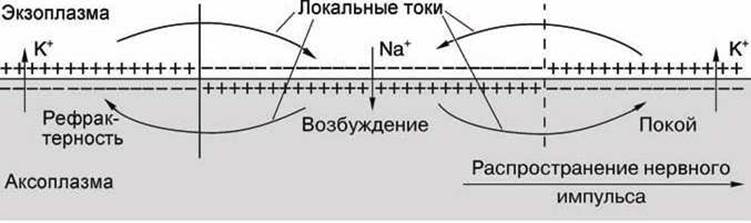
Figure 129 - Propagation of the action potential
In areas close to the excited region, the magnitude of the Membrane Potential rises above the threshold value. Driven by this shift in the membrane potential, sodium channels open, and further depolarization is driven by the influx of sodium ions across the membrane. This triggers an avalanche-like, spontaneous depolarization of the membrane, generating an action potential. Subsequently, the excitation is similarly transmitted further to adjacent resting regions of the membrane.
Local currents flow in both directions from the excited region, but excitation can only propagate into the region of the membrane that is at rest, that is, in only one direction along the axon. The Nerve Impulse cannot travel in the opposite direction because the areas through which the excitation has just passed remain unexcitable—refractory—for a certain period of time.
Last update: 13/08/2026
Editorial and Educational Adaptation: This material has been compiled based on the primary/original source text. The project team performed an editorial review, corrected technical inaccuracies, structured sections, and adapted the content for an educational format.
What was processed:
- elimination of formatting defects (OCR errors, structural breaks, corrupted characters);
- editorial organization of content;
- standardization of terminology in accordance with academic sources;
- verification of factual statements against the original source text.
All mentions of the author, publication year, and origin of the primary text have been preserved in accordance with the source.