Protein Chemistry. Structure, Properties, Research Methods - Shendryk A.N. 2022
Methods for Experimental Investigation of Protein Structure
Chromatography
Affinity Chromatography
In 1968, Anfinsen, Cuatrecasas, et al. proposed a new method for isolating Proteins from biological media, based on the ability of protein molecules to undergo specific binding. This property of proteins is quite widespread. Typically, the substance (S) bound by a protein (P) is either a compound with which the protein interacts in vivo, a synthetic analogue of such a compound, or an antibody for which the protein acts as an antigen. The method itself was named affinity chromatography (AC). It greatly expanded the experimental toolkit of biochemical research. Methodologically, AC is very similar to Column chromatography, utilizing a column with a solid polymer stationary phase onto which compound S has been pre-immobilized. As a mixture of proteins passes through the column, only the protein (usually a single one) that binds to compound S is retained. Matrices used for immobilizing substance S include polyacrylamide, agarose, dextran, and silica gel.
For example, one of the proteins found in leukocytes binds vitamin B12. It is believed that this protein is secreted into plasma, where it participates in transporting vitamin B12 to Tissues. For a long time, studying this protein presented major difficulties because it could not be isolated in pure form with a good yield using conventional purification Methods. Affinity chromatography solved this problem after vitamin B12 was coupled to Sepharose, which was used as the stationary phase. This increased the purification fold of the protein specifically binding vitamin B12 by nearly 10,000 times, with a yield of >90% in a single step.
Preparation of the Affinity Sorbent
This is a matter of paramount importance in AC. An affinity sorbent typically consists of three parts:
> A support (matrix);
> A spacer arm;
> A Ligand.
However, these three components are not strictly mandatory. The support itself may sometimes contain suitable ligands capable of binding the desired component of the analyte mixture. For instance, glucose and mannose residues in Sephadex G-75 can function as ligands that bind Lectins.
Agarose is widely used as a support in AC and is the most common matrix. Various ligands and spacer arms are easily attached to it following activation with Cyanogen bromide. Disadvantages of agarose include:
> Biodegradation by bacterial hydrolytic Enzymes;
> Chemical degradation by amines or acids;
> Nonspecific sorption, which is related to the activation method. Cyanogen bromide activates numerous hydroxyl groups in the support, not all of which are accessible to ligand molecules. These free OH groups can nonspecifically bind Components of the analyzed mixture. In addition, the following are used:
1. Cellulose. Frequently used for preparing immunosorbents. Cellulose has inferior hydrodynamic properties compared to other sorbents.
2. Polyacrylamide. Its advantage is low nonspecific protein sorption.
3. Porous Glass. Possesses high mechanical strength and permeability.
4. Insoluble proteins. One of the earliest supports of this type was obtained by treating a protein solution with ethyl chloroformate. Upon stirring the reaction mixture, a gel precipitates in the form of fine particles.
Spacer Arm
This essentially serves as a "bridge" between the support and the ligand. It reduces steric hindrance during the cross-linking of the support with the ligand. The structures of certain spacer arms are shown in the figure.
Class="center">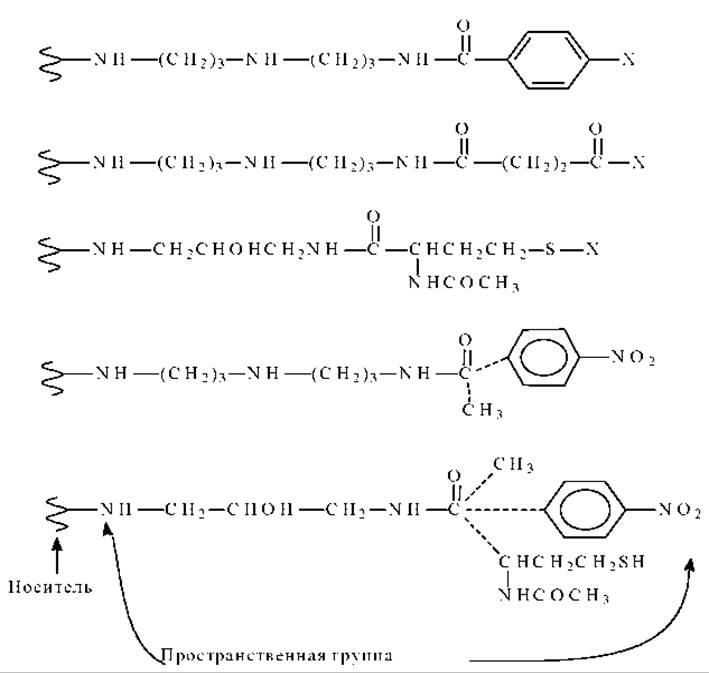
Ligand
The ligand can be attached to the support directly or via a spacer arm. The immobilized ligand must tightly bind the target component being isolated from the mixture to ensure the removal of impurities during column washing with buffer. At the same time, this binding must be reversible so that the protein can be "eluted" from the support after the impurities have been washed away.
Affinity Sorbents
Currently, Three types of affinity sorbents are most common:
> Immobilized Lectins for the isolation of Soluble Glycoproteins;
> Immobilized Antibodies to obtain purified antigen preparations;
> immobilized enzyme Cofactors.
Immobilized Lectins
Affinity chromatography using immobilized lectins is based on their selective affinity for various terminal CARBOHYDRATES in glycoprotein molecules. Immobilized concanavalin A or lentil lectin specifically bind, for example, glycoproteins with glucose or mannose residues. Immobilized limulin is used to isolate glycoproteins with a high sialic acid content. Immobilized peanut agglutinin is specific for glycoproteins containing N-acetylgalactosamine, etc.
Immobilized Antibodies
Immunoadsorption is the principle that gave rise to affinity chromatography. A purified antigen is attached to a carrier, and specific antibodies are adsorbed (bound) to it. The antibody is desorbed using a concentrated antigen solution. In the absence of sufficient amounts of the latter, the antibody protein is eluted from the column using low-pH Buffer solutions or solutions containing guanidine hydrochloride or urea.
The high selectivity (Specificity) of antibodies is a crucial factor when using them as ligands. Such antibodies are obtained by immunizing animals with antigen preparations.
Immobilized Substrates, Inhibitors, and Enzyme Cofactors
The optimal ligands for enzyme affinity chromatography are substrates. However, using them is challenging, as they are rapidly converted into the products of the corresponding enzymatic reaction. Special measures must be taken to inhibit the reaction while preserving the ability for specific enzyme binding. Typically, this is achieved by lowering the Temperature from -2 °C to -50 °C. The enzyme is desorbed by raising the temperature.
More widely used ligands are inhibitors and effectors, which do not affect the Active Site of the enzyme upon binding.
To date, extensive research has been conducted to identify universal affinity ligands for enzymes. Adenine nucleotide Coenzymes, such as NAD+, NADP+, and several others, are considered the most suitable. About a third of all known investigated enzymes exhibit activity in the presence of the aforementioned cofactors. Blue dextran has proven to be an effective structural analogue of NAD+-containing carriers for synthesizing sorbents with broad specificity. The isolation of individual enzymes from a mixture using group-specific ligands is successfully achieved by varying the conditions.
Last update: 06/08/2026
Editorial and Educational Adaptation: This material has been compiled based on the primary/original source text. The project team performed an editorial review, corrected technical inaccuracies, structured sections, and adapted the content for an educational format.
What was processed:
- elimination of formatting defects (OCR errors, structural breaks, corrupted characters);
- editorial organization of content;
- standardization of terminology in accordance with academic sources;
- verification of factual statements against the original source text.
All mentions of the author, publication year, and origin of the primary text have been preserved in accordance with the source.