Pharmacognosy with the Basics of Plant Biochemistry - Kovalyov V. M. 2004
Special Part
Phenolic Compounds
Medicinal Plants and Raw Materials Containing Iridoids
GENTIAN ROOT — RADICES GENTIANAE
Yellow gentian — Gentiana lutea L., fam. Gentianaceae
Yellow gentian; the name derives from the Greek plant name gentiane, named after King Gentius of Illyria; Latin luteus, -a — yellow.
A perennial herbaceous plant with roots up to 15 cm long and 1-4 cm wide. The root surface features longitudinal wrinkles, while the rhizome has transverse wrinkles. The cross-section clearly reveals yellow wood and dark bark. The stem is erect, 60-120 cm tall. Leaves are opposite, elliptic or broadly elliptic, entire-margined, up to 30 cm long and 15 cm wide, with five to seven longitudinal Veins. Lower leaves are short-petiolate, while upper ones are sessile and semi-amplexicaul. Flowers are regular, bisexual, on long pedicels, clustered in axillary cymes of 3-11 flowers; the calyx is membranous, brownish-yellow, two- to five-toothed, cleft almost to the base on one side; the corolla is rotate, deeply divided, 6-7 cm long, yellow. The fruit is an elongated capsule.
Distribution. Gentian is a rare and endangered plant. It is found in the Carpathians and is listed in the Red Data Book of Ukraine. Efforts are underway to introduce it into cultivation.
Harvesting. Roots are harvested early in spring or in autumn. Four-year-old plants are dug up (on plantations, gentian root is harvested in the fifth or sixth year of growth). The raw material is cleaned of soil, stems are removed, washed in cold Water, cut into pieces, split lengthwise if necessary, and dried in the sun or in dryers at 50-60 °C very quickly to prevent Fermentation, which inactivates bitter Glycosides.
Chemical composition of the raw material. Gentian roots contain secoiridoids — gentiopikroside, its glycosides and isomers — gentiopicrin (2.5%), amarogentin; Xanthones — gentisin, isogentisin; Alkaloids — gentianine, the disaccharide gentiobiose, fatty oil, resinous and pectic substances, and ascorbic acid. The roots do not accumulate starch, but store a specific trisaccharide, gentianose (over 5%), and other Oligosaccharides.
Biological activity and application. The root decoction improves Digestion, stimulates appetite, and exhibits choleretic, anti-inflammatory, and antiseptic properties.
In homeopathy, fresh roots are used for loss of appetite and reduced digestive function.
Class="center">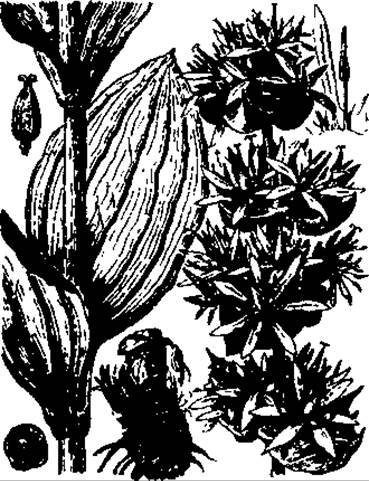
BOGBEAN LEAF — FOLIA MENYANTHIDIS
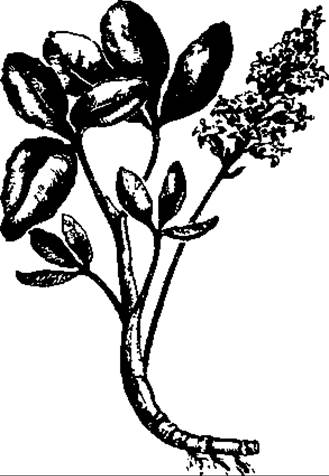
Bogbean (marsh trefoil) — Menyanthes trifoliata L., fam. Menyanthaceae
Bogbean (marsh trefoil); the name derives from Greek men — month, anthos — flower; Latin trifoliatus, -a — three-leaved.
A perennial herbaceous plant with a long creeping rhizome that ascends at the tip. Leaves are alternate, trifoliate, with petioles up to 30 cm long. Individual leaflets are short-petiolate, elliptic or elongated obovate, 5-8 cm long and 3-5 cm wide, entire-margined or slightly uneven-edged. The scape is leafless, 15-35 cm tall. Flowers are gathered in a compact raceme. Five sepals are fused to the middle. The corolla is pale pink, funnel-shaped. The fruit is a rounded-ovoid capsule opening into two Valves, 7-8 cm long.
Distribution. It grows in damp, waterlogged places, peat bogs, along river and lake banks throughout Ukraine, the European part of Russia, the Far East, Belarus, and the Baltic states.
Harvesting. Leaves are harvested during and after the flowering period. Young and apical leaves are not harvested as they turn black during drying. The collected leaves are spread out in a draft for a few hours, then laid out in a loose layer and dried quickly in an attic, under a canopy, or in dryers at 40-50 °C.
Chemical COMPOSITION OF THE raw material. Bogbean leaves contain Iridoids and secoiridoids — loganin (up to 10%), sweroside, foliamentin, mentiafolin; Flavonoids (rutin, trifolin); Tannins (over 7%); monoterpene alkaloids; and iodine.
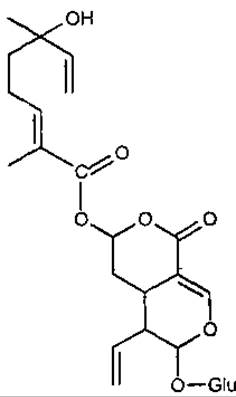
Mentiafolin
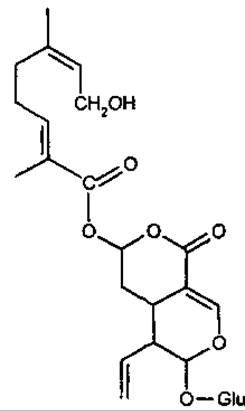
Foliamentin
Biological activity and application. Infusions stimulate appetite, improve digestion, enhance gastric and intestinal peristalsis, and exhibit choleretic, anti-inflammatory, and laxative effects. It is a component of sedative herbal mixtures.
In homeopathy, the whole fresh plant, harvested at the onset of flowering, is used for headaches associated with low Blood pressure or increased intracranial pressure, accompanied by a sensation of pressure in the occiput and icy coldness in the hands and feet.
VIBURNUM BARK — CORTEX VIBURNI
Guelder rose — Viburnum ópulus L., fam. Honeysuckle — Caprifoliaceae
Guelder rose; the name comes from viere — to weave, to plait; opulus is an ancient Latin name for one of the maple species, given due to the similarity of its leaves.
Plant. A branched shrub or a small tree (2-4 m tall). Young shoots are covered with a greenish-gray or yellowish-brown, glabrous, smooth bark with occasional large lenticels, about 2 mm thick.
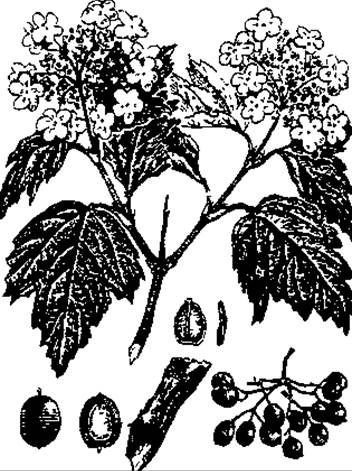
Leaves are opposite, broadly ovate, three- to five-lobed, with ovate, dentate-serrate, acute lobes, glabrous above, velvety-pubescent beneath, 5-10 cm long and 5-8 cm wide; leaf petioles bear club-shaped glands at the Base of the leaf blade and sessile saucer-shaped glands at its apex. Flowers are white, arranged in umbel-like panicles; corolla is gamopetalous, five-lobed. Marginal flowers of the inflorescence are sterile, with a short, relatively large, flat corolla featuring unequal lobes; the corolla of the internal, fertile flowers is regular and short-bell-shaped. Fruits are globose, laterally compressed, glossy drupes 8-12 mm in diameter, with a subtle remnant of the style and sepals; the fruit pulp contains a single flat, Heart-shaped, rounded stone; fruit color is orange-red or dark red, stone color is light brown. Blooms in May-June. Fruits ripen in August-September.
Distribution. Guelder rose grows throughout Ukraine in forests, among shrubs, and along riverbanks. It is widely cultivated in household gardens.
Harvesting. The bark of trunks and branches is gathered in spring during sap flow, before bud burst, when it easily separates from the wood. Semi-circular incisions are made on the trunk and branches with a sharp knife at a distance of 20-25 cm from each other, along with two longitudinal incisions. Ring incisions should not be made, as this may cause the plant to die. The harvested bark is wilted in the air, then dried in a drier at 50-60 °C or under a canopy in the open air. During drying, the raw material is turned over periodically, and care is taken to ensure that pieces of bark do not nest inside one another, otherwise the material will mold and rot. Drying is considered complete when the raw material breaks easily and with a crack upon bending.
Chemical composition of the raw material. The bark contains C10 iridoids termed opulusiridoids. A structural feature of these compounds is the acylation of not only the aglycone hydroxyls, but also the sugar moiety. Phenolic acids (chlorogenic, neochlorogenic, caffeic), phenolic glycosides (arbutin, salicin), triterpenoids (ursolic and oleanolic acids), and tannins are also present.
Fruits contain ascorbic, chlorogenic, neochlorogenic, and other phenolic acids, saponins, carotenoids, bioflavonoids, pectic substances, and sugars.
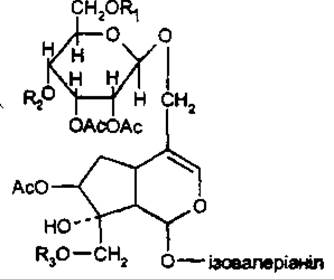
R1 = R2 = H; R3 = acetyl — Opulusiridoid I
R1 = R2 = R3 = H — Opulusiridoid II
R1 = R2 = R3 = Acetyl — Acetylopulusiridoid
Biological activity and application. Decoction and fluid extract of viburnum bark exhibit hemostatic and mild diuretic effects, possess astringent and sedative properties, enhance uterine Muscle tone, and prolong The activity of hypnotics. They are used for uterine hemorrhages, hemorrhoids, gastrointestinal disorders, etc.
The fruits are used as a vitamin Supplement and also exert diaphoretic and diuretic effects.
In homeopathy, fresh trunk bark and roots are used for cramp-like pains to stop false labor pains during Pregnancy; as a Miscarriage-preventing agent; generally for spasmodic pains and to stop bleeding.
Last update: 06/08/2026
Editorial and Educational Adaptation: This material has been compiled based on the primary/original source text. The project team performed an editorial review, corrected technical inaccuracies, structured sections, and adapted the content for an educational format.
What was processed:
- elimination of formatting defects (OCR errors, structural breaks, corrupted characters);
- editorial organization of content;
- standardization of terminology in accordance with academic sources;
- verification of factual statements against the original source text.
All mentions of the author, publication year, and origin of the primary text have been preserved in accordance with the source.