Pharmacognosy with the Basics of Plant Biochemistry - Kovalyov V. M. 2004
Special Part
Phenolic Compounds
Xanthones
Class="center">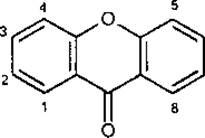
Xanthone (dibenzo-γ-pyrone)
The name originates from the Greek word xanthos, meaning "yellow," because these substances typically have a cream or yellow color.
The first representative of this group was isolated in 1821 by Henry from the roots of Gentiana lutea and named gentisin. Later, its Structure was established and confirmed by synthesis as 1,7-dihydroxy-3-methoxyxanthone. In 1901, Wiechowski obtained a crystalline substance from the leaves of the mango tree (Mangifera indica, family Anacardiaceae) and named it mangin. Its structure was elucidated in 1957 as 1,4,5,7-tetrahydroxyxanthone. From mango fruits, Iseda isolated a yellow crystalline substance which he named mangiferin. Its structure was later proven. In 1961, 17 natural xanthones were described, and by 1969, over 70 compounds were already known: 20 substances from the Gentianaceae family and 50 from the Clusiaceae (Hypericaceae) family. Currently, over 300 xanthone compounds have been isolated and studied from 150 plant species belonging to the families Gentianaceae, Polygalaceae, Clusiaceae, Moraceae, and others.
Xanthones are generally divided into five groups: true xanthones, furanoxanthones, pyrano- and dihydropyrano-xanthones, dipyranoxanthones, and xanthonolignoids.
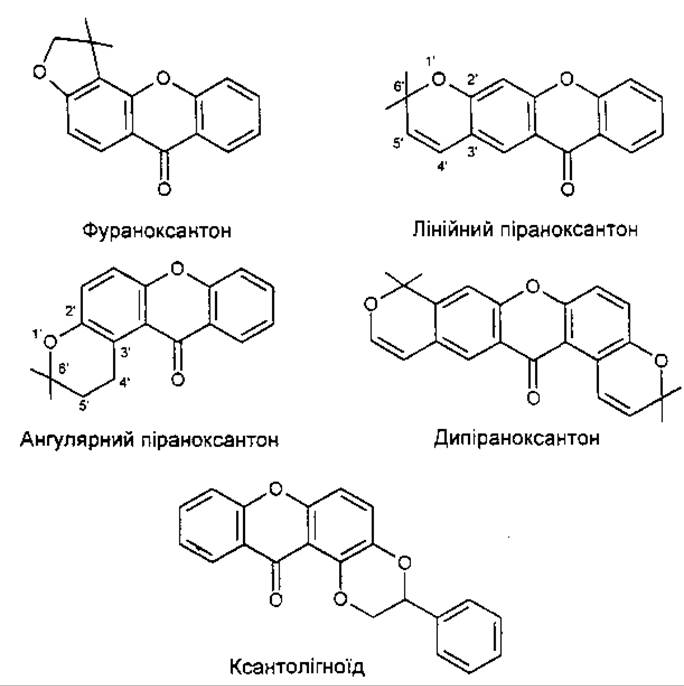
The Biosynthesis pathway of xanthones is similar to that of Flavonoids. Judging by numerous data, the aromatic rings are derived from shikimic acid, while the pyrone ring originates from acetate.
True xanthones. Xanthones are derivatives of dibenzo-γ-pyrone, in which the substituents are hydroxy, alkoxy, or alkyl groups, C- and O-glycosyl residues, and chlorine atoms. According to the number of radicals, xanthones are classified into mono-, di-, tri-, tetra-, penta-, hexa-, hepta-, and octa-substituted.
Monosubstituted xanthones are found in the Clusiaceae (Guttiferae) family. These include three compounds: 2-hydroxyxanthone, its methyl ether, and 4-hydroxyxanthone.
Disubstituted xanthones occur in a free state only in the Clusiaceae family. They are typically substituted with hydroxyl and methoxyl groups at positions 1 and 5, or 1 and 7. There are over 20 such compounds.
Trisubstituted xanthones have been found in the Gentianaceae, Clusiaceae, and Polygalaceae families as aglycones or D-Glycosides, where the sugar moiety is represented by monose (ß-D-glucopyranose) or bioses (primeverose and rutinose). About 60 substances of this subgroup are known.
In plants of the Gentianaceae family, substitution occurs at positions 1,3,5 or 1,3,7; in Clusiaceae, at 1,3,5-, 1,5,6-, 1,6,7-, or 2,3,4-; in Polygalaceae, xanthones have been found in two species of the genus Polygala, with substitution observed at positions 1,2,3.
Tetrasubstituted xanthones are found in the Gentianaceae family (substitution types 1,3,7,8 and 1,3,5,8) and Clusiaceae (substitution types 1,3,6,7; 1,3,5,6; and 1,3,4,5). One compound each has been found in the Lythraceae and Fabaceae families. They are frequently glycosylated with D-glucose, primeverose, or rutinose, forming O-glycosides.
Pentasubstituted xanthones constitute the largest group in terms of quantity. They are widespread in the Gentianaceae, Clusiaceae, Fabaceae, and other families. The Gentianaceae family is characterized by the following substitution patterns: 1,2,3,6,7; 1,2,3,4,5; 1,3,5,6,7. Glycosyl residues are linked to the aglycone via both O- and C-glycosidic bonds.
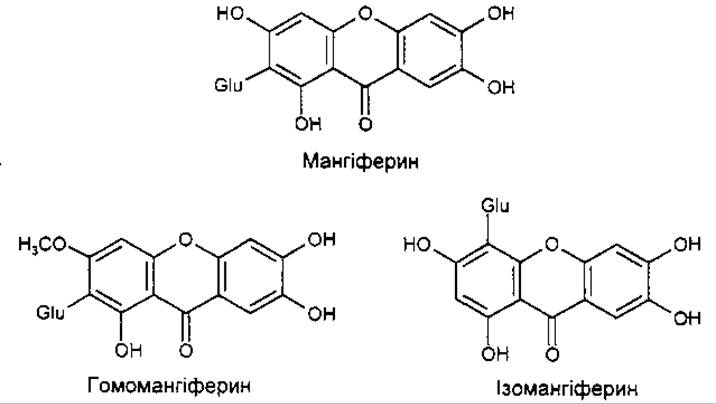
Mangiferin is one of the most widespread xanthones in nature. It accumulates in significant quantities in the leaves of the mango tree (Mangifera indica). In the herb and roots of licorice-like plants of the genus Hedysarum (family Fabaceae), true xanthones have been found, the main one being the glycoside mangiferin along with its derivatives: glucomangiferin and glucoisomangiferin. These compounds exhibit significant antiviral activity. Mangiferin stimulates the Central Nervous system, and in large doses, exerts cardiotonic and diuretic effects; it also displays antibacterial and anti-inflammatory activity.
Hexasubstituted xanthones are found in the Clusiaceae family. Substitution with hydroxyl, methoxyl, and isoprenyl radicals typically occurs at positions 1,2,3,5,6,7.
Hepta- and octasubstituted xanthones have been detected so far only in Lichens.
Furanoxanthones can be linear or angular. They were discovered in 1977 in lower plants, specifically in the genus Aspergillus (class Ascomycetes of Fungi). Among higher plants, they have been found in Allanblackia floribunda (family Clusiaceae).
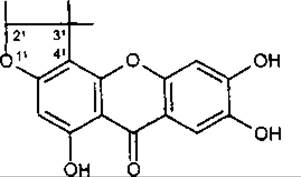
Angular furanoxanthone from Allanblackic floribunda
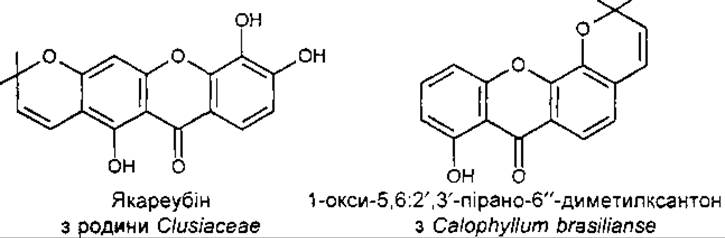
Pyrano- and dihydropyrano-xanthones can be divided into mono-, di-, tri-, tetra-, and pentasubstituted pyranoxanthones. Like furanoxanthones, they can be linear or angular.
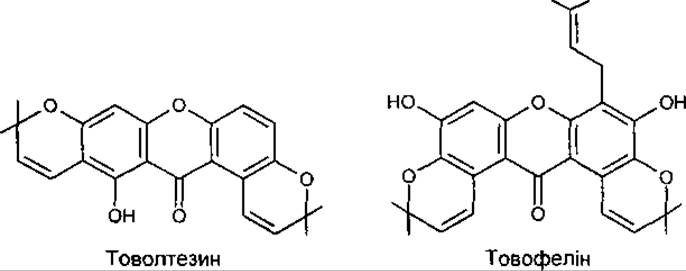
Compounds of the dipyranoxanthone group have been insufficiently studied. As an example, the formulas of tovoltesin and tovofellin are presented, which were isolated from the genus Tovomita, family Clusiaceae.
The sugar moiety in pyrano- and dipyranoxanthone molecules is represented exclusively by ß-glucose.
Xantholignoids have been isolated exclusively from plants of the Clusiaceae family. For instance, kilokorin has been obtained from the roots of common St. John's wort, and gadenzin A from the tropical plant Vismia guaramiranga.
Distribution, Localization, and Biological Function
The Study of xanthones is primarily associated with the Gentianaceae and Clusiaceae families, where they are predominantly found. Xanthones have also been detected in plants belonging to the Moraceae, Polygalaceae, Loganiaceae, Aspidiaceae, Fabaceae, Iridaceae, Anacardiaceae, and other families.
Xanthones are localized in various plant parts: flowers, fruits, leaves, stems, roots, and wood.
It is believed that xanthones participate in redox processes and perform protective Functions during plant infection.
Methods of Isolation and Investigation
Structurally, xanthones are similar to flavonoids; therefore, the methods for their extraction from plant raw Materials are identical.
Air-dried plant material is treated with lower alcohols; the alcoholic extract is evaporated to an aqueous residue, from which Phenolic Compounds are isolated using organic Solvents, starting with low-polarity ones and gradually replacing them with more polar ones (i.e., fractionation is performed). Thus, xanthones with several methoxyl groups and pyranoxanthones are extracted with chloroform or methylene chloride. Xanthone glycosides are extracted with butanol or ethyl acetate depending on their polarity. Typically, plants contain anywhere from a few to 20 xanthone compounds; therefore, the resulting mixtures are separated into individual components by selective extraction using Column and Thin-Layer Chromatography with various sorbents: polyamide, silica gel, Cellulose, Sephadex, etc. Aglycones and glycosides are separated on silica gel. From cellulose, xanthones are eluted with acetic acid, starting at 5% and gradually increasing its concentration to 80%.
Xanthones exhibit characteristic reactions with general Reagents for phenols: iron salts, lead acetate, and aluminum chloride.
Biological Activity and Application
Xanthones substituted at positions 1,3,5,8 exhibit antiviral properties; those substituted at 1,3,7,8 display antitubercular activity. Xanthones with substituents at positions 1,6 and 1,3 act as Sarcoma inhibitors, while trisubstituted xanthones at positions 1,3,8 function as antifungal agents.
The pharmacological action of Medicinal plant raw materials and preparations containing xanthones is presented in Table 9 of the Appendices.
Last update: 06/08/2026
Editorial and Educational Adaptation: This material has been compiled based on the primary/original source text. The project team performed an editorial review, corrected technical inaccuracies, structured sections, and adapted the content for an educational format.
What was processed:
- elimination of formatting defects (OCR errors, structural breaks, corrupted characters);
- editorial organization of content;
- standardization of terminology in accordance with academic sources;
- verification of factual statements against the original source text.
All mentions of the author, publication year, and origin of the primary text have been preserved in accordance with the source.