Pharmacognosy with the Basics of Plant Biochemistry - Kovalyov V. M. 2004
Special Part
Phenolic Compounds
Medicinal Plants and Raw Materials Containing Lignans
RHIZOMES AND ROOTS OF ELEUTHEROCOCCUS — RHIZOMATA ET RADICES ELEUTHEROCOCCI
Eleutherococcus — Eleutherococcus senticosus (Rupr. et Maxim.) Maxim., fam. Araliaceae
Eleutherococcus, prickly eleutherococcus; the name comes from the Greek eleutheros meaning free and kokkos meaning berry, while the Latin senticosus means thorny.
Plant. A tall (2–2.5 m) branching shrub. The ROOT System is branched, up to 30 m long. The bark of the rhizomes is smooth or longitudinally wrinkled, closely adhering to the wood. The root surface features light transverse ridges; the fracture is long-fibrous, with a porous core, and is light yellow or cream-colored.
Shoots are straight, covered with numerous fine prickles. Leaves are long-petiolate, palmately divided into five leaflets; the leaflets are elliptic, with a cuneate base and finely serrate margins.
Flowers are small, on slender pedicels, gathered into nearly spherical umbellate inflorescences; staminate and bisexual flowers are pale purple, while pistillate flowers are yellowish. It blooms in July–August. The fruit is a black spherical drupe.
Distribution. Mixed forests of the Far East. In Ukraine, it is cultivated in certain botanical gardens.
Harvesting. In autumn, the underground Organs are dug out of the soil, shaken free of earth, washed, and wilted in the open air. Then they are chopped into pieces, thick roots are split lengthwise, and they are dried in dryers at a Temperature of 70–80 °C until the roots become brittle.
Chemical composition of the raw material. The raw material contains eight eleutherosides (A, B, B1, C, D, E, F, G), which belong to various groups of BIOLOGICALLY ACTIVE SUBSTANCES — triterpene saponins, Coumarins, and Lignans. The main lignan is syringaresinol. It also contains essential oil, resins, and gum.
Class="center">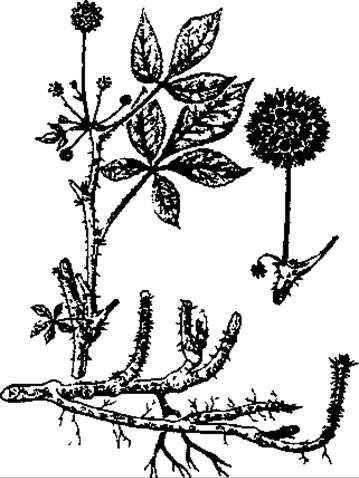
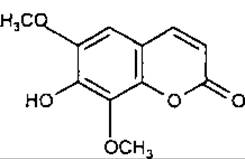
Isofraxidin (aglycone of eleutheroside B1)
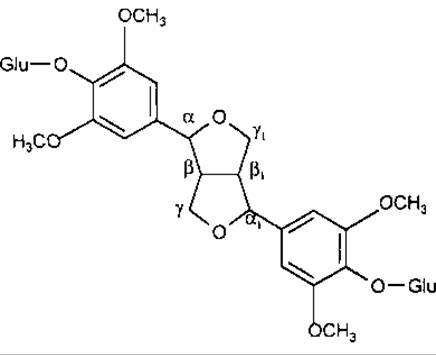
Eleutheroside E
Biological activity and application. Liquid extract is used as a CNS stimulant and to improve visual and auditory acuity; it acts as an adaptogen and lowers Blood sugar levels. Contraindications include myocardial infarction, hypertensive crisis, and acute infectious diseases.
SCHIZANDRA FRUIT — FRUCTUS SCHIZANDRAE SCHIZANDRA SEEDS — SEMINA SCHIZANDRAE
Chinese magnolia vine — Schisandra chinensis (Turcz.) Baill., fam. Schisandraceae. The name comes from the Latin schizo — to split, and andres — male (referring to the bilobed anthers).
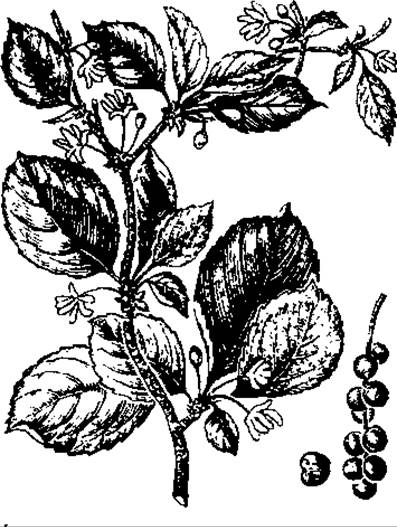
Plant. A monoecious or dioecious woody deciduous liana with a specific lemon-like odor, 4–8 (up to 15) m long. Leaves are alternate, obovate or acuminate-elliptic, entire or slightly serrate, with red petioles. Flowers are unisexual (rarely bisexual), white or pinkish-white, fragrant, with waxy perianth segments, 3–5 in the leaf axils. The fruit is an aggregate fleshy follicle consisting of numerous red berry-like single- or two-seeded fruitlets. Seeds are irregularly shaped, 3–5 mm long, with a glossy brown seed coat. It blooms in May–June, and fruits ripen in September.
Distribution. It grows in the Far East, in Primorsky and Khabarovsk Krais, on Sakhalin, in mixed forests. In Ukraine, it is found in household plots.
Harvesting. The harvested fruits are wilted under a shelter in the open air for 2–3 days, and then finish-dried in dryers, starting at a temperature of 35 °C and finishing at 60 °C. Seeds are dried at a temperature of 50 °C.
Chemical COMPOSITION OF THE raw material. The fruits contain lignans (4–5%). Research on them in the early 1960s was conducted by D. A. Balandin, who isolated schizandrin and determined its Structure. In addition to schizandrin, the raw material contains deoxyschizandrin, schizandrol, γ-schizandrin, etc.
The fruits contain up to 20% organic acids (citric, malic, tartaric, etc.), Flavonoids, anthraquinones, saponins, Vitamin C (up to 500 mg%), and essential oil. The seeds contain essential (2%) and fatty (up to 33%) oils.
Biological activity and application. Schisandra seed tincture is used as an excitatory, tonic, and CNS-stimulating agent. An infusion is made from the fruits. The preparations increase somatic body mass and Muscle mass. They are contraindicated in cases of insomnia, Hypertension, and organic cardiovascular diseases.
MILK THISTLE SEEDS — SEMINA SILYBI
Blessed milk thistle — Silybum marianum (L.) Gaertn., fam. Asteraceae
Blessed milk thistle, Mary thistle; the generic name Silybum is derived from the latinized Greek plant name silybum, meaning a thistle; the specific epithet marianum refers to the Virgin Mary.
Plant description. A biennial (cultivated as an annual) herbaceous plant, up to 1.5 m in height. Leaves are alternate, elliptic, pinnatifid or pinnatisect, with spiny-toothed margins, up to 80 cm long, featuring distinctive white patches against a green Background.
Inflorescences are globose capitula (heads) with pink or white tubular flowers.
Fruit. An achene with a pappus, ovoid in shape, laterally compressed. The Base of the achene is obtuse, the apex is acute, and the surface is smooth, wrinkled, glossy, or matte. The color ranges from black to light brownish, sometimes with a brown tinge, frequently mottled.
Distribution. Found as a weed in the southern regions of Ukraine and CIS countries. It is also cultivated.
Harvesting. The aerial PARTS OF THE plant are mowed, dried, threshed, after which the seeds are further dried in dryers and cleaned of impurities.
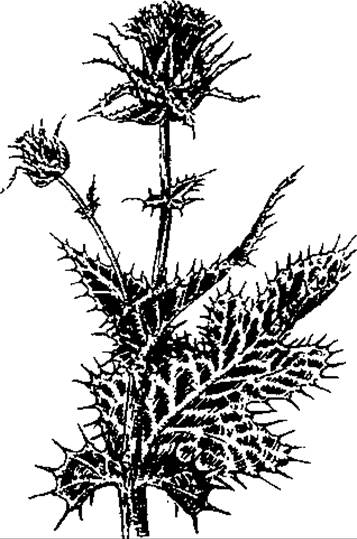
Chemical composition of the raw material. The seeds contain flavonolignans: 1,4-dioxane type (silybin, silydianin), benzofuran type (silychristin, etc.), and cyclohexanoid type (neohydnocarpin), as well as up to 32% fatty oil, biogenic amines, and resins.
Biological activity and application. Hepatoprotective drugs such as Silybor, Legalon, Carsil, and Hepabene are produced from the seeds.
In homeopathy, mature seeds are used to treat Liver disorders and digestive ailments, as well as hemorrhoids, rectal prolapse, Amenorrhea, and varicose Veins.
MAYAPPLE RHIZOMES AND ROOTS — RHIZOMATA CUM RADICIBUS PODOPHYLLI
American mandrake (mayapple) — Podophyllum peltatum L., fam. Berberidaceae; the generic name comes from the Greek pus, podos — FOOT, and phyllon — leaf, because the plant's leaves resemble bird's feet; the specific epithet peltatus derives from pelta — a small shield.
A perennial herbaceous plant, 25–30 cm tall, with a creeping, horizontal, cylindrical, jointed, reddish-brown rhizome, from the thickened nodes of which fleshy, cord-like adventitious roots arise. The stem is smooth and erect, bearing at the apex two opposite, long-petioled, palmate 5- to 7-parted leaves, between which a large (5 cm in diameter), nodding, 6- to 9-petaled white flower develops on a short pedicel. The fruit is a juicy yellow berry. It blooms in early June, and the fruits ripen in August.
Himalayan mayapple, or Emod Mayapple (Podophyllum emodi Wall.), grows in the mountain forests of the Western Himalayas. Its rhizomes contain 12% podophyllin. It is used in the same manner as the rhizomes of American mayapple.
Distribution. Native to North America. Cultivated near Moscow and Saint Petersburg.
Harvesting. Rhizomes are excavated in September, cleaned of stems, cut into 10–15 cm pieces, and sun-dried.
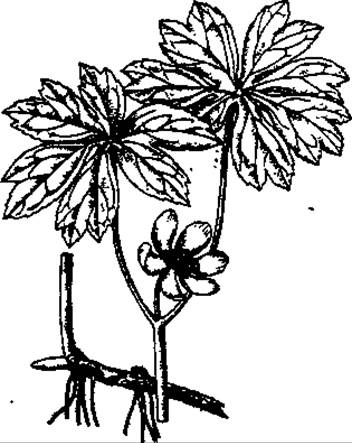
Chemical composition of the raw material. The raw material yields a glycoside resin known as podophyllin (4–8%), which contains dissolved lignans (3%). The principal ones are podophyllotoxin, α-peltatin, and β-peltatin (3%).
Biological activity and application. Podophyllin is used for Urinary Bladder papillomatosis and pharyngeal Papillomas, and acts as a strong laxative. Condyline (Wartec) and podophyllotoxin are applied topically to treat condylomas. They exhibit cytostatic, antiviral, and mummifying (escharotic) effects.
In homeopathy, the fresh rhizome is used for PEPTIC ULCER DISEASE, pancreatitis, and gastroenteritis.
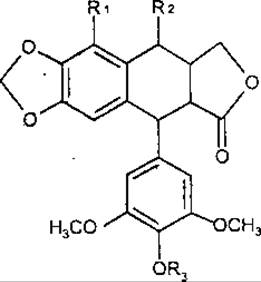
R1 = Н, R2 = ОН, R3 = СН3 - podophyllotoxin
R1 = ОН, R2 = R3 = Н - α-peltatin
R1 = ОН, R2 = Н, R3 = СН3 - β-peltatin
Last update: 06/08/2026
Editorial and Educational Adaptation: This material has been compiled based on the primary/original source text. The project team performed an editorial review, corrected technical inaccuracies, structured sections, and adapted the content for an educational format.
What was processed:
- elimination of formatting defects (OCR errors, structural breaks, corrupted characters);
- editorial organization of content;
- standardization of terminology in accordance with academic sources;
- verification of factual statements against the original source text.
All mentions of the author, publication year, and origin of the primary text have been preserved in accordance with the source.