Review of Medical Physiology - William F. Ganong 2002
Blood Circulation
Cardiovascular Homeostasis in Health and Disease
Hypertension
Hypertension is a sustained elevation of systemic ARTERIAL Blood PRESSURE. Pulmonary hypertension also occurs, but the pressure in the pulmonary trunk is almost independent of systemic arterial pressure.
Experimental Hypertension
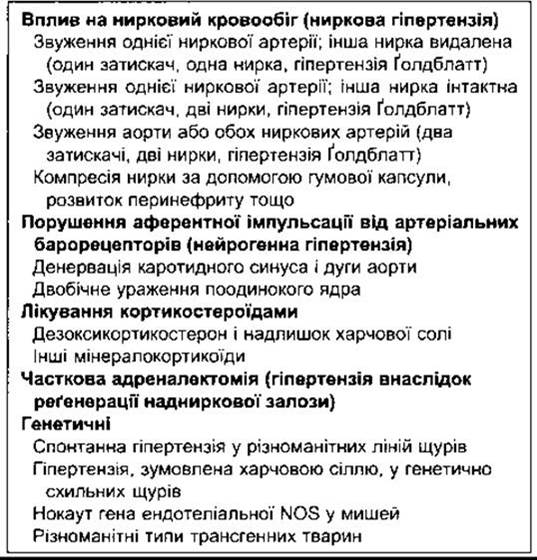
Arterial blood pressure depends on Cardiac Output and total peripheral resistance (pressure = flow x resistance; see Chapter 30). Peripheral resistance is determined by blood viscosity and, principally, by the diameter of the resistance vessels. Although hypertension can be caused by an increased cardiac output, sustained hypertension is typically driven by an increase in peripheral resistance. Some Methods used to induce sustained hypertension in experimental animals are summarized in Table 33-5. Most of these involve interventions affecting the Kidneys, The Nervous system, or the Adrenal Glands. There are also strains of rats that develop hypertension spontaneously (SHR rats) or in response to a high-salt diet (Dahl salt-sensitive rats).
Hypertension caused by renal artery stenosis or renal compression is termed renal hypertension. As noted in Chapter 24, some animals with renal hypertension exhibit elevated plasma renin levels, whereas others have normal levels. In general, Goldblatt hypertension ("two-Kidney, one-clip"; see Table 33-5) is renin-dependent, whereas Goldblatt hypertension ("one-kidney, one-clip") is renin-independent. Another factor that likely contributes to The Development of renal hypertension is the impaired ability of the kidney to excrete Na+ following renal artery constriction. Neurogenic hypertension is described in Chapter 31. Under normal or excessive salt intake, deoxycorticosterone induces hypertension that persists even after the administration of the agent is discontinued. Severe hypertension is observed in animals following unilateral nephrectomy.
Class="center">Table 33-5. METHODS FOR PRODUCING sustained hypertension in experimental animals
Human Hypertension
In humans, hypertension is very common and occurs in association with numerous disorders (Table 33-6). Hypertension leads to a variety of significant complications. When the left ventricle is subjected to a prolonged increase in the workload required to eject blood against a higher resistance (afterload), myocardial hypertrophy ensues. The initial response involves the activation of immediate early genes in ventricular Muscle, followed by the Activation of a series of genes normally involved in fetal growth. The prognosis of Left Ventricular Hypertrophy is poor. The total Energy Expenditure of The Heart—already elevated during ejection against an increased pressure (see Chapter 29)—increases further due to the enlargement of the heart muscle. Consequently, any reduction in coronary blood flow has much more severe consequences in hypertensive patients than in healthy individuals. Coronary stenosis that would remain entirely asymptomatic in a normal-sized heart can lead to myocardial infarction in a person with cardiac hypertrophy. Hypertension also accelerates the development of atherosclerosis, so myocardial infarction frequently occurs even when heart size is normal. Over time, The ability to compensate for high peripheral resistance is lost, and Heart Failure develops. Hypertensive patients are likewise predisposed to cerebral thrombosis and Hemorrhage. Renal failure is another major complication. However, the risk of heart failure, stroke, and renal failure is markedly reduced by effective antihypertensive therapy, even when hypertension is only moderate.
Malignant Hypertension
Chronic hypertension may progress if necrotic changes develop within the arterioles. This rapidly leads to papilledema, cerebral disorders, and progressive renal failure. This syndrome is known as malignant hypertension; if left untreated, it is fatal within two years. However, its progression can be halted and the patient's condition stabilized with appropriate antihypertensive therapy.
Table 33-6. Incidence of Various Forms of hypertension in a hypertensive patient population1
Composition of population, % |
|
93 |
|
Renal hypertension |
|
Renovascular |
2 |
Parenchymal |
3 |
Endocrine hypertension |
|
Primary aldosteronism |
0.3 |
Cushing's syndrome |
0.1 |
Pheochromocytoma |
0.1 |
Other adrenal forms |
0.2 |
Estrogen therapy |
1 |
Miscellaneous (Liddle's syndrome, coarctation of the aorta, etc.) |
0.3 |
1 Modified and reproduced with permission from Williams GH: Hypertensive vascular disease In: Harrison’s Principles of Internal Medicine, 14th ed. Fauci A et al [editors]. McGraw-Hill, 1998).
Essential Hypertension
In 90% of patients with elevated blood pressure, the underlying cause is unknown, a condition referred to as essential hypertension. The clinical course of untreated essential hypertension can vary significantly. For instance, in women, it often follows a benign course, with elevated blood pressure remaining the sole symptom for many years. However, hypertension may also rapidly progress to a malignant phase.
Today, essential hypertension can be managed, though not cured. Effective blood pressure reduction can be achieved using drugs that block α-adrenoceptors in the peripheral or Central Nervous System, agents that block β-adrenoceptors, angiotensin-converting Enzyme Inhibitors, calcium channel blockers, and vascular smooth muscle relaxants.
Other types of Hypertension
Although essential hypertension accounts for the majority of cases, an increasing number of patients are diagnosed with secondary hypertension, where a specific underlying cause is identified. Consequently, these cases do not fall under essential hypertension. For example, hypertension in Diabetes Mellitus is not a distinct disease, but rather a syndrome that may stem from multiple etiologies. Known causes include renal disease, Disorders of the adrenal glands and other endocrine Organs, as well as genetic defects (see Table 33-6). Identifying these causes is clinically crucial, as some forms are not only treatable but curable.
Some hypertensive patients are salt-sensitive, much like Dahl salt-sensitive rats, whereas others exhibit only a mild blood pressure increase on a high-salt diet, similar to Dahl salt-resistant rats. Because there are currently no simple screening methods to identify salt-sensitive versus salt-resistant individuals, recommending dietary sodium restriction for all hypertensive patients is clinically prudent. However, the extent to which this intervention can prevent or mitigate hypertension depends on the patient's individual salt sensitivity.
In pregnant women, the hypertension associated with Preeclampsia and Eclampsia may be triggered by a pressor peptide secreted by the Placenta.
In humans, deoxycorticosterone and aldosterone elevate blood pressure, and hypertension is a hallmark symptom of primary hyperaldosteronism. It is also observed in patients with excessive secretion of deoxycorticosterone (see Chapter 20). Hypertension is particularly pronounced in glucocorticoid-remediable aldosteronism, a congenital disorder caused by ACTH-stimulated aldosterone synthase (see Chapter 20). The hypokalemia induced by these Hormones leads to renal injury (hypokalemic nephropathy), meaning the resulting hypertension may be partially of renal origin. Additionally, expanded extracellular fluid volume resulting from Na+ retention plays a contributing role.
In hypertension caused by Excessive production of aldosterone and deoxycorticosterone, plasma renin activity is characteristically low. It is also low, for reasons that remain unclear, in the presence of normal or low aldosterone and deoxycorticosterone production in 10–15% of patients, while all other cases are classified as essential hypertension (low-renin hypertension).
Hypertension is also a feature of Cushing's syndrome, in which aldosterone levels are typically normal. The precise Pathophysiology of hypertension in this condition remains elusive. Potential mechanisms include increased deoxycorticosterone production driven by elevated circulating ACTH levels; enhanced angiotensinogen production stimulated by elevated circulating glucocorticoids; a direct action of glucocorticoids on arterioles; or a combination of these factors.
Pheochromocytoma — a tumor of The adrenal medulla or extra-adrenal chromaffin tissue — also causes hypertension. Pheochromocytoma is discussed in Chapter 20.
Renal hypertension, caused by renal artery stenosis, is described above and in Chapter 24. In Liddle syndrome, hyperactivation of epithelial Na+ channels leads to renal salt retention and subsequent hypertension (see Chapter 38).
Coarctation of the aorta is a congenital narrowing of a segment of the Thoracic Aorta that increases resistance to blood flow, resulting in marked hypertension in the upper body. Blood pressure in the lower body is generally normal, although it may be elevated due to enhanced renin release.
Long-term use of estrogen-containing oral contraceptives induces marked hypertension in some women. This hypertension is caused by an increased blood level of angiotensinogen, The production of which is stimulated by estrogens (see Chapter 24). Normally, the elevated concentration of blood angiotensin II resulting from increased blood angiotensinogen suppresses renin secretion. The reduction in renin levels helps normalize blood angiotensin II concentrations. However, in some women this feedback mechanism is impaired, leading to the development of "pill-induced hypertension." Of course, sporadic hypertension in women with previously normal blood pressure is not a reason to discontinue oral contraceptives; nevertheless, it is advisable for them to have their blood pressure checked every six months.
Last update: 10/08/2026
Editorial and Educational Adaptation: This material has been compiled based on the primary/original source text. The project team performed an editorial review, corrected technical inaccuracies, structured sections, and adapted the content for an educational format.
What was processed:
- elimination of formatting defects (OCR errors, structural breaks, corrupted characters);
- editorial organization of content;
- standardization of terminology in accordance with academic sources;
- verification of factual statements against the original source text.
All mentions of the author, publication year, and origin of the primary text have been preserved in accordance with the source.