Pharmacognosy with the Basics of Plant Biochemistry - Kovalyov V. M. 2004
Special Part
Phenolic Compounds
Coumarins
Coumarins are naturally occurring compounds whose structural core is based on a benzo-alpha-pyrone Skeleton (the lactone of cis-o-hydroxycinnamic acid).
Class="center">
9,10-Benzo-alpha-pyrone (coumarin)

Cis-o-hydroxycinnamic acid (o-coumaric acid)
Coumarin, the parent compound of this group, was first isolated in 1820 by Vogel from the seeds of the South American tonka bean tree (Dipterix odorata, family Fabaceae). It derives its name from the local term for this tree, "coumarouna".
The structure of coumarin as a lactone of o-coumaric acid was not established immediately; however, the subsequent synthesis of coumarin from salicylaldehyde and malonic acid indicated its relationship with o-hydroxycinnamic acid.
Depending on their chemical structure, natural coumarins are classified into the following groups.
1. Simple coumarins. These compounds are found in the herb of yellow sweet clover (Melilotus officinalis, Fabaceae).

Coumarin

Dihydrocoumarin (melilotin)
2. Hydroxy-, methoxy (alkoxy-), and methylenedihydroxycoumarins. Substituents can be present in either the benzene ring, the pyrone ring, or both simultaneously.
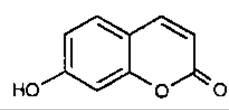
Umbelliferone (7-hydroxycoumarin)
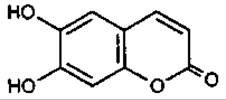
Esculetin
(6,7-dihydroxycoumarin)
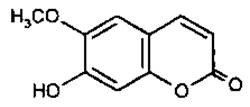
Fraxetin
(6-methoxy-7,8-dihydroxycoumarin)
These compounds are most widely distributed in plants of the Apiaceae and Rutaceae families.
3. Furocoumarins, or coumaran-alpha-pyrones. These compounds are formed by the Condensation of a furan ring with the coumarin core at the 6,7-position (psoralen derivatives) or the 7,8-positions (angelicin derivatives). Substituents may be located in all three rings.
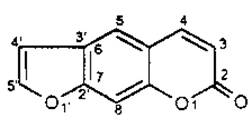
Psoralen (furo-2',3':6,7-coumarin)

Angelicin (isopsoralen) (furo-2',3': 7,8-coumarin)
4. Pyranocoumarins, or chromeno-α-pyrones. They are formed As a result of the condensation of coumarin with 2′,2′-dimethylpyran at positions 5,6; 6,7, or 7,8 and may bear substituents in all rings.

2',2'-Dimethylxanthyletin

Visnadine
5. Benzocoumarins, featuring a benzene ring fused with a coumarin core at positions 3 and 4, occur in plants of the Anacardiaceae and Rosaceae families. A hydroxyl derivative of 3,4-benzocoumarin serves as a structural moiety of ellagic acid.

Hydroxyl derivative of 3,4-benzocoumarin

Coumestrol
6. Coumarin derivatives containing a benzofuran system fused to coumarin at the 3,4-position (coumestrols). Isolated from various clover species (Trifolium spp., Fabaceae).
Other complex compounds containing a coumarin moiety also occur in nature.
Coumarin is synthesized from shikimic acid (see the flavonoid biosynthesis pathway) via The formation of $n$-coumaric acid, hydroxylation, the formation of a precursor glycoside with concurrent trans-cis isomerization, and subsequent lactone ring closure.
Scheme of Coumarin Formation

Distribution, Localization, and Biological Function in Plants
Coumarins are found in plants across various families. They are most typical of the Apiaceae, Rutaceae, and Fabaceae families, whereas in other families (such as Asteraceae, Hippocastanaceae, and Solanaceae) they occur relatively rarely. Simple coumarin and furocoumarin derivatives are the most widespread. The majority of compounds in this class exist in the free state, and less frequently as Glycosides.
Coumarins are unevenly distributed within plants, with concentrations ranging from 0.2 to 10%. They accumulate predominantly in fruits, seeds, roots, bark, and flowers, and to a lesser extent in herbs and leaves. In the Apiaceae family, coumarin compounds are localized in essential oil ducts. It is common to find 5 to 10 coumarins of varying chemical structures within a single plant. Their Qualitative and quantitative composition differs among species, even within the same genus, and can vary within a single species (subspecies or chemotype). Furthermore, the coumarin profile changes during plant ontogeny.
At low concentrations, coumarins stimulate plant growth, whereas at high concentrations, they inhibit it.
Physicochemical Properties
Coumarins and furocoumarins are crystalline, colorless, aromatic substances that sublime when heated to 100 °C. Coumarins are readily soluble in organic Solvents such as ethyl and methyl alcohols, petroleum and diethyl ethers, chloroform, fats, and fatty oils. Glycosides are predominantly soluble in Water-alcohol mixtures. Coumarins also dissolve in aqueous alkaline solutions (especially upon heating) due to the formation of hydroxycinnamic acid salts (a characteristic property of lactones). Most coumarins exhibit characteristic fluorescence in UV light when dissolved in neutral alcoholic or alkaline solutions, as well as in concentrated sulfuric acid within the visible spectrum. This is particularly true for umbelliferone derivatives, which display an intense bright-blue fluorescence under UV light.
Extraction and Research Methods
Coumarins are typically isolated from plant Materials using extraction with alcohol, chloroform, benzene, diethyl ether, and petroleum ether (often combining solvents). The best results for extracting free coumarins and glycosides from herbal raw materials are achieved using ethyl alcohol. After distilling off the alcohol, the resulting thick extract is treated with petroleum ether, benzene, and chloroform for purification and fractionation. Occasionally, plant raw materials are treated first with ether, followed by chloroform, ethyl, and methyl alcohols. To remove pigments and Essential Oils during the industrial production of coumarins, the extracts are treated with activated charcoal.
Column Chromatography on sorbents such as aluminum oxide and silica gel is also employed to remove co-extractives. Coumarins are readily eluted from columns using a mixture of organic solvents.
Qualitative and Quantitative Analysis. The cyclic system of coumarins, comprising a benzene ring and a heterocyclic $\alpha$-pyrone ring, provides a structural basis for a variety of Chemical Reactions.
One of the Characteristic Properties of coumarins as lactones is their specific behavior in the presence of alkalis. They undergo slow Hydrolysis when treated with dilute alkali, forming a yellow solution of coumarinic acid salts. Upon acidification of these alkaline solutions or saturation with CO2, coumarins revert to their original state.

When diazonium salts interact with coumarins in a mildly alkaline medium, the diazo radical attaches to the C-6 position of the coumarin system, which is para to the phenolic hydroxyl group. As a result, the solution turns red.

Coumarin derivatives fluoresce under ultraviolet light, a property utilized for their chromatographic detection. Depending on their structure, coumarins exhibit blue, cyan, violet, green, or yellow fluorescence, which intensifies AFTER treating the chromatograms with alkali. After being kept in a drying cabinet at 120 °C, the chromatograms are treated with diazotized sulfanilic acid, causing the coumarins to stain orange, reddish-orange, or violet.
The Quantitative determination of coumarins relies on their physicochemical properties. The ability of the lactone ring to reversibly open and close depending on the pH of the medium is utilized in the gravimetric determination of total coumarins.
The specific reaction of coumarins with alkalis forms The basis of the neutralization method (back titration), which is used to assay both total coumarins and individual substances. Quantitative determination of coumarins is also carried out polarographically. UV-induced fluorescence serves as the basis for fluorometric methods, while the ability of coumarins to form stable colored solutions with diazo Reagents in an alkaline medium is applied in colorimetric assays.
Spectrophotometric Methods are also widely used for the quantitative analysis of coumarins. These methods involve measuring the optical density of coumarin solutions at the wavelength of maximum UV absorption corresponding to a specific coumarin, as a function of its concentration. As a rule, these methods are preceded by chromatographic Separation of coumarins on paper or in a thin layer of sorbent, which is why they are commonly referred to as chromato-optical methods.
Biological Activity and Applications
Natural coumarins exhibit a wide range of biological activities. Some of them (such as psoralen, bergapten, xanthotoxin, etc.) display photodynamic activity—meaning they increase Skin sensitivity to UV rays—and are therefore used in the Treatment of vitiligo, alopecia areata, and leukoderma.
Others (for instance, pyranocoumarins from the roots of *Phlojodicarpus*, adamantine from the roots and fruits of *Peucedanum alsaticum*, pteroxin from *Selinum*, and pastinacin from parsnip fruits) act as antispasmodics. Esculetin, fraxetin, and their glycosides esculin and fraxin, found in horse chestnut fruits, exhibit Vitamin P-like activity; umbelliferone has antimicrobial properties; osthol is antitumor; and dicoumarin acts as an anticoagulant. There is also evidence supporting the successful use of methyl, methoxy, and hydroxyl derivatives of coumarin as anthelmintics, in the treatment of parasitic skin diseases, and for trichomonal colpitis.
Thus, coumarins are characterized by a wide diversity of biological effects on The Human Body; however, they have not found widespread clinical application due to the lack of optimal dosage forms, The Development of which is hindered by their poor water solubility.
Information regarding herbal raw materials and preparations containing coumarins is provided in Appendix Table 5.
Last update: 06/08/2026
Editorial and Educational Adaptation: This material has been compiled based on the primary/original source text. The project team performed an editorial review, corrected technical inaccuracies, structured sections, and adapted the content for an educational format.
What was processed:
- elimination of formatting defects (OCR errors, structural breaks, corrupted characters);
- editorial organization of content;
- standardization of terminology in accordance with academic sources;
- verification of factual statements against the original source text.
All mentions of the author, publication year, and origin of the primary text have been preserved in accordance with the source.