Pharmacognosy with the Basics of Plant Biochemistry - Kovalyov V. M. 2004
Special Part
Essential Oils
Medicinal Plants and Raw Materials Containing Steroidal Saponins
DIOSCOREA RHIZOMES AND ROOTS — RHIZOMATA CUM RADICIBUS DIOSCOREAE
Nippon yam — Dioscorea nippónica Makino, delta yam — Dioscorea deltóides Wall., fam. Dioscoreaceae. Named Dioscorea in honor of the ancient Greek physician Dioscorides; Lat. nipponicus, -a — Japanese, from Nippon — Japan.
Plant. A dioecious perennial herbaceous liana up to 4 m long, featuring a twining stem and a thick, horizontal, branched, tuberous rhizome up to 20 cm long and 0.5 to 4 cm thick. It has twisted or slightly bent, short and thick cylindrical branches. The surface is longitudinally fissured and yellowish-brown. The roots are thin and elastic, up to 30 cm long and 0.5—1 mm thick. Leaves are alternate, petiolate, broadly ovate, with a cordate base and seven lobes, the middle lobe being the largest; upper leaves are three- to five-lobed. Flowers are unisexual, dioecious, greenish. Staminate flowers are usually gathered in groups of three to seven into a Cincinnus, forming simple, less commonly branched axillary racemes; pistillate flowers are gathered in a simple raceme. Fruit is a three-celled capsule.
Distribution. Dioscorea nipponica grows in the Primorsky and Khabarovsk Territories, while Dioscorea deltoidea grows wild in Pakistan. Both species are cultivated.
Harvesting. Rhizomes with roots are excavated throughout the vegetative period, cut into pieces, and dried.
Chemical composition of the raw material. The active constituents are steroidal saponins (up to 8 %), the main ones being diosgenin Glycosides — dioscin (1.2 %) and gracillin. Maximum glycoside accumulation is observed during the bud formation phase.
Class="center">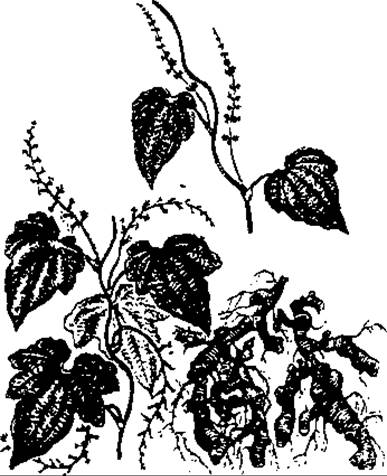

Diosgenin
R = Glu-O-Rha-O-Rha — Dioscin
R = Rha-O-Glu-O-Glu — Gracillin
Diosgenin exhibits anti-inflammatory properties. It was first isolated from the roots of Dioscorea tokogo in 1936. In addition to Dioscorea species, diosgenin is synthesized in certain plants of the Solanaceae and Fabaceae families.
Biological activity and application. Diosgenin serves as a precursor for the synthesis of hormonal steroid drugs — cortisone and progesterone. The raw material yields polysponin, a purified extract of Dioscorea rhizomes containing a total Water-soluble steroidal saponin content of not less than 30 %. It is used in the combination therapy of atherosclerosis.
PUNCTURE VINE HERB — HERBA TRIBULI TERRESTRIS
Puncture vine (cat's heads) — Tribulus terrestris L., fam. Zygophyllaceae
Latinated Greek plant name tribolas; Lat. terrestris, -e — terrestrial.
An annual herbaceous, harshly pubescent plant. Stem is prostrate, branched, 10-50 cm long. Leaves are opposite, paripinnate, with six to eight pairs of oblong leaflets. Flowers are bisexual, regular, small, five-petaled, yellow, solitary, in the leaf axils. Fruit is pentagonal, disintegrating into five nutlets covered with sharp spines.

Distribution. The habitat covers the entire southern part of Ukraine. It occurs in Crimea, the Steppe zone, and occasionally in the Forest-Steppe zone on dry sandy locations, melon fields, vegetable gardens, crop fields, and along roadsides.
Harvesting. The herb is pulled out with roots during the flowering and fruiting stage. For 2-3 hours, the herb is wilted in the sun and then dried under a canopy or in well-ventilated rooms.
Chemical COMPOSITION OF THE raw material. Tribulus herb contains steroidal glycosides (2 %), among which are dioscin and gracillin, tigogenin, hecogenin; flavonoid glycosides (astragalin, tribuloside, rutin), Tannins, resins, and ascorbic acid.
Biological activity and application. The liquid extract of puncture vine exhibits diuretic, anti-sclerotic, and hypotensive effects, and stimulates gastric juice secretion. Tribusponin, a drug used for the Prevention and Treatment of atherosclerosis accompanied by Hypertension and angina pectoris, is manufactured from this plant. In Bulgaria, preparations with a stimulating effect are produced from puncture vine herb.
FENUGREEK SEED — SEMINA FOENIGRAECI
Fenugreek — Trigonella foenum-graecum L., fam. Fabaceae
The name originates from Greek trigonon — triangle; Lat. foenum — hay and graecus, -a, -um — Greek.
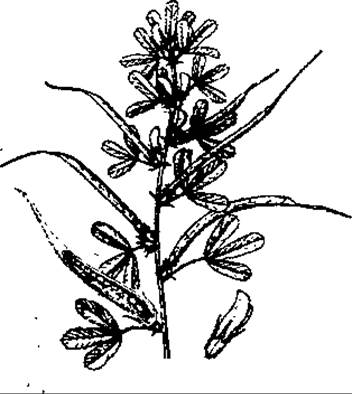
The plant is an annual herb. The stem is erect, sparsely pubescent, 10-50 cm tall. Leaves are alternate, trifoliate, with dentate leaflets. Flowers are zygomorphic, solitary or in pairs in the leaf axils; the corolla is pale yellow. The fruit is a legume (pod). Seeds are irregularly rhombic or spherical, less frequently square, 5-7 mm long, yellow, yellowish-green, yellowish-brown, or brown. The taste is bitter and pungent, with a specific, aromatic scent.
Distribution. Native to the Mediterranean region. Cultivated in Ukraine as a fodder and essential oil crop.
Collection. Seeds are harvested during the period of full maturity.
Chemical composition of the raw material. The seeds contain steroidal saponins (0.1-0.3%), aglycone derivatives: diosgenin, yamogenin, tigogenin, gitogenin, neotigogenin, and neogitogenin. These can serve as precursors for the semisynthesis of Hormones and Other Steroids. The content of steroidal compounds in seeds increases upon incubation with Auxins (Plant growth stimulators).
Seeds are rich in mucilage, which contains sucrose and galactomannans. Nitrogen-containing compounds include trigonelline (nicotinic acid methylbetaine) and Choline. The fixed oil content ranges from 6-10%; the lipid fraction contains about 2% lecithin, along with phytin. Other investigated constituents include C-Flavonoids (vitexin, isovitexin, vicenin, aroylvitexin), Proteins (up to 30%), essential oil, and nicotinic acid.
Biological activity and application. Raw material for The production of steroidal hormones. The extract is a component of the phytolysin preparation. The seeds exhibit anti-sclerotic activity and are used as a tonic and appetite stimulant.
AGAVE LEAVES — FOLIA AGAVAE
American agave — Agave americana L., sisal agave — A. sisalana Perrino, fam. Agavaceae
American agave, sisal agave; the name originates from the Greek ageve, meaning daughter of Cadmus and mother of Pentheus.
A perennial herbaceous plant. The stem is shortened, with a rosette of elongated, fleshy leaves at the base. Leaves are succulent, leathery, blue-green, with hard prickles along the margins; the apex is acute and terminates in a spine up to 1.5 cm long, with a bluish waxy bloom On the surface. Flowers are bisexual, greenish-yellow, borne on a tall peduncle in a many-flowered panicle. The fruit is a capsule.
Distribution. Over 300 species of agave are known, growing wild in East and tropical Africa, and South America. American agave is cultivated outdoors in Crimea.
Collection. The leaves are cut and processed fresh.

Chemical composition of the raw material. The leaves contain steroidal saponins — hecogenin, manogenin, and gitogenin.

Hecogenin
Biological activity and application. Raw material for the production of steroidal hormones.
In homeopathy, fresh leaves are used for atonic constipation and as a diuretic.
Last update: 06/08/2026
Editorial and Educational Adaptation: This material has been compiled based on the primary/original source text. The project team performed an editorial review, corrected technical inaccuracies, structured sections, and adapted the content for an educational format.
What was processed:
- elimination of formatting defects (OCR errors, structural breaks, corrupted characters);
- editorial organization of content;
- standardization of terminology in accordance with academic sources;
- verification of factual statements against the original source text.
All mentions of the author, publication year, and origin of the primary text have been preserved in accordance with the source.