Pharmacognosy with the Basics of Plant Biochemistry - Kovalyov V. M. 2004
Special Part
Alkaloids
Medicinal plants and raw materials containing diterpene alkaloids
Aconitum —Aconitum L.; Ukrainian common names include wolfsbane, monkshood; the Latin name derives from the Greek akoniton, the name of a poisonous plant.
Species of the genus Aconitum are perennial herbaceous plants. Their rhizomes consist of thickened tuberous roots. Stems are erect, glabrous, 70-130 cm tall. Leaves are alternate, palmatipartite, and reniform-cordate. Flowers are zygomorphic, blue, purple, yellow, or white, arranged in a raceme, sometimes a panicle. The fruit is an aggregate follicle. More than 100 species grow in the CIS countries, 17 of which are found in Ukraine. All of them are extremely toxic.
Dzungarian aconite — Aconitum soongoricum L. and Karakol aconite — Aconitum karakolicum Rap., fam. Ranunculaceae, were included in the State Pharmacopoeia of the USSR (SP VIII). Some botanists classify Karakol aconite as a variety of Dzungarian aconite. The distribution ranges of these plants overlap, and they are sometimes harvested together. They grow in the alpine zone of the high-altitude Regions of the Tien Shan and Dzhungarian Alatau at an altitude of 1000-3000 m above sea level, near Lake Issyk-Kul.
Diterpenoid alkaloids are present in all plant Organs. During the budding and flowering phase, their content reaches 0.3-0.6% in the herb, and up to 2% in the underground organs in autumn. Aconitine is considered the main and most toxic alkaloid in the total alkaloid fraction. The atisine group in the raw material is represented by songorine and monoacetylsongorine.
Originally, aconite tubers were harvested, but due to the depletion of natural stands, collection shifted to fresh herb of Dzungarian aconite — Herba Aconiti soongorici recens for the preparation of tinctures used externally for radiculitis, rheumatism, and neuralgia (exerting a counter-irritant and distracting effect). Currently, these species are used exclusively in folk medicine as antitumor remedies.
Class="center">
Dzungarian aconite
In European countries and the USA, monkshood (Aconitum napellus L., a polymorphic species ranging from Eastern Europe to the Himalayas) is more widely known. It is cultivated to obtain tuberous roots, which are used to prepare galenical formulations for external application.
In homeopathy, fresh plants harvested at the beginning of flowering are used for acute conditions of influenzal and pyogenic Etiology accompanied by fever. They are prescribed for short-term use in scarlet fever, acute articular rheumatism, cystitis, Hypertension, and also in ophthalmology.
BLOW-FLOWER WOLFSHBANE HERB - HERBA ACONITI LEUCOSTOMI
White-lipped aconite — Aconitum leucostómum Worosch., fam. Ranunculaceae
White-lipped wolfsbane (monkshood).
A plant 120-200 cm tall, with a vertical rhizome.
Stems are ribbed, hollow, and sparsely pubescent. Leaves are coriaceous, short-petiolate, reniform-round, deeply incised, glabrous above, with short curved hairs beneath, especially along the Veins. Flowers are zygomorphic, ranging from purple to yellow in color, arranged in a dense multiflorous raceme.
Fruit is an aggregate of glandular-pubescent follicles.
Distribution. Grows in the mountains of Eastern Siberia (Altai) and Central Asia. The main harvesting regions are Kyrgyzstan and Kazakhstan.
Harvesting. The herb is mowed during the budding phase at a height of 5 cm from the ground. The raw material is wilted for one day, then chopped into large pieces using a silage cutter and dried in the sun or in dryers at a Temperature of 80 °C. Safety regulations must be observed when handling, as the plant is toxic.
Chemical composition of the raw material. The alkaloid content reaches 4%. The main ones are lappaconitine, lappaconidine, mesaconitine, axin, etc.; they are accompanied by saponins, Coumarins, and Tannins.

Biological activity and application. Alapinin (lappaconitine hydrobromide mixed with accompanying alkaloids) is used as an antiarrhythmic agent.
RETICULATE-FRUITED LARKSPUR HERB — HERBA DELPHINII DICTYOCARPI
Reticulate-fruited larkspur — Delphinium dictyocarpum DC., fam. Ranunculaceae
Siberian larkspur (delphinium); the name derives from the Greek delphis — dolphin, due to the distant resemblance of the flower bud to the figure of a dolphin; diktyon — net and karpos — fruit.
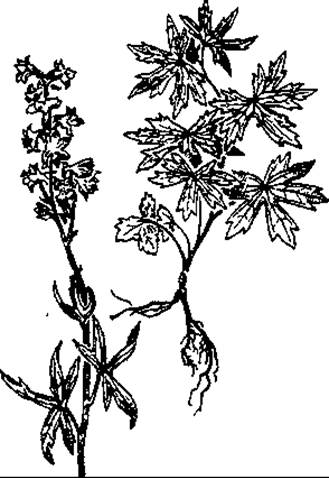
A perennial herbaceous plant with an erect, ribbed stem, 60-100 cm tall. Leaves are alternate, petiolate, reniform-cordate, palmatipartite or dissected into 5-7 rhombic lobes. Flowers are arranged in multiflorous racemes 20-35 cm long. Perianth is simple, pentamerous, corolla-like, blue or dark blue; the upper perianth segment bears a spur. Nectariferous petals and petaloid staminodes are blue. The fruit is a multi-seeded follicle.
Distribution. An endemic plant. Grows in the mountains of southern Western Siberia and Eastern Kazakhstan, and in the Northern Urals. Cultivated in Ukraine.
Preparation. The plant is harvested at the level of the lower green leaves during the budding stage and the beginning of flowering. Air-shade drying or drying in dryers at a temperature of 50 °C. The plant is poisonous.
Chemical COMPOSITION OF THE raw material. All PARTS OF THE plant contain diterpene and isoquinoline alkaloids. The alkaloids condelphine, methyllycaconitine, elatine, and delsine have been investigated in the context of the search for tubocurarine-like Muscle relaxants. The structural basis of these alkaloids is the lycoctonine core. The alkaloid content in the herb reaches 1.5%. The content of the main alkaloid, methyllycaconitine, in the fruits is 0.9%.
Biological activity and application. The curare-like agent mellictine is used as a relaxant in Nervous system disorders accompanied by increased muscle tone, as well as in surgery.
Steroidal Alkaloids (Glycoalkaloids)
Steroidal alkaloids comprise about 350 representatives found in plants of the families Solanaceae, Liliaceae, Apocynaceae, Buxaceae, and Convolvulaceae. Steroidal alkaloids combine The properties of both alkaloids and steroidal saponins. They are divided into three groups: cholestane derivatives (C27), C-nor-D-homosteroidal alkaloids, and pregnane derivatives (C21).
Cholestane derivatives. The backbone of this group of compounds is the cyclopentanoperhydrophenanthrene core linked to a heterocyclic system. These surface-active compounds contain nitrogen within the aglycone Structure, exhibit high pharmacological activity and hemolytic action, and bind Cholesterol. Biosynthesis proceeds via steroidal saponins, which is why they are usually formed together, for example, in plants of the genus Solanum.
Just like saponins, they contain sugar components attached to the aglycone by a glycosidic bond at the C-3 position. The carbohydrate moiety is monoside or oligososide, containing D-glucose, D-galactose, L-rhamnose, L-arabinose, D-xylose, L-fructose, or acids such as D-glucuronic and D-galacturonic acids. In plants, alkaloids exist in the form of both aglycones and Glycosides. Substitution with methyl groups occurs at the C-10, C-13, and C-18 positions. Depending on the cis and trans configuration of the rings, they are divided into two groups: spirosolane and spirostane. Examples of the first group include solasodine, and of the second, tomatidine.
The most important derivatives of solasodine are the glycoalkaloids solasonine and solamargine, which have been isolated from Solanum laciniatum and Solanum aviculare species. They find Practical Application as starting Materials for The production of Steroid Hormones. In solasonine, an oligosaccharide consisting of glucose, galactose, and rhamnose is attached at the C-3 position, whereas in solamargine, the carbohydrate chain consists of glucose and two rhamnose residues.
Plants of the genera Solanum and Veratrum contain alkaloids in which the E and F rings are fused (the solanidane group). This group includes solanidin and its glycosides: alpha-, beta-, and gamma-solanines. Alpha-solanine contains the trisaccharide solatriose at C-3, beta-solanine contains the bioside solabiose, and gamma-solanidine is a monoglycoside in which the solanidin aglycone is bound to galactose.

A minor amount of hellebore alkaloids is of cholestane origin (rubijervine, isorubijervine, veralcamine).

C-nor-D-homosteroidal alkaloids. These pseudoalkaloids are not widely distributed in nature; they lack an angular methyl group in the C-ring, and the D-ring is expanded by one carbon atom. C-nor-D-homosteroid derivatives include the main hellebore alkaloids, which are subdivided into jervine and cevadine types (jervatrone and cevatrone groups). Jervatrone alkaloids contain 1-4 oxygen atoms, while cevatrone alkaloids contain 7-8 oxygen atoms in the molecule.
The jervatrone group includes jervine, veratramine, veratrosine, and others.
More important in hellebore raw materials are cevan derivatives (germine, protoverine, veracevine, zygadine).
The listed alkaloids possess high pharmacological activity. They form ester bonds with organic acids. For example, well-known esters of veracevine include those with acetic acid (the alkaloid cevanine), angelic acid (cevadine), vanillic acid (vanilloylveracetin), etc.
Germine, like veracetin, forms a hemiacetal (ketal), as well as esters with branched-chain acids. For example, Esterification with alpha-methylbutyric acid yields the alkaloid protoveratridine.
Cevatrone group of alkaloids: |
||||
R1 |
R2 |
R3 |
R4 |
R5 |
H |
OH |
H |
OH |
H — Germine |
OH |
OH |
H |
OH |
H — Protoverine |
H |
H |
OH |
H |
OH — Veracevine |
H |
H |
H |
OH |
H — Zygadine |

Cevane
Cevatrone alkaloids are also found in the seeds of the American plant sabadilla (Schoenocaulon officinale, or Sabadilla officinarum, Melanthiaceae).
Pregnane-group alkaloids are common in African plants of the genera Funtumia and Holarrhena (Apocynaceae). They are of interest as starting materials for the semi-synthesis of STEROID HORMONES OF the progesterone type.
Medicinal Plants and raw materials containing diterpene alkaloids
Aconites — Aconitum L.; Ukrainian vernacular names include bolyholov, borets, volvokoboy; the Latin name comes from the Greek akoniton, the name of a poisonous plant.
Species of the genus Aconitum are perennial herbaceous plants. Their rhizomes consist of thickened tuberous roots. Stems are erect, glabrous, 70-130 cm tall. Leaves are alternate, palmatipartite, orbicular-cordate. Flowers are zygomorphic, blue, purple, yellow, or white, arranged in a raceme, sometimes a panicle. The fruit is an aggregate follicle. More than 100 species grow in the CIS countries, 17 of which are found in Ukraine. All of them are extremely poisonous.
Dzungarian aconite (Aconitum soongoricum L.) and Karakol aconite (Aconitum karakolicum Rap.), belonging to the buttercup family (Ranunculaceae), were included in the 8th edition of the State Pharmacopoeia. Some botanists classify Karakol aconite as a variety of Dzungarian aconite. The distribution ranges of these plants overlap, and they are sometimes harvested together. They grow in the alpine belt of the high-altitude regions of the Tien Shan and Dzungarian Alatau at an altitude of 1000-3000 m above sea level, near Lake Issyk-Kul.
Diterpene alkaloids are present in all plant organs. During the budding and flowering phase, their content in the herb reaches 0.3-0.6%, and up to 2% in the underground organs by autumn. Aconitine is considered the main and most toxic alkaloid in the total alkaloid fraction. The atizine group in the raw material is represented by songorine and monoacetylsongorine.
Originally, aconite tubers were harvested, but due to the depletion of their natural populations, collectors shifted to gathering fresh Dzungarian aconite herb (Herba Aconiti soongorici recens) to produce a tincture used externally for radiculitis, rheumatism, and neuralgia (exerting a counter-irritant and distracting effect). Today, these species are used exclusively in folk medicine as anti-tumor agents.
Dzungarian aconite
In European countries and the USA, wolfsbane, or blue monkshood (Aconitum napellus L.), is more widely known. It is a polymorphic species distributed from Eastern Europe to the Himalayas. It is cultivated to obtain tuberous roots, which are used to prepare galenical preparations for external application.
In homeopathy, fresh plants harvested at the beginning of flowering are used for acute illnesses of influenzal and pyogenic etiology accompanied by high fever. They are prescribed for short-term use in scarlet fever, acute articular rheumatism, cystitis, hypertension, and ophthalmology.
WHITE-LIPPED ACONITE HERB - HERBA ACONITI LEUCOSTOMI
White-lipped aconite — Aconitum leucostómum Worosch., fam. Ranunculaceae
White-lipped wolfsbane.
A plant 120-200 cm tall, with a vertical rhizome.
Stems are ribbed, hollow, and sparsely pubescent. Leaves are leathery, short-petiolate, reniform-orbicular, deeply incised, glabrous above, with short curved hairs underneath, especially along the veins. Flowers are zygomorphic, ranging from purple to yellow, in a dense, multiflorous raceme.
The fruit is an aggregate of glandular-pubescent follicles.
Distribution. It grows in the mountains of Eastern Siberia (Altai) and Central Asia. The main harvesting regions are Kyrgyzstan and Kazakhstan.
Harvesting. The herb is mowed during the budding phase at a height of 5 cm from the ground. The raw material is wilted for one day, then chopped into large pieces using a silage cutter and dried in the sun or in dryers at a temperature of 80 °C. Safety precautions must be observed during handling, as the plant is poisonous.
Chemical composition of the raw material. The alkaloid content reaches 4%. The main ones include lappaconitine, lappaconidine, mesaconitine, axine, etc., accompanied by saponins, coumarins, and tannins.
Biological activity and application. Alapinin (lappaconitine hydrobromide mixed with accompanying alkaloids) is used as an antiarrhythmic agent.
NET-FRUITED LARKSPUR HERB — HERBA DELPHINII DICTYOCARPI
Net-fruited larkspur — Delphinium dictyocarpum DC., fam. Ranunculaceae
Net-fruited larkspur (delphinium); the name comes from the Greek *delphis* (dolphin), due to the distant resemblance of the flower bud to a dolphin, and *diktyon* (net) and *karpos* (fruit).
A perennial herbaceous plant with an erect, ribbed stem, 60-100 cm tall. Leaves are alternate, petiolate, orbicular-cordate, palmatipartite, or dissected into 5-7 rhombic lobes. Flowers are arranged in multiflorous racemes 20-35 cm long. The perianth is simple, pentamerous, corolla-like, blue or dark blue; the upper perianth segment has a spur. Nectariferous petals and petaloid staminodes are blue. The fruit is a multi-seeded follicle.
Distribution. An endemic plant. It grows in the mountains of southern Western Siberia, Eastern Kazakhstan, and the Northern Urals. Cultivated in Ukraine.
Harvesting. The plant is mowed at the level of the lower green leaves during the budding and early flowering stages. Shade-drying in a well-ventilated area or in dryers at 50 °C. The plant is poisonous.
Chemical composition of raw materials. All parts of the plant contain diterpene and isoquinoline alkaloids. The alkaloids condelphine, methyllycaconitine, elatine, and delsine have been investigated in the search for tubocurarine-like muscle relaxants. The structural basis of these alkaloids is the lycoctonine core. The total alkaloid content in the herb reaches 1.5%, while the content of the main alkaloid, methyllycaconitine, in the fruits is 0.9%.
Biological activity and application. The curariform agent mellictine is used as a relaxant in disorders of The Nervous System accompanied by increased muscle tone, as well as in surgery.
Steroidal alkaloids (glycoalkaloids)
Steroidal alkaloids comprise about 350 representatives found in plants of the families Solanaceae, Liliaceae, Apocynaceae, Buxaceae, and Convolvulaceae. Steroidal alkaloids combine the properties of both alkaloids and steroidal saponins. They are divided into three groups: cholestane derivatives (C27), C-nor-D-homosteroidal alkaloids, and pregnane derivatives (C21).
Cholestane derivatives. The compounds of this group are based on the cyclopentanoperhydrophenanthrene core linked to a heterocyclic system. These surface-active compounds contain nitrogen within the aglycone structure, exhibit high pharmacological activity and hemolytic action, and bind cholesterol. Their biosynthesis proceeds via The pathway of steroidal saponins, which is why they are usually formed together, for example, in plants of the genus Solanum.
Just like saponins, they contain sugar components linked to the aglycone via a glycosidic bond at the C-3 position. The carbohydrate moiety can be monosidic or oligososidic, containing D-glucose, D-galactose, L-rhamnose, L-arabinose, D-xylose, L-fructose, or acids such as D-glucuronic and D-galacturonic acids. In plants, alkaloids exist both as free aglycones and as glycosides. Substitution with methyl groups occurs at the C-10, C-13, and C-18 positions. Depending on the cis- and trans-arrangement of the rings, they are divided into two groups: spirosolane and spirostane. Examples of the first group are solasodine, and of the second, tomatidine.
The most important solasodine derivatives are the glycoalkaloids solasonine and solamargine, isolated from Solanum laciniatum and Solanum aviculare species. They find practical application as raw materials for the production of steroidal hormones. In solasonine, an oligosaccharide consisting of glucose, galactose, and rhamnose is attached at the C-3 position, whereas in solamargine, the carbohydrate chain consists of glucose and two rhamnose residues.
Plants of the genera Solanum and Veratrum contain alkaloids in which rings E and F are fused (the solanidane group). This group includes solanidine and its glycosides: alpha-, beta-, and gamma-solanines. Alpha-solanine contains the trisaccharide solatriose at C-3, beta-solanine contains the bioside solabiose, and gamma-solanidine is a monoglycoside in which the solanidine aglycone is linked to galactose.
A minor amount of hellebore (Veratrum) alkaloids is of cholestane origin (rubijervine, isorubijervine, veralcamine).
C-nor-D-homosteroidal alkaloids. These pseudoalkaloids are rare in nature; they lack an angular methyl group in the C ring, and the D ring is expanded by one carbon atom. The C-nor-D-homosteroid derivatives include the main hellebore alkaloids, which are subdivided into jervine and cevine types. Jervine alkaloids contain 1-4 oxygen atoms, while cevine alkaloids contain 7-8 oxygen atoms in the molecule.
The jervine group includes jervine, veratramine, veratrosine, and others.
The more important derivatives in hellebore raw materials are cevanine derivatives (jervine, protoverine, veracevine, zygadenine).
The listed alkaloids possess high pharmacological activity. They form ester bonds with organic acids. For example, well-known esters of veracevine include those with acetic acid (the alkaloid cevanine), angelic acid (cevadine), and vanillic acid (vanilloylveracevine), among others.
Jervine, much like veracevine, forms a hemiketal as well as esters with branched-chain acids. For instance, esterification with alpha-methylbutyric acid yields the alkaloid protoveratridine.
Ceveratrum group of alkaloids: |
||||
R1 |
R2 |
R3 |
R4 |
R5 |
H |
OH |
H |
OH |
H —Jervine |
OH |
OH |
H |
OH |
H —Protoverine |
H |
H |
OH |
H |
OH — Veracevine |
H |
H |
H |
OH |
H —Zygadenine |
Cevane
Ceveratrum alkaloids are also found in the seeds of the American plant sabadilla (Schoenocaulon officinale, or Sabadilla officinarum, Melanthiaceae).
Pregnane-group alkaloids are common in African plants of the genera Funtumia and Holarrhena (Apocynaceae). They are of interest as starting materials for the semisynthesis of progesterone-type steroidal hormones.
Last update: 06/08/2026
Editorial and Educational Adaptation: This material has been compiled based on the primary/original source text. The project team performed an editorial review, corrected technical inaccuracies, structured sections, and adapted the content for an educational format.
What was processed:
- elimination of formatting defects (OCR errors, structural breaks, corrupted characters);
- editorial organization of content;
- standardization of terminology in accordance with academic sources;
- verification of factual statements against the original source text.
All mentions of the author, publication year, and origin of the primary text have been preserved in accordance with the source.