Biochemical Engineering Fundamentals, Part 1 - Bailey J., Ollis D. 1989
Applications of Enzyme-Catalyzed Reactions
Conclusions
We have introduced the main Industrial Applications of enzyme catalysts, explored Methods for Enzyme Immobilization in continuous processes, and examined the reaction kinetics characteristic of immobilized catalysts. Now, let us turn to the natural multi-enzyme systems typical of living Cells, which carry out highly complex, branched sequences of enzyme-catalyzed reactions, often incorporating feedback mechanisms.
The following chapter is devoted to the stoichiometry and Thermodynamics of interconnected cellular reactions. Then, Chapter 6 will cover the regulation and control systems for these reaction sequences, while Chapter 7 will discuss Cell population growth kinetics. Before moving on to biological reactors in Chapter 9, Chapter 8 will address the fundamental issues of mass transfer and energy exchange. Readers primarily interested in reactors for enzymatic processes may proceed directly to the relevant sections of Chapter 9, which outline the core principles of biological Reactor analysis and design. Specifically, Sections 9.1.2 and 9.1.4 focus exclusively on the analysis of enzyme reactors, whereas several topics in Section 9.6 on multiphase reactors are directly relevant to biological systems utilizing immobilized Enzymes.
Exercises
4.1. Insoluble Substrates. Mixing an aqueous suspension of uniform-sized gelatin (polyglycine) particles with a powdered proteolytic enzyme yields a mixture containing a volume fractions of gelatin and e moles of enzyme per liter of suspension.
a) Assuming an initial particle size d0 and that Glycine is the sole reaction product, derive expressions describing The rate of glycine formation and The change in particle size as a function of time. Also assume that the reaction rate at s0≪e0 is given by the Michaelis–Menten Equation, i.e.,
Class="center">
where sa is the substrate surface area per unit volume of the reaction mixture.
b) Recovering silver from exposed photographic film requires the Enzymatic Hydrolysis of the gelatin binder. Determine the minimum contact time between the photographic film and the enzyme solution required to completely hydrolyze the gelatin.
4.2. Autocatalysis. In a batch process, The kinetics of autocatalytic activation of Pepsin (Fig. 4.4) can be assumed to follow the Michaelis–Menten equation.
a) Show that the maximum activation rate is achieved at

b) Show that the time course of the reaction is described by the equation

c) For this autocatalytic system, plot 1/v versus 1/s in a Lineweaver–Burk coordinate system. Which alternative plot would be more convenient?
4.3. Multi-Substrate Enzymatic Reactions. In industrial enzyme reactors, multiple substrates are frequently present simultaneously in the reaction mixture.
a) Show that for a two-substrate system, the conversion rates of S1 and S2 are expressed by the equation

and that, consequently, each substrate acts as a competitive inhibitor of the other.
b) Derive a general expression describing the overall reaction rate for an enzyme interacting with m substrates simultaneously.
4.4. Kinetics of Cellulose Hydrolysis. Cellulose hydrolysis is mediated by a solubilizing enzyme, an enzyme that produces the disaccharide cellobiose, and a ß-glucosidase that hydrolyzes this disaccharide (Fig. 4.1). Because the first two enzymes are inhibited by cellobiose (assuming cellobiose represents all oligomeric inhibitors), the simplified reaction scheme can be represented as follows:
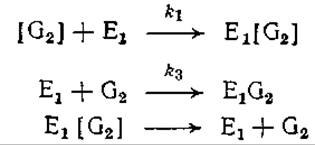
Here, [G2] and G2 denote insoluble cellulose and soluble cellobiose, respectively, and E1 is The enzyme catalyzing the rate-limiting step of cellobiose formation.
a) Assume that no Glucose is formed in the absence of ß-glucosidase. Derive the corresponding expressions comprehensively describing the dependence of g2 on time for both competitive and noncompetitive inhibition.
b) Show that plotting g2/t against (1/t)ln(s0/g2) makes it possible to distinguish between uninhibited, competitively inhibited, and noncompetitively inhibited systems. Why is it preferable in this case to use g2 rather than the unreacted Substrate Concentration? [It has been experimentally demonstrated that this system exhibits noncompetitive inhibition; see Howell J. A., Stuck J. D., Kinetics of Solka floe Hydrolysis by Trichoderma viride Cellulase; Biotech. Bioeng., 17, 873 (1975).]
4.5. Biocatalyst Selection for Reaction-Limited Regimes. Acetyl-L-Tyrosine ethyl ester (ATEE) is hydrolyzed by immobilized a-Chymotrypsin at a specific volumetric rate of 18.4 µmol of ATEE per 1 cm3 per second. The effective diffusion coefficient of ATEE is found to be approximately 3.8∙10-6 cm2/s. What should be the radius of the spherical biocatalyst particles chosen to study the kinetic Properties of the immobilized enzyme under reaction-limited conditions?
4.6. Masking of Immobilized Enzyme inactivation by Mass Transfer. Let us consider an immobilized enzyme that irreversibly loses its activity in accordance with equation (3.78). Assume that the substrate conversion is an approximately first-order reaction.
a) Suppose that the enzyme is immobilized on the outer surface of a substrate-impermeable solid support and that at t = 0 the Damköhler number is large. Sketch the effectiveness factor and the reaction rate as Functions of time. What erroneous Conclusions regarding The Effect of immobilization on enzyme stability might be drawn if appropriate corrections for mass transfer effects are not introduced?
b) Answer the same question for another situation, where the enzyme is immobilized inside a substrate-permeable slab. Assume that the external mass transfer resistance is relatively small.
4.7. Hysteresis; Effect of pH on Immobilized Papain. Studies of a pH electrode with papain immobilized on its surface reveal that the dependence of the pH generated at the electrode surface (internal pH) on the bulk solution pH at different directions of pH variation is represented by distinct curves. [In this case, the hydrolysis of benzoyl-L-Arginine ethyl ester (BAEE) to the corresponding acid was studied; see the figure in the paper: Naparstek A., Romette J. L., Kernevez J. P., Thomas D., Nature, 249, 490 (1974).]
a) Assuming that s0 ≫ Km, the enzyme layer is very thin, and papain activity is maximal at pH 6.0, show that this phenomenon can be attributed to external mass transfer resistance.
b) The kinetic constants for this reaction catalyzed by the soluble enzyme at pH 6.0 and 20 °C are: k2 = 19 international units (one international unit is defined as the number of micromoles of BAEE hydrolyzed by 1 mg of enzyme per min), K1 = 5∙10-3 M. Find the hydrogen ion mass transfer coefficient and the value of the enzyme pK2 corresponding to these constants, provided that a mg/cm2 of enzyme is deposited on the electrode surface and The activity of the immobilized enzyme is only 6% of that of the soluble enzyme. (In all cases, s ≫ Km.)
c) Using the determined pK2 value and the parameters given in the previous part of the problem, calculate the effectiveness factors at various external pH values; plot the effectiveness factor versus external pH. In some cases, the coefficient should exceed unity, and at certain pH values, the problem may have multiple solutions. [See also the work: Bailey J. E., Chow M. T. C., Biotech. Bioeng., 16, 1345 (1974).]
4.8. Stoichiometry of Reactions Within a Catalyst Particle. Within a porous immobilized enzyme particle, the enzyme-catalyzed reaction proceeds as follows:

where a, β, γ, and δ are stoichiometric coefficients.
a) Using the material balance equations for the substrates and reaction products, derive expressions that determine the concentrations of all species inside the catalyst particle in terms of the concentration S1 (at the same point in the particle), the concentrations at the outer surface of the particle, as well as the effective diffusion coefficients of the substrates and products.
b) Show that a reactant with limited solubility in the reaction medium will limit the reaction rates inside the immobilized enzyme particle.
4.9. Reversible Glucose Isomerization in a Packed-Bed Column. The industrially important process of isomerizing glucose to fructose is carried out in a fixed-bed column reactor using immobilized glucose isomerase; the kinetics of this enzyme-catalyzed reaction are described by the reversible Michaelis–Menten equation [equation (3.18)].
a) Show that substituting s = s - se (where se is the equilibrium concentration) into the aforementioned equation leads to a simple Michaelis–Menten equation (with respect to s). How will the apparent Michaelis constant (Kapp) and maximum velocity (vapp) be expressed in this equation?
b) The variation of s as a function of position in a one-dimensional fixed-bed catalyst with porosity ε and average superficial velocity uz can be described by the equation

with a single boundary condition: s = s0 - se at z = 0. By integrating this expression, find another equation that determines the reactor operating parameters in terms of the space time (τ), defined as τ = L(1 - ε)/εuz [The ratio of the reactor (catalyst) volume to the volumetric flow rate].
c) Consider a slowly inactivating immobilized enzyme situated in the fixed-bed reactor described in part (b) of this problem. If the inactivation process obeys the law e(act.) = e(t = 0)exp(-kdt), find, using suitably modified data from the previous problem, the function f[s0, vm,app > s(L)], the plot of which versus time t would allow the determination of both τ and kd.
4.10. Immobilized Enzyme Catalyst with Nonuniform Enzyme Distribution. Assuming that the catalyzed reaction is first-order, compare the overall rates and effectiveness factors when an enzyme immobilized in a porous slab, having the same total amount of enzymatic activity units, is:
a) distributed uniformly throughout the entire volume of the slab;
b) concentrated and uniformly distributed in the outer layer of the slab near the outer catalyst surface, while being completely absent from the inner region, the thickness of which is equal to half the slab thickness.
4.11. Simultaneous Estimation of Reaction Kinetics and Mass Transfer Parameters. The enzyme is immobilized On the surface of a nonporous solid. Assuming that external mass transfer resistance cannot be neglected and that the intrinsic kinetics of the enzymatic reaction are described by the Michaelis–Menten equation:
a) find an expression that clearly defines the coordinates in a Lineweaver–Burk plot; using this equation, express the apparent maximum velocity (vmaxapp) and apparent Michaelis constant (Kmapp) in terms of the true variables vmax, Km, and ks (the mass transfer coefficient);
b) show how the parameters vmax, Km, and ks can be determined graphically if data are available for a sufficiently wide range of substrate concentrations.
4.12. Kinetics of Charged-Species Reactions with Immobilized Enzymes. The concentration of a charged species (substrate, inhibitor) at a charged matrix, such as an enzyme membrane, can be expressed by the following equation:

where z is the ionic charge of the substrate or inhibitor; e is the electron charge; ψ is the electrostatic potential of the membrane (ψ (solution) = 0). Show that the apparent values of Ks and K1 are determined by the expression

if concentrations are considered in the bulk of the entire solution. Assuming that e, e-, e2- are present in the membrane (where e- is the active form of the enzyme), show that the maximum initial reaction rate (neglecting the effect of mass transfer) is achieved in the case of an enzyme carrier matrix with ψ defined by the equation

where a = ezeψ/RТ and h0 = [Н+] in the bulk solution.
4.13. Microencapsulation; ß-galactosidase. Lactose hydrolysis by ß-galactosidase is inhibited by the reaction product, and therefore the equation expressing the rate of this reaction has the form

To facilitate the Separation of ß-galactosidase from milk, the enzyme solution is enclosed in nitrocellulose microcapsules with a diameter of about 30 µm.
a) Plot the Lineweaver–Burk graph for p = 0; 0.5; 1.5; 5, and 10 mM (e0 = 75 mg per 100 ml) given that vm = kpe0, kp = 0.57 µmol/(mg enzyme per minute), Km = 0.54 mM, Ki = 1.5 mM.
b) Based on the graph from part (a) of the problem, without using the equation given in the condition, plot 1/v versus 1/s for a batch process under the following initial conditions:
Sq, mM |
0.5 |
5.0 |
10.0 |
5.0 |
р0, mM |
0 |
0 |
0 |
5.0 |
c) Show that even at the maximum possible reaction rate within the microcapsule in the system described in part (a), the process rate is reaction-limited, i.e., the diffusion of the substrate and reaction product occurs faster than the reaction itself [see: Wadiak D. Т., Carbonell R. G., Kinetic Behavior of Microencapsulated ß-Galactosidase, Biotech. Bioeng., 17, 1157 (1975)].
4.14. Membrane bioreactor. The enzyme is retained in a continuous-flow bioreactor by a semipermeable membrane. The active enzyme is inactivated during a first-order reaction with a rate constant kd. The constancy of product composition is maintained by the gradual Introduction of the active enzyme into the reactor so that the active Enzyme Concentration therein remains constant at ea. A gel-like enzyme layer concentrates on the membrane, increasing the resistance to solution flow; therefore, to maintain a constant flow rate J of the reaction mixture through the membrane, the pressure drop across the membrane must be continuously adjusted. At the same time, the required flow rate J can only be achieved if the total enzyme concentration etot (the sum of active and inactive forms) does not exceed a certain maximum allowable value determined by the equation
emax = es exp (—J/ke)
where es is the enzyme saturation concentration and ke is the enzyme mass transfer coefficient.
a) Determine the dependence of the total enzyme concentration in the reactor on time.
b) If the flow rate drops below J, the process must be stopped and the reactor cleaned. Determine the maximum continuous operation time of the reactor tmах as a function of J.
c) Find the value of J that yields the maximum amount of reaction product during the period of continuous reactor operation (0 ≤ t ≤ tmax) at e0 = 5 kg/m3, es = 100 kg/m3, kе = 0.017 mm/s, kd = 0.018 day-1.
d) Solve problem (c) at e0 = 50 kg/m3 (all other parameters remaining unchanged).
e) How does the inactivation rate constant kd affect the value of J determined from the conditions of problem (c)? What other economically important parameters are affected by kd?
Most of the works cited at the end of Chapter 3 contain material relevant to the topics of this chapter as well. In addition, many problems of enzyme technology are discussed in A number of other publications, including:
1. Tauber H., The Chemistry and Technology of Enzymes, John Wiley and Sons, Inc., New York, 1949.
2. Underkofler L. A., Manufacture and Use of Industrial Microbial Enzymes, Bioeng. Food Process. CEP Symp. Ser. no. 69, 62, 11 (1966).
3. Faith W. TNeubeck С. E., Reese E. T., Production and Application of Enzymes, Advan. Biochem. Eng., 1, 77 (1971).
4. Arima K., Microbial Enzyme Production, in Global Impacts of Applied Microbiology, Starr M. P. (ed.), John Wiley and Sons, Inc., New York, 1964.
5. Wolnak B. et al., The Present and Future Technological Status of Enzymes, U.S. Dept. Commerce Doc., PB-219636, Natl. Tech. Inf. Serv., December 1972.
6. Aunstrup K., Enzymes of Industrial Interest: Traditional Products, in Annual Reports on Fermentation Processes, Perlman D. (ed.), vol. 2, Academic Press, New York, 1978.
7. Godfrey T., Reichelt J., Industrial Enzymology, Macmillan Publishers Ltd., London, 1983.
The monographs and collections listed below provide valuable information on the production, identification, and application of immobilized enzymes:
8. Guilbault G. G.. Enzvmatic Methods of Analysis, Pergamon Press, New York, 1970.
9. Zaborsky O. R., Immobilized Enzymes, CRC Press, Cleveland, Ohio, 1973.
10. Insolubilized Enzymes, Salmona M., Saronio C., Garatlin S. (eds.), Raven Press, New York, 1974.
11. Olson A. C., Cooney C. L., Immobilized Enzymes in Food and Microbial Processes, Plenum Press, New York, 1974.
12. Immobilized Enzymes for Industrial Reactors, Messing R. A. (ed.), Academic Press, Inc., New York, 1975.
13. Immobilized Enzymes, Mosbach К. (ed.). Methods in Enzymology, vol. XLIV (Colwick S. P., Kaplan N. O., eds.-in-chief), Academic Press, New York, 1976.
14. Immobilized Enzymes, Research and Development, Chibata I. (ed.), Halsted Press, New York, 1978.
15. Characterization of Immobilized Biocatalysts, Buchholz K., (ed.), DECHEMA Monographs No. 1724—1731, vol. 31, Verlag-Chemie, Weinheim, 1979.
16. Chibata I., Tosa T., Sato T., Mori T., Matsuo Y., Preparation and Industrial Application of Immobilized Aminoacylases, in Fermetation Technology Today, Terui G. (ed.), p. 383, Society of Fermentation Technology, Japan, 1972.
17. Wang S. S., King С.-K., The Use of Coenzymes in Biochemical Reactors in Advances in Biochemical Engineering, vol. 12, Ghose T. K., Feichter A., Blakebrough N. (eds.), p. 119, Springer Verlag, New York, 1979.
18. Klibanov A. AL, Stabilization of Enzymes by Immobilization, Analyt. Biochem., 93, 1 (1979).
Two valuable review articles on cellulose and "cellulase" have been published:
19. Lee У. Ft., Fan L. Т., Properties and Mode of Action of Cellulase; Kinetics of Hydrolyses of Insoluble Cellulose by Cellulase, in Advances in Biochemical Engineering, vol. 17, p. 101, 131, Fietcher A., (ed.), Springer Verlag, New York, 1980.
The works cited below provide a detailed examination of the relationship between Chemical Reactions and mass transfer. Some of them focus primarily on biological systems, while others deal with synthetic catalysts. As previously noted, the material presented in the latter can readily be applied to biological systems with only minor adjustments in terminology and notation.
20. Atkinson В., Biochemical Reactors, Pion Ltd., London, 1974.
21. Weisz P. W., Diffusion and Chemical Transformation: An Interdisciplinary Excursion, Science, 179, 433 (1973).
22. Satterfield C. N., Mass Transfer in Heterogeneous Catalysis, MIT Press, Cambridge, Mass., 1970.
23. Petersen E. E., Chemical Reaction Analysis, Prentice-Hall, Inc., Englewood Cliffs, N.J., 1965.
24. Ans R., The Mathematical Theory of Diffusion and Reaction in Permeable Catalysts, vol. 1, The Theory of the Steady State, vol. 2, Questions of Uniqueness, Stability and Transient Behavior, Clarendon Press, Oxford, 1975.
The multi-volume series under the general title Enzyme Engineering publishes papers presented at the biennial enzyme engineering conferences organized by the Engineering Foundation. The first volume was published by Wiley-Interscience (New York, 1972); subsequent volumes were issued by Plenum (New York) and also published in the Annals of the New York Academy of Sciences.
Last update: 06/08/2026
Editorial and Educational Adaptation: This material has been compiled based on the primary/original source text. The project team performed an editorial review, corrected technical inaccuracies, structured sections, and adapted the content for an educational format.
What was processed:
- elimination of formatting defects (OCR errors, structural breaks, corrupted characters);
- editorial organization of content;
- standardization of terminology in accordance with academic sources;
- verification of factual statements against the original source text.
All mentions of the author, publication year, and origin of the primary text have been preserved in accordance with the source.