Harper's Illustrated Biochemistry, Volume 1 - Murray R. 1993
Structure and Functions of Proteins and Enzymes
Enzymes: Kinetics
Michaelis–Menten Equation
Graphical Determination of the Michaelis constant KM
The Substrate Concentration at which the velocity is equal to half of the maximum is denoted by KM and is called the Michaelis constant. It can be determined from the plot of v versus [S] (Fig. 8.14). Note that KM has the dimensions of molar concentration.
When [S] approaches KM, v becomes highly sensitive to changes in [S]; in this region, the enzyme operates at half-maximal velocity. Many Enzymes are characterized by KM values that roughly correspond to the physiological concentrations of their substrates.
The Michaelis–Menten equation
Class="center">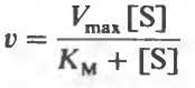
describes The behavior of many enzymes as substrate concentration changes. Using this equation, the dependence of the initial velocity of an enzymatic reaction on [S] and KM can be illustrated by the following specific Examples.
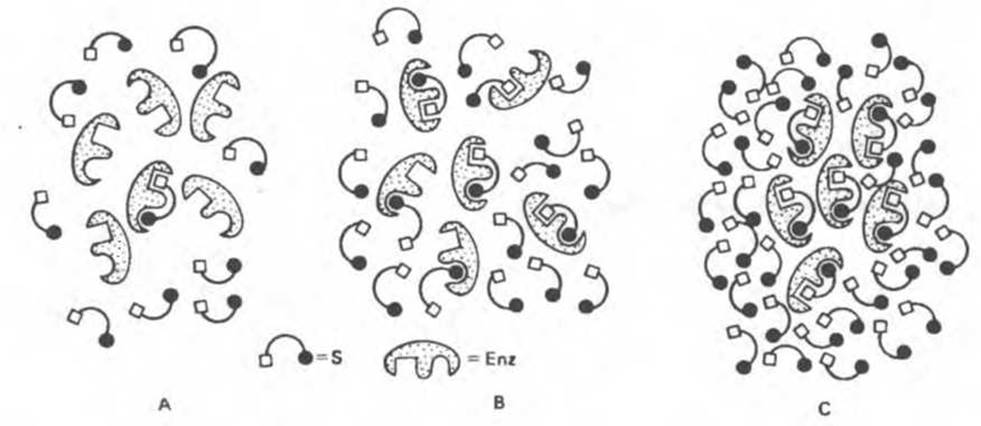
Fig. 8.15. Diagram illustrating enzyme-substrate binding at low (A) and high (C) substrate concentrations, as well as at a substrate concentration equal to KM (B). States A, B, and C correspond to points A, B, and C on the curve shown in Fig. 8.14.
1. [S] is much less than KM (point A in Figs. 8.14 and 8.15). In this case, the term [S] in the denominator can be neglected, and the denominator is practically equal to KM. The ratio of the two constants, Vmаx and KM, can be replaced by a new constant k. Thus, we have:

(≃ means "approximately equal to").
In other words, when the substrate concentration is significantly lower than the concentration at which the reaction velocity is half-maximal (i.e., significantly less than KM), the initial velocity v is proportional to the substrate concentration [S].
2. [S] is much greater than KM (point C in Figs. 8.14 and 8.15). In this case, the term KM in the denominator can be omitted, i.e.

This means that at a substrate concentration [S] far exceeding KM, the initial velocity v is equal to the maximum velocity Vmax.
3. [S] = KM (point B in Figs. 8.14 and 8.15).

This means that at a substrate concentration equal to KM, the initial reaction velocity v is half of the maximum. This also suggests a method for estimating KM: experimentally determining the substrate concentration at which the initial velocity is equal to half of the maximum.
For many enzymes, determining Vmax (and hence KM) directly from the plot of v versus [S] is difficult. To overcome this, the reciprocal of the Michaelis–Menten equation is used, i.e.
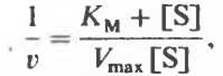
and its right-hand side is expressed as the sum of two terms:
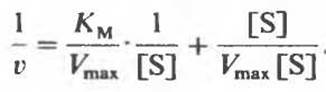
Hence, upon simplification, we obtain
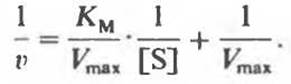
Thus, we obtain the equation of a straight line
y = ax + b,
where y = 1/v and x = 1/[S].
If we plot y (i.e., 1/v) against x (i.e., 1/[S]), the intercept on the y-axis, b, will be equal to 1/Vmах, and the slope, a, will be KM/Vmax. The intercept on the x-axis (in the negative region) can be found by Setting y to zero. Thus
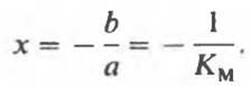
The double-reciprocal plot of the Michaelis—Menten equation is known as a Lineweaver—Burk plot (Fig. 8.16). From it, KM can be determined either from the slope and the y-intercept or from the x-intercept in the negative region. Since [S] has the dimensions of molar concentration, KM is also expressed in moles per liter. The velocity v can be expressed in any units, since KM is independent of [Enz.]. The reciprocal plot allows KM to be determined using a relatively small number of data points, which is why it is frequently used to find KM.
When using the Lineweaver—Burk plot in practice to estimate KM, one often finds that almost all data points cluster in the region of low substrate concentrations. This happens when measurements are taken at equal intervals of [S]. To avoid this, measurements should be carried out at values of [S] corresponding to equal intervals on the reciprocal scale.
An alternative approach to the experimental estimation of KM and Vmах was proposed by Eadie and Hofstee. The Michaelis—Menten equation can be rearranged to the form
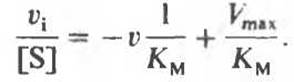

Fig. 8.16. Lineweaver—Burk double-reciprocal plot (1/v versus 1/[S]), used for the graphical Determination of kM and Vmax.
To find KM and Vmax, a plot of v/[S] (y-axis) versus v (x-axis) is constructed. In this case, the y-intercept equals Vmах/KM, and the x-intercept equals Vmax. The slope is equal to —1/KM.
Although the Lineweaver—Burk and Eadie—Hofstee equations are quite convenient in certain cases, rigorous determination of KM and Vmах requires appropriate statistical analysis.
Estimates of KM are of great practical value. At substrate concentrations 100 times greater than KM, the enzyme operates at virtually maximum velocity; therefore, the maximum velocity (Vmax) reflects The amount of active enzyme present. This crucial fact is utilized to estimate Enzyme Concentration in a preparation. The value of KM serves as a guide for how much substrate should be added to determine Vmax. Reciprocal plots are also widely used in evaluating the action of inhibitors.
The relationship between KM and Kd, the dissociation constant of the enzyme-substrate complex,
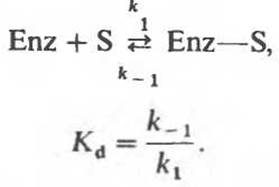
The affinity of an enzyme for its substrate is inversely proportional to the dissociation constant Kd of the Enz—S complex:
In other words, the lower the tendency of the enzyme-substrate complex to dissociate, the higher the affinity of the enzyme for the substrate.
The value of KM for a given enzyme-substrate pair can serve as a rough measure of Kd. However, this is valid only if the assumption made in deriving the Michaelis—Menten equation holds true. This assumption states that the first step of the enzymatic reaction
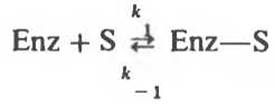
is rapid and that equilibrium is constantly maintained at this stage. In other words, The rate of dissociation of Enz—S into Enz + S is much higher,
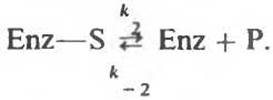
It follows from the Michaelis—Menten equation that the value of [S] at which
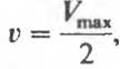
equals
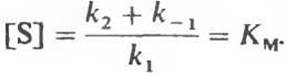
But if
k-1 » k2,
then
k2 + k ≃ k-1
and
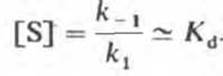
Under these conditions, 1/KM = 1/KM and equals the affinity of the enzyme for the substrate. If k2 + k-1≉ k-1, then 1/KM will yield an underestimated value of the affinity.
Last update: 06/08/2026
Editorial and Educational Adaptation: This material has been compiled based on the primary/original source text. The project team performed an editorial review, corrected technical inaccuracies, structured sections, and adapted the content for an educational format.
What was processed:
- elimination of formatting defects (OCR errors, structural breaks, corrupted characters);
- editorial organization of content;
- standardization of terminology in accordance with academic sources;
- verification of factual statements against the original source text.
All mentions of the author, publication year, and origin of the primary text have been preserved in accordance with the source.