Biochemistry - The Chemical Reactions of Living Cells, Volume 2 - D. Metzler 1980
Types of reactions catalyzed by enzymes
Multiple displacement reactions and the coupling of ATP cleavage reactions with endergonic processes
General mechanism of formation of thioesters, esters, and amides
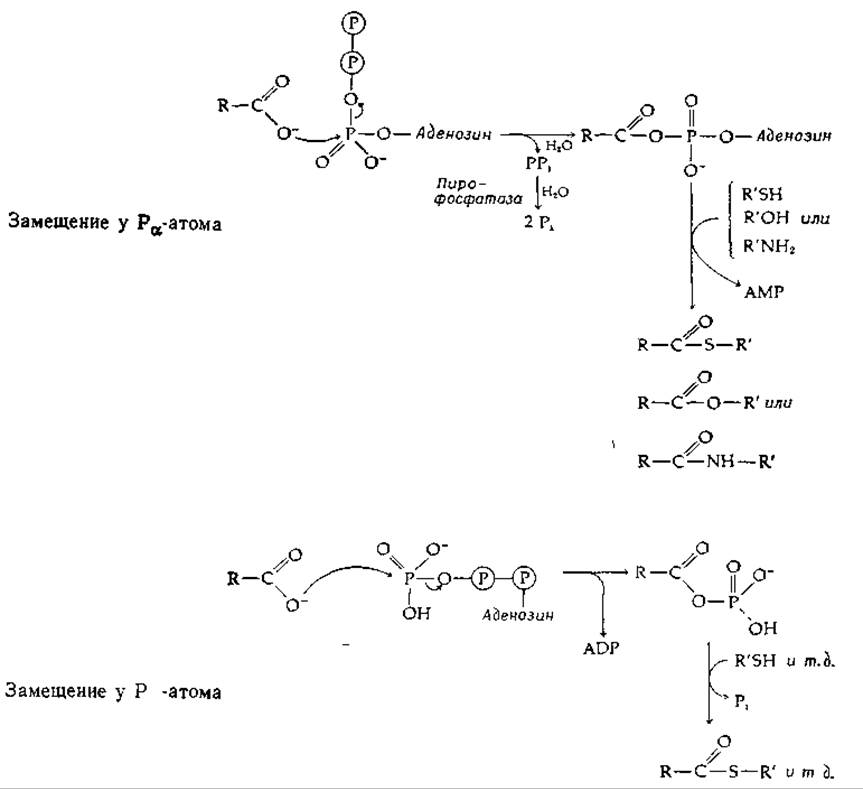
The reaction sequences shown in equations (7-29) and (7-30) represent the general mechanism employed by Cells to attach carboxylic acids to —OH-, —SH, and —NH2 groups. For example, the reaction sequence in (7-30) is involved in The formation of aminoacyl-tRNA molecules required for Protein Synthesis. The Mechanism of these reactions is outlined in Table 7-2. Depending on the type of product formed (thioester, ester, or amide), the reactions are designated as S1A, S1B, or S1C. The symbols a and y indicate the site of ATP Cleavage: at Pa or at Py. For instance, the Formation of Acetyl-CoA in eukaryotes proceeds via the S1A(a) mechanism. Notably, this sequence includes the Hydrolysis of inorganic pyrophosphate (PPi) to inorganic phosphate (Pi), whose role in coupling ATP cleavage with Biosynthesis is discussed below (Chapter 11, Section B, 2).
Despite these generalizations, each specific enzyme possesses its own unique features. The action of succinyl-CoA synthetase (succinate thiokinase) from E. coli likely proceeds via the S1A(y) mechanism, with succinyl phosphate serving as an intermediate:
Class="center">
Designation of reaction sequences used in this book:
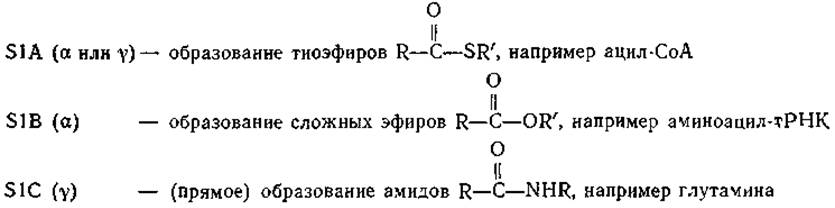
aThe purpose of successive substitutions at the P atom and subsequently at the C atom is to couple small molecules in a process driven by the cleavage of ATP or a related compound. ATP cleavage may occur at either the Pa or Py atom.
However, the initial step may involve the formation of a phosphoenzyme in which the phosphate group is attached to the N3 atom of the Histidine side chain belonging to the a subunit of the a2ß2 tetramer [88, 88a, b].
Glutamine synthesis, catalyzed by Glutamine Synthetase, presumably proceeds via the S1C(y) type. However, direct Evidence for the Formation of the putative y-glutamyl phosphate intermediate is still lacking. Partial isotope exchange reactions, which would theoretically be expected to accompany such a synthesis, have not been observed [89]. Apparently, the acyl phosphate generated as an intermediate is short-lived, and all three reactants must bind to the enzyme simultaneously for the Active Site to become functional. Evidence that acyl phosphate formation does indeed occur [90, 91] is provided by the Isolation of the internal amide of glutamic acid, 5-oxoproline (pyrrolidonecarboxylic acid), and the reduction of the intermediate with sodium borohydride to the corresponding alcohol:

Because direct proof of acyl phosphate formation as an intermediate proved difficult to obtain, it has been suggested that glutamine synthetase and certain Other Enzymes catalyzing multiple-displacement reactions might operate via a "fully concerted" mechanism. In this scenario, both displacement steps would occur simultaneously through a single "key Transition State," as illustrated in the scheme for glutamine synthetase below:

However, no convincing evidence has been obtained to date in support of such a mechanism for any chemical reaction. It appears far more likely that enzymatic reactions proceed through a series of discrete steps.
Last update: 06/08/2026
Editorial and Educational Adaptation: This material has been compiled based on the primary/original source text. The project team performed an editorial review, corrected technical inaccuracies, structured sections, and adapted the content for an educational format.
What was processed:
- elimination of formatting defects (OCR errors, structural breaks, corrupted characters);
- editorial organization of content;
- standardization of terminology in accordance with academic sources;
- verification of factual statements against the original source text.
All mentions of the author, publication year, and origin of the primary text have been preserved in accordance with the source.