BIOCHEMISTRY - L. Stryer - 1984
VOLUME 2
PART II: GENERATION AND STORAGE OF METABOLIC ENERGY
CHAPTER 18. AMINO ACID DEGRADATION AND THE UREA CYCLE
18.3. Serine and Threonine Can Be Deaminated Directly
The α-amino groups of Serine and Threonine can be converted directly into NН4 because each of these Amino Acids possesses a hydroxyl group in its side chain. These direct deamination reactions are catalyzed by serine dehydratase and Threonine dehydratase, both of which require PLP as a prosthetic group.
Serine + Pyruvate + NH4+,
Threonine → α-Ketobutyrate + NН4+.
These Enzymes are called dehydratases because the deamination steps they catalyze are preceded by dehydration. Serine loses a hydrogen atom from its α-carbon and a hydroxyl group from its β-carbon to form aminoacrylate. This unstable compound reacts with H2O to yield pyruvate and NН4+.
18.4. In Most Terrestrial Vertebrates, Excess Nitrogen Is Converted into Urea and Excreted
A portion of the NН4+ generated during amino acid degradation is utilized in The Biosynthesis of nitrogen-containing compounds. In most terrestrial vertebrates, excess NН4+ is converted into urea and excreted in this form. In Birds and terrestrial reptiles, NН4+ is converted into uric acid for excretion, whereas many aquatic animals excrete it directly as ammonia. These three groups of organisms are referred to as ureotelic, uricotelic, and ammonotelic, respectively.
Class="center">
Fig. 18.4. The Urea Cycle

In terrestrial vertebrates, urea is synthesized via the urea cycle. This pathway of reactions was proposed by Hans Krebs and Kurt Henseleit in 1932—five years before the discovery of The Tricarboxylic Acid Cycle. Indeed, the urea cycle was the first cyclic metabolic pathway ever discovered. One of the nitrogen atoms of urea synthesized in this cycle is derived from ammonia, and the other from aspartate. The carbon atom of urea originates from СO2. Ornithine serves as the carrier that transports these carbon and nitrogen atoms through the urea cycle.
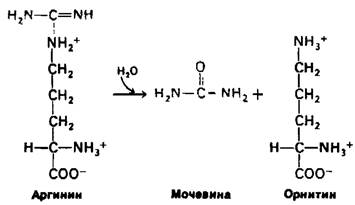
The immediate precursor of urea is Arginine, which is hydrolyzed by arginase to yield urea and ornithine. The remaining Reactions of the urea cycle accomplish the synthesis of arginine from ornithine. First, a carbamoyl group is transferred to ornithine to form citrulline, a reaction catalyzed by ornithine transcarbamylase. The donor of the carbamoyl group in this reaction is carbamoyl phosphate, which has a high group-transfer potential owing to its anhydride bond.
Argininosuccinate synthetase subsequently catalyzes the Condensation of citrulline and aspartate. This synthesis of argininosuccinate is driven by the Cleavage of ATP to AMP and pyrophosphate, followed by the subsequent Hydrolysis of pyrophosphate.


In the final step, argininosuccinase cleaves argininosuccinate into arginine and fumarate. Notably, through these Reactions Involving the transfer of the amino group of aspartate to form arginine, the carbon Skeleton of aspartate is preserved.

Carbamoyl phosphate is synthesized from NH4+, СO2, ATP, and H2O in a complex reaction catalyzed by carbamoyl phosphate synthetase. An unusual property of this enzyme is its absolute requirement for N-acetylglutamate for catalytic activity.

The consumption of two ATP molecules renders the synthesis of carbamoyl phosphate effectively irreversible.
18.5. The Urea Cycle is Linked to the Tricarboxylic Acid Cycle
The stoichiometry of urea synthesis is as follows:
СO2 + NH4 ++ ЗАТР + Аспартат + 2Н2O → Мочевина + 2ADP + 2 Pi + АМР + PPi + Фумарат.
Pyrophosphate is rapidly hydrolyzed, meaning that four high-energy phosphate bonds are consumed in the synthesis of a single urea molecule. The synthesis of fumarate plays a crucial role in the urea cycle because it interconnects the urea cycle and the tricarboxylic acid cycle (Fig. 18.5). Fumarate is hydrated to malate, which is subsequently oxidized to oxaloacetate. For this key intermediate, several metabolic fates are possible: 1) it can undergo Transamination to yield aspartate; 2) it can be converted into glucose via Gluconeogenesis; 3) it can condense with acetyl-CoA to form citrate.
Fig. 18.5. The urea cycle, the tricarboxylic acid cycle, and the transamination of oxaloacetate are interconnected via fumarate and aspartate

Another remarkable feature is the compartmentalization of the urea cycle and its associated reactions. The production mediated by Glutamate dehydrogenase, its incorporation into carbamoyl phosphate, and the subsequent synthesis of citrulline all take place within the mitochondrial matrix. In contrast, the next Three Reactions of the urea cycle, which lead to The formation of urea, occur in the Cytosol.
Last update: 06/08/2026
Editorial and Educational Adaptation: This material has been compiled based on the primary/original source text. The project team performed an editorial review, corrected technical inaccuracies, structured sections, and adapted the content for an educational format.
What was processed:
- elimination of formatting defects (OCR errors, structural breaks, corrupted characters);
- editorial organization of content;
- standardization of terminology in accordance with academic sources;
- verification of factual statements against the original source text.
All mentions of the author, publication year, and origin of the primary text have been preserved in accordance with the source.