BIOCHEMISTRY - L. Stryer - 1984
VOLUME 2
PART II GENERATION AND STORAGE OF METABOLIC ENERGY
CHAPTER 18. AMINO ACID DEGRADATION AND THE UREA CYCLE
Unlike Fatty acids and glucose, Amino Acids in excess of the amount required for Protein Synthesis AND other Biomolecules cannot be stored, nor are they excreted. Excess amino acids serve as metabolic fuel; the α-amino group is removed, and the remaining carbon Skeleton is converted into major metabolic intermediates. Most of the amino groups from excess Amino acids are channeled into urea formation, whereas their carbon skeletons are transformed into acetyl-CoA, acetoacetyl-CoA, Pyruvate, or one of the intermediates of The Tricarboxylic Acid Cycle. Consequently, fatty acids, Ketone Bodies, and glucose can be synthesized from amino acids.
18.1. α-Amino Groups Are Converted into Ammonium Ions by Oxidative Deamination of Glutamate
In mammals, amino acids are degraded primarily in the Liver. We shall first examine The Fate of the α-amino group and subsequently that of the carbon skeleton. The α-amino group of Most amino acids is transferred to α-oxoglutarate to yield glutamate, which then undergoes Oxidative Deamination to yield.
The transfer of an α-amino group from an α-amino acid to an α-oxo acid is catalyzed by aminotransferases, also referred to as transaminases.
Glutamate aminotransferase, the most important of these Enzymes, catalyzes the transfer of an amino group to α-oxoglutarate.
α-Amino acid + α-Oxoglutarate ⇄ α-Oxo acid + Glutamate.
Alanine aminotransferase, which is also prevalent in mammalian Tissues, catalyzes the transfer of an amino group to pyruvate,
α-Amino acid + Pyruvate ⇄ α-Oxo acid + Alanine.
Class="center">
The resulting alanine can transfer its amino group to α-oxoglutarate to form glutamate. These two aminotransferases act as a kind of "funnel," channeling amino groups from various amino acids into glutamate for subsequent conversion into NH4.
The ammonium ion is formed from glutamate via oxidative deamination. This reaction is catalyzed by Glutamate dehydrogenase, which has the unusual ability to use both NAD+ and NADP+.
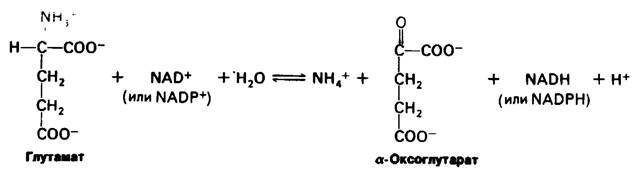
Glutamate dehydrogenase activity is regulated allosterically. The vertebrate enzyme consists of six identical subunits capable of further polymerization. Guanosine triphosphate (GTP) and adenosine triphosphate (ATP) act as allosteric inhibitors, whereas guanosine diphosphate (GDP) and adenosine diphosphate (ADP) serve as allosteric activators. Consequently, a decrease in energy charge accelerates amino acid oxidation. The transformations catalyzed by aminotransferases and glutamate dehydrogenase are described by the following overall reaction:
α-Amino acid + NAD+ + Н2O ⇄ α-Keto acid + NH+4+ NADH + H+
(or NADP+) (or NADPH).

In terrestrial vertebrates, it is converted into urea, which is subsequently excreted in the urine. We will examine urea synthesis in detail later.
18.2. Pyridoxal phosphate, the prosthetic group of aminotransferases, forms Schiff bases as intermediates
The prosthetic group of all aminotransferases is Pyridoxal phosphate (PLP), a derivative of pyridoxine (vitamin B6). During Transamination, pyridoxal phosphate is temporarily converted into pyridoxamine phosphate (PMP).
PLP enzymes form Schiff bases with substrates as reaction intermediates. In the absence of a substrate, the aldehyde group of pyridoxal phosphate is linked in a Schiff base to the ε-amino group of a specific Lysine residue within the Active Site. Upon addition of The amino acid substrate, a new Schiff base is formed: the α-amino group of the amino acid substrate displaces the ε-NH2 group of lysine in the active site. The resulting Schiff base between the Amino Acid and pyridoxal phosphate remains firmly bound to the enzyme via non-covalent interactions.

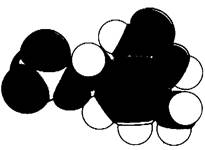
Fig. 18.1. Spatial model of pyridoxal phosphate
This Schiff base and the Schiff base formed between pyridoxal phosphate and the active-site lysine are aldimines. During catalysis, THE POSITION OF the double bond in the Schiff base between the amino acid and pyridoxal phosphate shifts to form a ketimine, which is subsequently hydrolyzed to pyridoxamine phosphate and an α-oxo acid. The reaction mechanism proposed by Esmond Snell and Alexander Braunstein is shown in Fig. 18.2. The active-site lysine or another suitably positioned basic group likely facilitates The conversion of the aldimine to the ketimine by acting as an electron sink. These transformations constitute half of the overall reaction:
Amino acid 1 + E-PLP ⇄ α-Oxo acid 1 + E-PMP.
Fig. 18.2. Proposed mechanism for transamination reactions
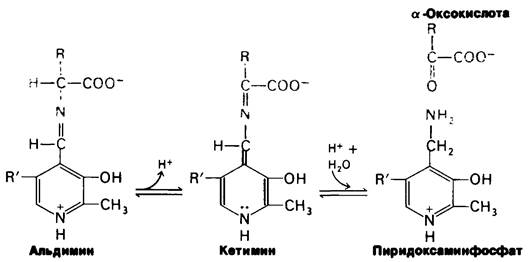
The second half of the overall reaction consists of the reverse of the pathway described above. A second α-oxo acid reacts with the enzyme-pyridoxamine phosphate complex (E-PMP), leading to The formation of a second amino acid and the regeneration of the enzyme-pyridoxal phosphate complex (E-PLP).
α-Oxo acid2 + E-PMP ⇄ Amino acid 2 + E-PLP,
The overall equation for these half-reactions is as follows:
Amino acid1 + α-Oxo acid2 ⇄ Amino acid2 + α-Oxo acid1.
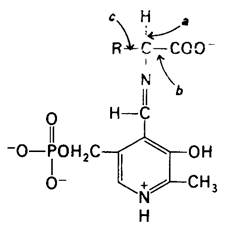
The catalytic versatility of enzymes containing Pyridoxal phosphate as a prosthetic group is remarkable. Transamination is merely one of the many amino acid transformations catalyzed by these enzymes. Other Reactions Involving the α-carbon atom of amino acids include decarboxylation, deamination, racemization, and aldol Cleavage (Fig. 18.3). In addition, pyridoxal phosphate enzymes catalyze elimination and substitution reactions at the β-carbon atom (e.g., Tryptophan synthase; Section 21.9) and the γ-carbon atom (e.g., cystathionase; Section 21.8) of amino acid substrates. All of these reactions share the following common features. First, a Schiff base is formed between the amino acid substrate (the amine component) and pyridoxal phosphate (the carbonyl component). Second, PLP acts as an electron sink, stabilizing negatively charged Intermediates of the catalytic process. The nitrogen atom in the PLP ring "pulls" electrons away from the amino acid substrate. In other words, PLP Functions as an electrophilic catalyst. Third, the resulting Schiff base undergoes subsequent Hydrolysis.
Fig. 18.3. Pyridoxal phosphate enzymes labilize one of the three bonds at the α-carbon atom of the amino acid substrate. For example, bond a is labilized by transaminases, bond b by Decarboxylases, and bond c by aldolases (such as Threonine aldolase). Pyridoxal phosphate enzymes also catalyze reactions at the β- and γ-carbon atoms of amino acids
Last update: 06/08/2026
Editorial and Educational Adaptation: This material has been compiled based on the primary/original source text. The project team performed an editorial review, corrected technical inaccuracies, structured sections, and adapted the content for an educational format.
What was processed:
- elimination of formatting defects (OCR errors, structural breaks, corrupted characters);
- editorial organization of content;
- standardization of terminology in accordance with academic sources;
- verification of factual statements against the original source text.
All mentions of the author, publication year, and origin of the primary text have been preserved in accordance with the source.