BIOCHEMISTRY - L. Stryer - 1984
VOLUME 2
PART II GENERATION AND STORAGE OF METABOLIC ENERGY
CHAPTER 18. AMINO ACID DEGRADATION AND THE UREA CYCLE
18.6. Inherited Enzyme Deficiencies of the Urea Cycle Lead to Hyperammonemia
High concentrations of NH4+ are toxic to humans. The principal pathway for the removal of NH4+ is the synthesis of urea in the Liver. Complete blockage of any of The Urea Cycle steps in the liver is apparently incompatible with life, because no other known pathway for urea synthesis exists. Inherited disorders caused by the partial blockage of one of the urea cycle reactions have been diagnosed. A common feature of such disorders is an elevated Blood concentration of ammonium (hyperammonemia). Almost complete deficiency of any urea cycle enzyme causes coma and results in death shortly after birth. Partial deficiencies of these Enzymes lead to mental retardation, lethargy, and intermittent vomiting. A low-protein diet reduces blood ammonia levels and improves the clinical condition in mild forms of these inherited disorders.
Why is a high concentration of NH4+ toxic? This is likely because a high concentration of ammonium ions shifts the equilibrium of the reaction catalyzed by Glutamate dehydrogenase toward glutamate formation, which leads to the depletion of α-ketoglutarate. The reaction may be further stimulated by the incorporation of NH4+ into glutamate to form glutamine (Section 21.2). The depletion of α-ketoglutarate, an intermediate of The Tricarboxylic Acid Cycle, leads to a reduced rate of ATP formation. The Brain is exceptionally sensitive to decreases in ATP levels.
Class="center">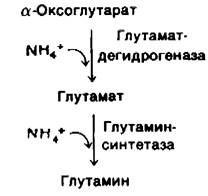
18.7. Fate of Carbon Skeletons of Degraded Amino Acids
We have examined a series of reactions leading to the removal of the α-amino group from Amino Acids and its conversion into urea. We now turn to The Fate of the remaining carbon skeletons. The strategy of amino acid degradation is The formation of major metabolic intermediates that can be converted into glucose or oxidized in the tricarboxylic acid cycle. Indeed, the carbon skeletons of the diverse set of twenty Amino acids are channeled into just seven molecules: Pyruvate, acetyl-CoA, acetoacetyl-CoA, α-ketoglutarate, succinyl-CoA, fumarate, and oxaloacetate. Here we encounter yet another example of the remarkable economy of metabolic transformations.
Amino acids degraded to yield acetyl-CoA or acetoacetyl-CoA are termed ketogenic, because their breakdown increases the level of Ketone Bodies. Amino acids whose degradation leads to pyruvate, α-ketoglutarate, succinyl-CoA, fumarate, or oxaloacetate are called glucogenic. The feasibility of glucose synthesis from these amino acids is ensured by the fact that these tricarboxylic acid cycle components and Pyruvate can be converted into phosphoenolpyruvate and subsequently into glucose (Section 15.13). Recall that mammals lack a pathway for the direct Synthesis of glucose from acetyl-CoA or acetoacetyl-CoA.
Figure 18.6. The Fate of amino acid carbon skeletons. Glucogenic amino acids are shown in red, ketogenic in yellow.

Of the standard set of twenty amino acids, only leucine is strictly ketogenic. Isoleucine, Lysine, phenylalanine, Tryptophan, and Tyrosine are classified as both Ketogenic and Glucogenic. Some of their carbon atoms appear in acetyl-CoA or acetoacetyl-CoA, whereas others are found in potential glucose precursors. The remaining fourteen amino acids are purely glucogenic.
18.8. The C3 Family of Amino Acids: Alanine, Serine, and Cysteine Are Converted into Pyruvate
Pyruvate serves as an entry point (into the tricarboxylic acid cycle) for the three-carbon amino acids: Alanine, Serine, and Cysteine (Figure 18.7). Transamination of alanine yields pyruvate directly:
Alanine + α-Ketoglutarate ⇄ Pyruvate + Glutamate.
Figure 18.7. Pyruvate as an entry point for alanine, serine, cysteine, Glycine, and Threonine.

As noted above (Section 18.1), glutamate then undergoes Oxidative Deamination, leading to the formation of NH4+ and the regeneration of α-ketoglutarate. The overall reaction of these transformations is described by the equation
Alanine + NAD+ → Pyruvate + NH4+ + NADH + H+
Another simple reaction in amino acid degradation is the deamination of serine to pyruvate by serine dehydratase (Section 18.3):
Serine → Pyruvate + NH4+.
Cysteine can be converted into pyruvate via various pathways, with the sulfur atom appearing as H2S, SO32-, or SCN-.
The carbon atoms of two Other Amino Acids can also be converted into pyruvate. Glycine can be converted into serine by the enzymatic attachment of a hydroxymethyl group (Section 21.5). From threonine, pyruvate can be formed via aminoacetone.
Last update: 06/08/2026
Editorial and Educational Adaptation: This material has been compiled based on the primary/original source text. The project team performed an editorial review, corrected technical inaccuracies, structured sections, and adapted the content for an educational format.
What was processed:
- elimination of formatting defects (OCR errors, structural breaks, corrupted characters);
- editorial organization of content;
- standardization of terminology in accordance with academic sources;
- verification of factual statements against the original source text.
All mentions of the author, publication year, and origin of the primary text have been preserved in accordance with the source.