BIOCHEMISTRY - L. Stryer - 1984
VOLUME 2
PART II GENERATION AND STORAGE OF METABOLIC ENERGY
CHAPTER 18. AMINO ACID DEGRADATION AND THE UREA CYCLE
18.9. The C4-Amino Acid Family: Aspartate and Asparagine Are Converted into Oxaloacetate
Aspartate, a four-carbon amino acid, is directly transaminated into oxaloacetate, an intermediate of The Tricarboxylic Acid Cycle:
Aspartate + α-Ketoglutarate ⇄ Oxaloacetate + Glutamate.
Asparagine is hydrolyzed by the action of asparaginase to yield NH4+ and aspartate, which subsequently undergoes Transamination.
Recall that aspartate can also be converted into fumarate via The Urea Cycle (Section 18.5). Fumarate serves as an "entry point" for half of the carbon atoms of Tyrosine and phenylalanine, as will be briefly discussed below.
18.10. The C5-Amino Acid Family: Certain Amino Acids Are Converted
into α-ketoglutarate via glutamate. The carbon skeletons of several five-carbon Amino Acids enter the tricarboxylic acid cycle as α-ketoglutarate. These Amino acids are converted into glutamate, which then undergoes Oxidative Deamination catalyzed by Glutamate dehydrogenase to yield α-ketoglutarate (Fig. 18.8).
Class="center">Fig. 18.8. α-Ketoglutarate as an "entry point" for certain C5-amino acids that are first converted into glutamate

Histidine is converted into 4-imidazolone-5-propionate (Fig. 18.9). The amide bond in the ring of this intermediate is hydrolyzed to form an N-formimino derivative of glutamate, which is further converted into glutamate by transferring its formimino group to tetrahydrofolate, a carrier of activated one-carbon units (Section 21.6).
Fig. 18.9. Conversion of histidine into glutamate

Glutamine is hydrolyzed by glutaminase to yield glutamate and NH4+. Proline and Arginine are converted into glutamate γ-semialdehyde, which is subsequently oxidized to glutamate (Fig. 18.10).
Fig. 18.10. Conversion of proline and arginine into glutamate

18.11. Succinyl-Coenzyme A as an Entry Point into the Tricarboxylic Acid Cycle for Certain Amino Acids
Succinyl-CoA serves as the compound ("entry point") through which some of the carbon atoms of Methionine, isoleucine, Threonine, and valine enter the tricarboxylic acid cycle. The intermediate formed during the degradation of these four amino acids is methylmalonyl-CoA (Fig. 18.11).
Fig. 18.11. Conversion of methionine, isoleucine, threonine, and valine into succinyl-CoA

The pathway from propionyl-CoA to succinyl-CoA is of particular interest. In the presence of excess ATP, propionyl-CoA is carboxylated to form the D-isomer of methylmalonyl-CoA. This carboxylation reaction is catalyzed by propionyl-CoA carboxylase, a biotin-dependent enzyme whose catalytic mechanism is similar
to that of acetyl-CoA carboxylase and Pyruvate carboxylase. The D-isomer of methylmalonyl-CoA is racemized to the L-isomer, which serves as the substrate for a mutase that converts it into succinyl-CoA.
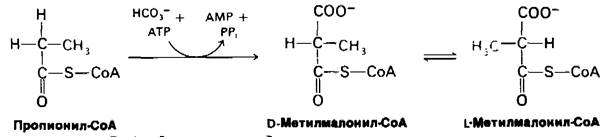
Succinyl-CoA is formed from L-methylmalonyl-CoA via an intramolecular rearrangement. The —CO—S—CoA group migrates from C-2 to C-3 in exchange for a hydrogen atom. This highly unusual isomerization is catalyzed by methylmalonyl-CoA mutase, one of only two known mammalian Enzymes that utilize a vitamin B12 derivative as a coenzyme.

The pathway from propionyl-CoA to succinyl-CoA is also involved in The oxidation of odd-chain Fatty acids. The final thiolytic Cleavage of an acyl-CoA with an odd number of carbon atoms yields acetyl-CoA and propionyl-CoA (see Section 17.11).
Last update: 06/08/2026
Editorial and Educational Adaptation: This material has been compiled based on the primary/original source text. The project team performed an editorial review, corrected technical inaccuracies, structured sections, and adapted the content for an educational format.
What was processed:
- elimination of formatting defects (OCR errors, structural breaks, corrupted characters);
- editorial organization of content;
- standardization of terminology in accordance with academic sources;
- verification of factual statements against the original source text.
All mentions of the author, publication year, and origin of the primary text have been preserved in accordance with the source.