Biochemistry - Chemical Reactions in Living Cells, Volume 2 - D. Metzler 1980
Biosynthesis; how new molecules are formed
Special aspects of fatty acid metabolism
Unsaturated fatty acids and their transformation products
Fatty acids containing one or more unsaturated double bonds provide the necessary fluidity to Cell membranes and serve as precursors for other cellular components. There are notable differences in how double bonds are introduced into fatty acids in animals, Protozoa, Fungi, and certain Bacteria, on the one hand, and in anaerobic bacteria such as E. coli, on the other. In the latter, the primary unsaturated fatty acid is vaccenic acid; it is formed by chain elongation following the Introduction of a cis double bond at the C10 fragment stage. Catalyzed by ß-hydroxydecanoyl thioester dehydratase present in E. coli Cells, the elimination of the ß-hydroxyl group yields predominantly a cis-ß,y- (rather than a trans-a,ß-) unsaturated compound [equation (12-14)]. Mechanistically, this process is analogous to the reverse action of enoyl hydratase [equation (7-42)], wherein the enzyme-bound trans-a,ß-unsaturated intermediate is isomerized to the cis-ß,y-unsaturated compound via an allylic rearrangement. Subsequently, this compound undergoes elongation to C16 and C18 CoA derivatives—namely, palmitoyl-CoA and vaccenoyl-CoA, respectively (Fig. 12-6).
Class="center">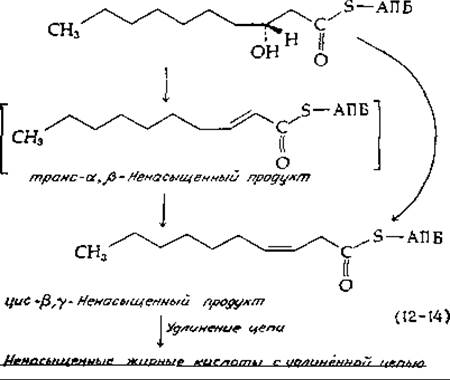
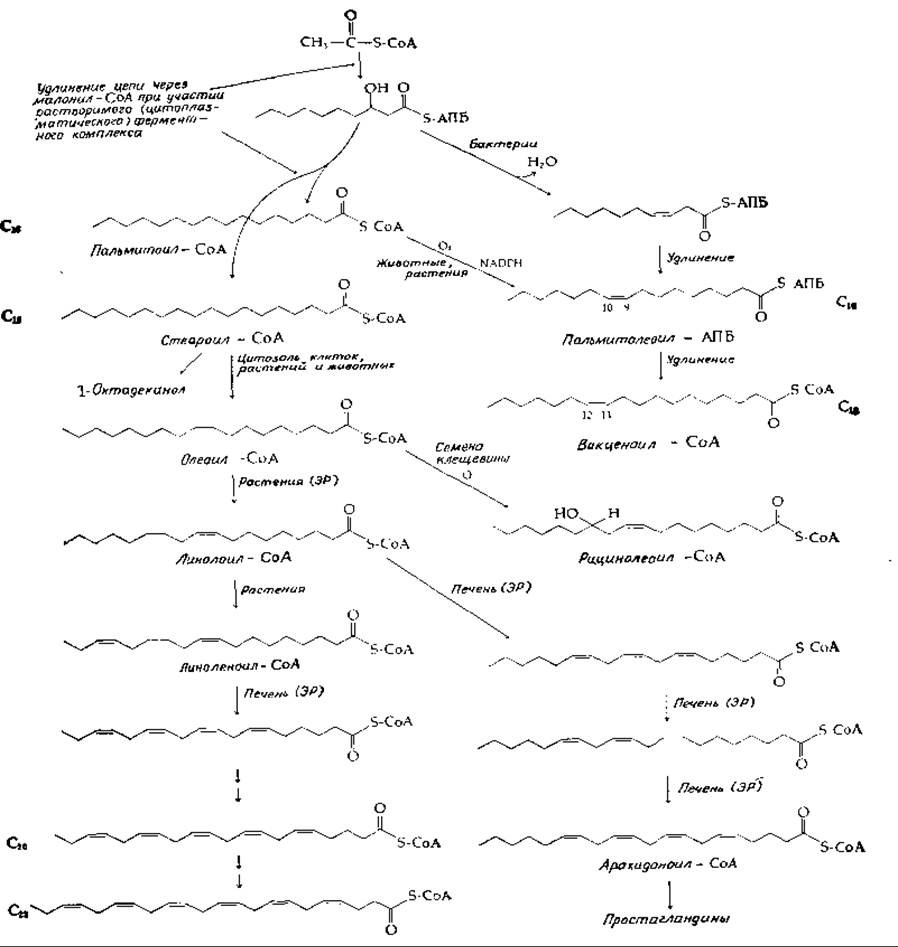
FIG. 12-6. Selected reactions in FATTY ACID Biosynthesis.
However, the dehydration of ß-hydroxydecanoyl-ACP1) represents a metabolic branch point distinct from the main biosynthetic pathways [41], whereas trans-a,ß-unsaturated long-chain acyl compounds lie on the primary pathway of chain elongation to palmityl-CoA (Fig. 12-6, left side).
1) Although Fig. 12-6 illustrates both CoA and ACP derivatives, many intermediate steps have been omitted. Biosynthesis frequently initiates while the fatty acid is attached to the acyl carrier protein, but the final product is released as a CoA derivative (Chap. 11, Sec. D,6).
In higher plants, animals, protozoa, and fungi, saturated fatty acids undergo desaturation by desaturases (Chap. 10, Sec. G,3), typically yielding double bonds with a cis configuration. In both animals and plants, the introduction of the first double bond into a saturated fatty acid occurs in the Cytosol. The resulting oleyl coenzyme is subsequently converted into the CoA derivatives of linoleic, linolenic, arachidonic, and other polyenoic acids through the reactions depicted in Fig. 12-6. In plant cells, desaturation processes take place in The Endoplasmic reticulum with the participation of NADPH, light-generated ferredoxin, and O2.
In animals, The conversion of oleyl-CoA to linoleyl-CoA does not occur. Consequently, polyunsaturated fatty acids such as linoleic, linolenic, and C20-arachidonic acids are essential dietary components. A deficiency in these plant-derived Essential Fatty Acids1) in animals leads to growth retardation, Skin lesions, Kidney damage, and reproductive dysfunction. It is now well established that an essential—though likely not the sole—function of essential fatty acids is their role as precursors in the synthesis of "local Hormones," specifically Prostaglandins (Sec. E,3) [42]. A particular role for arachidonic acid has been established in platelets, where lipoxygenase converts it into 12-L-hydroxy-5,8,10,14-eicosatetraenoic acid, a neutrophil chemotactic factor (Supplement 5-G).
Figure 12-6 also illustrates The formation of ricinoleic acid, a characteristic component of castor bean seeds and castor oil (Fig. 2-32). Certain organisms contain cyclopropane fatty acids (Fig. 2-32) [43]. The carbon donor for the cyclopropane ring is S-adenosylmethionine (SAM), with the carbon adding across the double bond of a fatty acid acyl group residing within phosphatidylethanolamine, a permanent membrane constituent [equation (12-15)] [44,45].
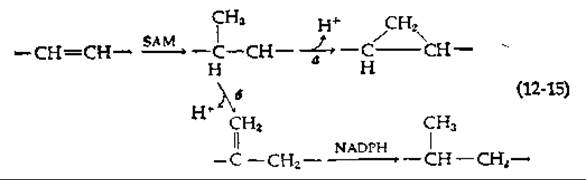
The same carbonium ion can yield either a cyclopropane fatty acid [equation (12-15), reaction a] or a methylated fatty acid derivative [equation (12-15), reaction b]; the latter can subsequently be converted into a branched-chain fatty acid. This process represents the pathway for methylated fatty acid formation in certain bacteria [44].
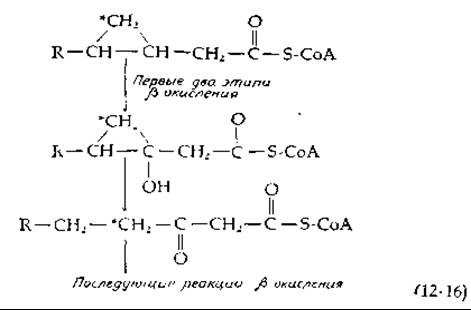
Cyclopropane Fatty acids are degraded via ß-Oxidation, which, however, undergoes some modifications when chain Cleavage reaches the cyclopropane ring [see equation (12-16)] [46]. Ring opening in cyclopropanol derivatives occurs very readily, even under mild non-enzymatic Acid-Base Catalysis.
1) Arachidonic acid is not typically found in plants; in animals, it is synthesized from linoleic acid as shown in Fig. 12-6.
Acetylene groups (—C ≡ C—) may also form in unsaturated fatty acids. This presumably occurs via the dehydrogenation of —CH = CH— bonds, although the Enzymes catalyzing this process remain poorly characterized. Examples of natural acetylenes include crepenynic acid (Fig. 2-32), alloxanthin (Sec. 3,3), and the following intriguing hydrocarbon found in the common cornflower Centaurea cyanus [45]:

Last update: 06/08/2026
Editorial and Educational Adaptation: This material has been compiled based on the primary/original source text. The project team performed an editorial review, corrected technical inaccuracies, structured sections, and adapted the content for an educational format.
What was processed:
- elimination of formatting defects (OCR errors, structural breaks, corrupted characters);
- editorial organization of content;
- standardization of terminology in accordance with academic sources;
- verification of factual statements against the original source text.
All mentions of the author, publication year, and origin of the primary text have been preserved in accordance with the source.