Biochemistry - The Chemical Reactions of Living Cells Volume 2 - D. Metzler 1980
Biosynthesis: How New Molecules Are Formed
Special Aspects of Fatty Acid Metabolism
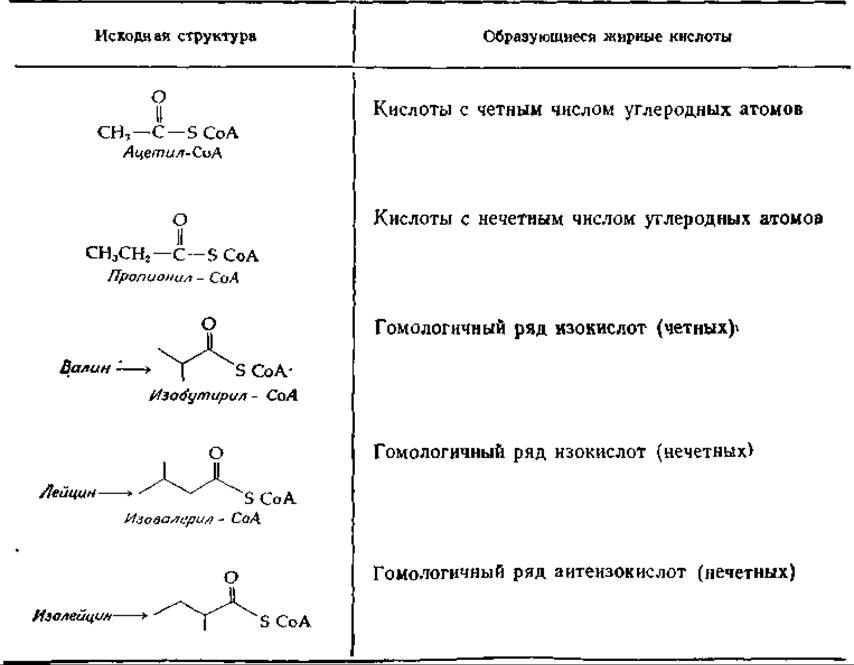
A wide variety of Fatty acids and their closest derivatives, differing considerably in Structure, are found in nature [36c]. This is partly due to the existence of several precursor structures from which long-chain Fatty acids are synthesized. For instance, when acetyl-CoA is used as the starting structure, chain elongation (via malonyl-CoA) yields fatty acids with an even number of carbon atoms (Fig. 11-2). The degradation of branched-chain Amino Acids—valine, isoleucine, and leucine—gives rise to various branched precursors (Table 12-2), which subsequently serve to synthesize iso- and anteisologous series of fatty acids. The latter are found in tobacco Lipids and wool, in the "acoustic lenses" of echolocating dolphins [37], and in many other biological sources [38]. The Introduction of side branches into various positions of the fatty acid chain is mediated by propionyl-CoA (via methylmalonyl-CoA). For example, the preen gland secretions of ducks and geese contain 2R- and 4R-methylhexanoic acids, 2,4,6,8-tetramethyldecanoic acid, and A number of other branched acids esterified with long-chain alcohols (predominantly 1-octadecanol) [39]. Tubercle bacilli contain a similar compound known as mycocerosic acid, which comprises 32 carbon atoms.
Class="center">
Table 12-2 Starting structures as precursors for FATTY ACID Biosynthesis
In most plants, animals, and Bacteria, fatty acids with an even number of carbon atoms predominate. In both plants and animals, the fatty acid synthase enzyme complex primarily produces unbranched C16- and C18-acyl-CoA derivatives (Fig. 12-6). Subsequently, the enzyme systems of The Endoplasmic reticulum (microsomes) in PLANT AND ANIMAL Cells elongate fatty acids using malonyl-CoA and NADPH. This elongation process can also occur in Cell/35.html">Mitochondria via reactions that are essentially the reverse of ß-Oxidation; the only deviation from the exact Reversal of the ß-oxidation pathway is The Use of NADPH as the reducing agent in the reaction catalyzed by enoyl-CoA reductase. It has been suggested that fatty acid elongation taking place on the outer mitochondrial membrane, coupled with the subsequent transport of the synthesized acids into the mitochondria, constitutes an additional shuttle pathway for transferring reducing equivalents from NADH into the mitochondria (Chap. 10, Sec. D, 11) [40].
Last update: 06/08/2026
Editorial and Educational Adaptation: This material has been compiled based on the primary/original source text. The project team performed an editorial review, corrected technical inaccuracies, structured sections, and adapted the content for an educational format.
What was processed:
- elimination of formatting defects (OCR errors, structural breaks, corrupted characters);
- editorial organization of content;
- standardization of terminology in accordance with academic sources;
- verification of factual statements against the original source text.
All mentions of the author, publication year, and origin of the primary text have been preserved in accordance with the source.