Biochemistry: The Chemical Reactions of Living Cells, Volume 2 - D. Metzler 1980
Biosynthesis: How New Molecules Are Formed
The Role of Reducing Agents in Biosynthetic Reactions
Reversal of the Oxidative Phase by a Strong Reducing Agent
Another important difference between FATTY ACID Biosynthesis and ß-Oxidation (in animal Cells) is that an absolute prerequisite for fatty acid biosynthesis is the presence of NADPH, whereas ß-oxidation requires NAD+ and Flavoproteins (Fig. 11-2). This circumstance, combined with many other facts, led to the formulation of a general rule stating that reductive reactions occurring during biosynthesis typically require NADPH rather than NADH (Ch. 8, Sec. G). Numerous measurements have shown that while in the Cytosol of Eukaryotic cells the [NADPH]/[NADP+] ratio is high, the [NADH]/[NAD+] ratio is low. Thus, the NAD+/NADH system maintains a high oxidation capacity (in full accordance with the fact that NAD+ is the most important biochemical oxidant), whereas the NADP+/NADPH system maintains a high reduction capacity.
The utilization of NADPH at stage f (Fig. 11-2) provides the conditions under which significant amounts of the ß-ketoacyl-ACP derivative are reduced to an alcohol. It is worth noting another difference between ß-oxidation and biosynthesis: the alcohol formed during this reduction step of the biosynthetic process has the D-configuration, whereas the corresponding alcohol formed during ß-oxidation has the L-configuration (Fig. 11-2).
The second reduction step of fatty acid biosynthesis in rat Liver (stage i, Fig. 11-2) also requires NADPH1). The corresponding step in ß-oxidation utilizes FAD, but NADPH is a stronger reducing agent than FADH2. Consequently, The Use of a reduced pyridine nucleotide creates thermodynamic advantages for driving the reaction toward biosynthesis. Interesting differences have been observed among various species. For example, NADPH alone is sufficient for fatty acid synthesis in rats, whereas the multienzyme complexes catalyzing this process in Mycobacterium phlei, Euglena gracilis, and the Yeast Saccharomyces cerevisiae achieve significantly more efficient synthesis by utilizing a mixture of NADPH and NADH rather than NADPH alone [5]. Presumably, NADPH is required to catalyze stage f, and NADH for stage i. This may indicate that the equilibrium position for stage i is strongly shifted toward product formation and that very low concentrations of NADH can ensure reduction.
1) No cofactor was found in the E. coli enzyme; however, the yeast enzyme contains riboflavin-5-phosphate, which appears to act as a cofactor ensuring the maximum rate of reduction.
Class="center">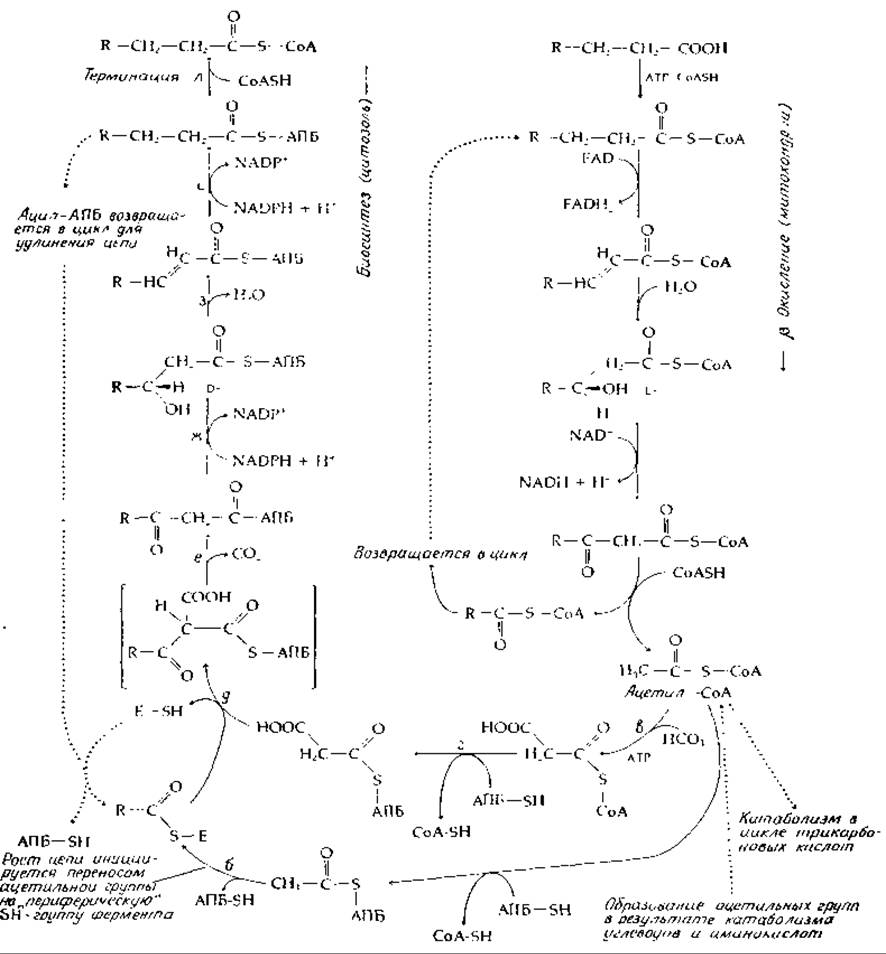
FIG. 11-2. Comparison of fatty acid biosynthesis with ß-oxidation
Last update: 06/08/2026
Editorial and Educational Adaptation: This material has been compiled based on the primary/original source text. The project team performed an editorial review, corrected technical inaccuracies, structured sections, and adapted the content for an educational format.
What was processed:
- elimination of formatting defects (OCR errors, structural breaks, corrupted characters);
- editorial organization of content;
- standardization of terminology in accordance with academic sources;
- verification of factual statements against the original source text.
All mentions of the author, publication year, and origin of the primary text have been preserved in accordance with the source.