Biochemistry - The Chemical Reactions of Living Cells, Volume 2 - D. Metzler 1980
Biosynthesis: How New Molecules Are Formed
Utilization of ATP Energy
Carboxylation and Decarboxylation; Fatty Acid Synthesis
A fourth mechanism by which ATP Cleavage can be coupled with biosynthetic reactions was discovered only a few years ago, when Wakil and co-workers demonstrated that fatty acid synthesis in the Cytoplasm of animal Cells is stimulated by carbon dioxide. However, when 14СО2 is used in experiments, no radioactivity is detected in the resulting Fatty acids. Subsequent research established that acetyl-CoA is carboxylated to malonyl-CoA, a process requiring both ATP and biotin [Eq. (11-5); see also Chapter 8, Section B]. The carboxyl group formed in this reaction is then converted back into СО2 via decarboxylation.
Class="center">
We now know that both the acetyl group of acetyl-CoA and the malonyl group of malonyl-CoA are transferred to the sulfur atoms of the phosphopantetheine groups of a low-molecular-weight acyl carrier protein (ACP; see Chapter 8, Section B,3). Next, the malonyl group of the malonyl-bearing protein (malonyl-ACP) condenses with acetyl-ACP. The resulting unstable ß-keto acid, shown in brackets in equation (11-6), appears to undergo decarboxylation either by the condensing enzyme or during subsequent reactions. The overall consequence of decarboxylation is that it drives the reaction to completion and enables C—C bond formation, fueled by the ATP cleavage required for the carboxylation step.
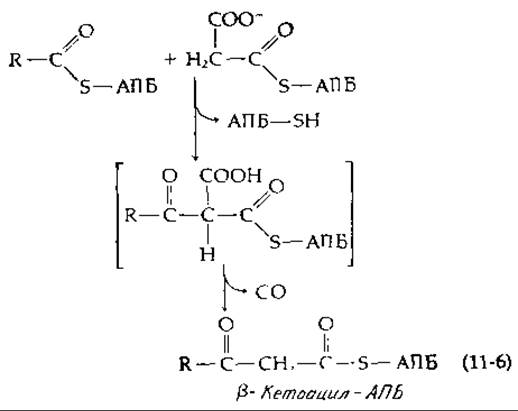
The secondary function of the carboxylation-decarboxylation cycle is also relatively clear: the attached carboxyl group in malonyl-CoA activates the methylene hydrogen atoms, facilitating their abstraction as H+ and thereby promoting Condensation. Apparently, both of these mechanisms are crucial for fatty acid synthesis via malonyl-CoA. As noted earlier, it is often difficult to determine precisely which pathway plays a more significant role in the evolution of a particular metabolic process.
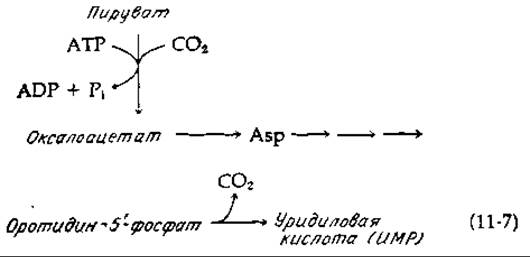
Carboxylation followed by decarboxylation is likewise a key step in several other biosynthetic pathways. In some cases, the decarboxylation that succeeds carboxylation involves multiple steps rather than a single one, as seen, for example, in The conversion of Pyruvate (or PEP) into uridylic acid [Eq. (11-7); for details, see Fig. 14-9].
Last update: 06/08/2026
Editorial and Educational Adaptation: This material has been compiled based on the primary/original source text. The project team performed an editorial review, corrected technical inaccuracies, structured sections, and adapted the content for an educational format.
What was processed:
- elimination of formatting defects (OCR errors, structural breaks, corrupted characters);
- editorial organization of content;
- standardization of terminology in accordance with academic sources;
- verification of factual statements against the original source text.
All mentions of the author, publication year, and origin of the primary text have been preserved in accordance with the source.