GENERAL MICROBIOLOGY - T.P. Pirog - 2004
13. BIOSYNTHETIC PROCESSES IN MICROORGANISMS
13.4. FATTY ACID BIOSYNTHESIS
Most Fatty acids that make up bacterial Lipids contain 16 or 18 carbon atoms. These acids are either saturated or contain one or more double bonds. Acetyl-CoA serves as the precursor for fatty acids. However, chain elongation in this case does not occur through the Condensation of two acetyl-CoA molecules followed by subsequent condensation of the resulting C2-compound with acetyl-CoA. There are two fundamental differences in fatty acid Biosynthesis:
1. CoA derivatives do not act as substrates for the Enzymes involved in fatty acid synthesis. Instead, the acyl carrier protein (ACP) is used, which contains 4'-phosphopantetheine as its prosthetic group, making it structurally similar to coenzyme A. The first reaction in fatty acid synthesis is the Formation of Acetyl-ACP:
Class="center">
2. Acetyl-ACP Functions as a primer in fatty acid synthesis, with C2 fragments being added to this primer in the form of malonyl-CoA. Malonyl-CoA is synthesized from acetyl-CoA in two steps.
Four enzymes are required to elongate the acyl-ACP by two carbon atoms. First, acetyl-ACP reacts with malonyl-ACP to form acetoacetyl-ACP, which is then reduced to β-hydroxybutyryl-ACP. Dehydration yields crotonyl-ACP, and subsequent reduction leads to The formation of butyryl-ACP:
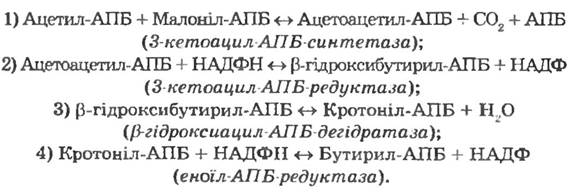
The branching point for the synthesis of saturated and Unsaturated fatty acids is β-hydroxydecanoyl-ACP.
The primary substrates for the formation of phosphatidic acids are 3-phosphoglycerol and acyl-ACP. 3-Phosphoglycerol is formed from dihydroxyacetone phosphate, an intermediate in Glycolysis. Phosphatidic acids are produced by transferring an acyl residue from acyl-ACP to 3-phosphoglycerol. The majority of phosphatidic acids are used for phospholipid synthesis (via the formation of esters with alcohols).
Last update: 12/08/2026
Editorial and Educational Adaptation: This material has been compiled based on the primary/original source text. The project team performed an editorial review, corrected technical inaccuracies, structured sections, and adapted the content for an educational format.
What was processed:
- elimination of formatting defects (OCR errors, structural breaks, corrupted characters);
- editorial organization of content;
- standardization of terminology in accordance with academic sources;
- verification of factual statements against the original source text.
All mentions of the author, publication year, and origin of the primary text have been preserved in accordance with the source.