Biochemistry of Amino Acids - A. Majster 1961
Intermediary Metabolism of Amino Acids
Tryptophan
Conversion of Tryptophan to Kynurenine and Nicotinic Acid
Kynurenine was discovered by Matsuoka and Yoshimatsu in the urine of rabbits fed large amounts of Tryptophan [732]. It is now known that kynurenine can be converted into kynurenic acid (which was actually discovered before kynurenine [733–735]), xanthurenic acid, nicotinic acid, and certain pigments. These tryptophan transformations have been established through nutritional biochemistry experiments, isotopic and enzymological studies, and experiments with microbial mutants.
Knox and Mehler [736] studied The conversion of tryptophan to kynurenine in in vitro experiments [736]. They obtained a soluble enzyme system from rat Liver that catalyzes the following reactions:
Class="center">
The oxidation of tryptophan to formylkynurenine proceeds with the participation of O2 and H2O21; catalase [737–739] inhibits this process. Tryptophan peroxidase activity has also been detected in Bacteria [740]. The second of the reactions shown above represents the Hydrolysis of formylkynurenine to kynurenine involving the enzyme formylase (kynurenine formamidase); this enzyme has been found in The Liver and in microorganisms [736–741].
It is known that in mammals, tryptophan peroxidase undergoes adaptive changes [742]. For instance, administering tryptophan to rats significantly increases tryptophan peroxidase activity in the liver for several hours, after which the activity drops back to normal levels2. Adrenalectomy decreases The activity of this enzyme in rat liver, whereas the administration of cortisone to the operated rats causes an increase in activity. It has been suggested that pituitary and adrenal hormonal factors influence enzyme activity (likely regulating the Synthesis of the enzyme itself) [742–746].
1 Tanaka and Knox [J. Biol. Chem., 234, 1163 (1959)] later established that only O2 participates in the oxidation of tryptophan to formylkynurenine; the activating effect of hydrogen peroxide is explained by its ability to regenerate the active ferrous form of the iron-porphyrin prosthetic group of the enzyme from the inactive ferric form. Since the enzyme lacks peroxidase activity, it should be designated as "tryptophan pyrrolase," as proposed by Kotake, who first described the action of this enzyme in 1934.—Transl.
2 Induced formation of "tryptophan peroxidase" is also observed in in vitro experiments with liver slices upon The addition of tryptophan to the incubated samples; in the absence of the substrate, the enzyme in tissue slices and homogenates is rapidly inactivated [743]. —Transl.
It is hypothesized that the oxidation of tryptophan by tryptophan peroxidase proceeds via an intermediate compound whose exact nature is not yet known. It has been established that oxindolealanine is not this intermediate [747–749]:

Other possible intermediate products in this process have been considered [748, 750, 751]. It has been suggested that thiamine participates in the reaction [752].
In 1945, Krehl and co-workers [753] found that rats receiving a diet deficient in nicotinic acid grow normally when tryptophan is added to their diet. This was followed by a series of studies proving the conversion of tryptophan into nicotinic acid (see, e.g., [724, 725, 754–768, 787]). Of particular interest are the early studies by Goldberger and Tanner [769] on the curative effect of tryptophan in pellagra. It is highly probable that the clinical effect of tryptophan described by Goldberger is due to its conversion into nicotinic acid. The conversion of kynurenine into nicotinic acid has been demonstrated in numerous studies using Neurospora mutants [724, 725, 758, 759, 761–764, 766–768]. Probable intermediate stages of this transformation are outlined below (see p. 400).
Heidelberger and co-workers [770, 771], using labeled compounds, established that in the rat Organism, the carbon atom at position 3 of the indole ring of tryptophan becomes the carboxyl carbon atom of nicotinic acid. These authors also showed that during the conversion of tryptophan to kynurenine in the rabbit and to kynurenic acid in the dog, the ß-carbon atom of tryptophan is transferred to the ß-carbon atom of kynurenine and to the C-3 atom in the kynurenic acid molecule. The side chain of tryptophan does not participate in The formation of the nicotinic acid molecule [770, 772]. In experiments on rats and rabbits, the conversion of tryptophan to kynurenine, kynurenic, and xanthurenic acids was also studied using tryptophan containing N15 in the pyrrole ring [773]. The same study showed that the nitrogen of the tryptophan ring is not incorporated into hemin in the rat, and that N15-indole is not utilized by the rat for the synthesis of tryptophan.

Kynurenine can be oxidized to 3-hydroxykynurenine and converted into anthranilic and kynurenic acids. The Mechanism of kynurenine oxidation to 3-hydroxykynurenine has not yet been precisely elucidated, but the occurrence of this reaction is considered proven [774, 775], and the involvement of riboflavin in it is deemed probable [776–778].
It is possible that this transformation is linked to the phosphorylation of the hydroxyl group, since the formation of a phosphorylated derivative of 3-hydroxyanthranilic acid has been detected in liver preparations [779, 780]. 3-Hydroxykynurenine accumulates as an intermediate product in the formation of eye pigments in insects [781]; it has been found in insect larvae [782, 783], plants [784], and human urine under certain pathological conditions [785].
It is possible that a-N-acetylkynurenine serves as an intermediate in the oxidation of 3-hydroxykynurenine. There is Evidence for the presence of a-N-acetyl-3-hydroxykynurenine in Neurospora [786]; a-N-acetylkynurenine and the corresponding acetyl derivative of 3-hydroxykynurenine have been detected in the urine of B6-vitamin-deficient rats fed large amounts of tryptophan [748].
Both kynurenine and 3-hydroxykynurenine are cleaved by kynureninase to yield Alanine and anthranilic or 3-hydroxyanthranilic acid. Kynureninase [748, 788–794] is found in the liver and Kidneys of mammals and in various microorganisms; Pyridoxal phosphate acts as a coenzyme in its action [791]. Various researchers have examined the mechanism of the kynureninase reaction [795–797]. Longenecker and Snell [797] suggested that in this reaction, the Schiff base (I) formed from kynurenine and the pyridoxal phosphate enzyme (see scheme on p. 402) is converted into the Schiff base of a-aminoacrylic acid (III). Intermediate compound (II) (see below) enters into a redox reaction with product (III), resulting in the formation of Anthranilic acid and the Schiff base of alanine. In addition to kynurenine and 3-hydroxykynurenine, kynureninase also cleaves formylkynurenine (into formylanthranilic acid and alanine) and 5-hydroxykynurenine (yielding 5-hydroxyanthranilic acid) [798, 799].

3-Hydroxyanthranilic acid is converted into nicotinic acid; The pathway of this transformation requires further study. Considerable attention has been focused on whether quinolinic acid is an intermediate in this process [739, 761, 801–804, 806, 807]. Although it has been established that 3-hydroxyanthranilic acid is converted into quinolinic acid and that nicotinic acid can be formed from quinolinic acid, there is evidence indicating that quinolinic acid does not lie on the main pathway leading to nicotinic acid formation. It is quite likely that the precursor of both quinolinic and nicotinic acids is an intermediate product formed during the Cleavage of 3-hydroxyanthranilic acid. Mehler [808] recently demonstrated that in the liver, the oxidation of 3-hydroxyanthranilic acid is accompanied by the consumption of two oxygen atoms and leads to the formation of an intermediate product that can spontaneously convert into quinolinic acid or be enzymatically transformed into picolinic acid:
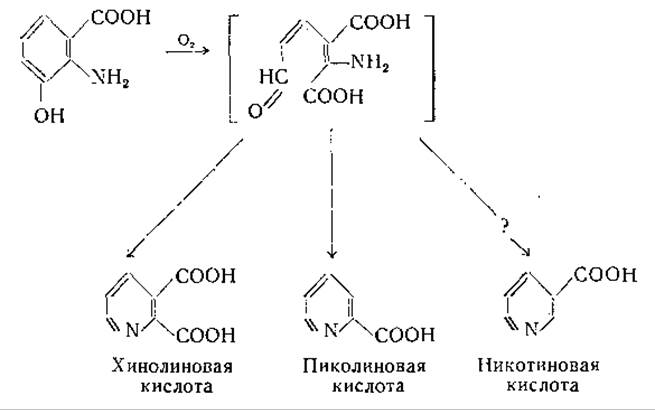
It is possible that nicotinic acid is formed from this intermediate product through the action of another enzyme. Free picolinic acid has not been found in nature, but its corresponding N-methyl derivative, homarine, has been discovered in certain marine invertebrate species [809]. Structure/149.html">The problem of nicotinic acid Biosynthesis has been detailed by Dalgliesh [806] and Mehler [739].
Interestingly, E. coli and Bacillus subtilis appear to lack the enzyme (kynureninase) capable of converting kynurenine into anthranilic acid. Experiments studying the transformations of labeled indole and tryptophan preparations in certain mutants of these organisms have shown that these compounds do not play a significant role in nicotinic acid formation. It is possible that the synthesis of nicotinic acid proceeds via a different pathway in E. coli and B. subtilis [810].
In some animal species, nicotinic acid is excreted unchanged, whereas in others it undergoes amidation and methylation or is eliminated as conjugates. Most carnivorous and omnivorous animals excrete N'-methylnicotinamide [811, 812]; herbivores excrete free nicotinic acid or its conjugates [813]. Certain bird species excrete nicotinuric acid, a conjugate of nicotinic acid and Ornithine [814, 815]. In humans [800, 816, 817] and certain animals, N'-methylnicotinamide is oxidized to N'-methyl-2-pyridone-5-carboxamide [818–820].

Last update: 06/08/2026
Editorial and Educational Adaptation: This material has been compiled based on the primary/original source text. The project team performed an editorial review, corrected technical inaccuracies, structured sections, and adapted the content for an educational format.
What was processed:
- elimination of formatting defects (OCR errors, structural breaks, corrupted characters);
- editorial organization of content;
- standardization of terminology in accordance with academic sources;
- verification of factual statements against the original source text.
All mentions of the author, publication year, and origin of the primary text have been preserved in accordance with the source.