Biochemistry of Amino Acids - A. Majster 1961
Intermediary Metabolism of Amino Acids
Tryptophan
Biosynthesis
The Biosynthesis of Tryptophan has been studied in Escherichia coli, Neurospora crassa, and other microorganisms. The fact that indole and anthranilic acid can substitute for tryptophan as a growth factor in certain microorganisms is consistent with the earlier hypothesis that these compounds are precursors of tryptophan [721, 722]. It was later found that indole and anthranilic acid accumulate in cultures of certain N. crassa and E. coli mutants that require tryptophan for growth [118, 723]. Other mutants have been isolated that can grow only in the presence of indole, but not anthranilic acid. Experimental evidence suggests that anthranilic acid is converted into indole [724, 1127]. It is possible, however, that Anthranilic acid and indole are formed from a common intermediate, perhaps compound "Z1" described by Davis (p. 349). It was found that the carboxyl group of anthranilic acid is not involved in indole formation and is converted primarily to carbon dioxide. Evidence indicates that the C-1 atom of the benzene ring of anthranilic acid takes part in the closure of the pyrrole ring during The formation of indole [725, 726]:
Class="center">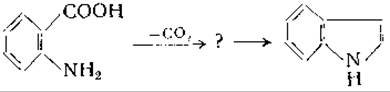
Data have been published indicating the possible formation of indole-3-glycerol phosphate As a result of the reaction between anthranilic acid and 5-phosphoribosyl pyrophosphate. It has been suggested that indole-3-glycerol phosphate may break down into indole and triose phosphate [1128]1. Anthranilic acid can be formed from shikimic acid, as well as a degradation product of kynurenine under the action of kynureninase (p. 401). There is evidence that, under certain conditions, phenylalanine can serve as a precursor of indole [724]. Various unidentified compounds accumulate in the cultures of tryptophan-requiring mutants, and growth studies of such mutants have revealed phenomena that are not yet fully understood [118]; therefore, The pathway of anthranilic acid formation cannot be considered completely established.
1 It is possible that free indole does not participate in tryptophan biosynthesis under normal conditions; according to Yanofsky (C. Janofsky et al., Biochim. Biophys. Acta, 28, 640, 1958; Proc. Nat. Acad. Sci. USA, 44, 1161, 1958), it appears likely that the indole moiety is transferred to the ß-carbon atom of Serine from indole-3-glycerol phosphate either directly or via an intermediate complex (indolyl-enzyme). — Transl. Note.
Much attention has been devoted to studying The final stage of tryptophan biosynthesis, namely the Condensation reaction of indole with serine [727, 729]:

The enzyme catalyzing this reaction, tryptophan desmolase (tryptophan synthetase), has been obtained in purified form; Pyridoxal phosphate has been found to be involved in its action. Zinc may also play a role in this system [730]. To study The Mechanism of tryptophan synthesis from indole and serine, a serine preparation labeled with deuterium at the a- and ß-positions, C14 at the ß-carbon atom, and N15 was used. It was established that half of the deuterium atoms are released during the condensation process. These data indicate the intramolecular dehydration of serine, followed by The addition of indole to the double bond of the resulting a-aminoacrylic acid [729]. Apparently, a Schiff base consisting of aminoacrylic acid and pyridoxal phosphate is formed during the reaction [731].
Last update: 06/08/2026
Editorial and Educational Adaptation: This material has been compiled based on the primary/original source text. The project team performed an editorial review, corrected technical inaccuracies, structured sections, and adapted the content for an educational format.
What was processed:
- elimination of formatting defects (OCR errors, structural breaks, corrupted characters);
- editorial organization of content;
- standardization of terminology in accordance with academic sources;
- verification of factual statements against the original source text.
All mentions of the author, publication year, and origin of the primary text have been preserved in accordance with the source.