Biochemistry of Amino Acids - A. Majster 1961
General Biochemistry and Physiology of Amino Acid Metabolism
Decarboxylation of Amino Acids
Bacterial Amino Acid Decarboxylases
The formation of amines from Amino Acids in Bacteria was observed earlier by many authors, but it was only through the studies of Gale and his coworkers that this process was shown to be the result of specific amino acid Decarboxylases. Gale and his colleagues [197, 222—227] investigated six decarboxylation reactions in bacteria, listed below:
Class="center">
Unlike The amino acid decarboxylases of animal and plant Tissues, bacterial decarboxylases typically have an acidic pH optimum. Gale investigated AMINO ACID DECARBOXYLATION across a wide range of microorganisms. His work demonstrated that many bacteria decarboxylate several of the six amino acids mentioned above, whereas some microorganisms are capable of decarboxylating only a single amino acid. Certain bacterial decarboxylases have been obtained in a partially purified state; it was subsequently established that Pyridoxal phosphate is required for each of the Reactions Catalyzed by these Enzymes. Many bacteria exhibiting decarboxylase activity produce these enzymes in significantly greater quantities when grown on media containing the corresponding amino acids. It was noted that maximal decarase formation is observed when bacteria are cultured in acidic media. Many years ago, Hanke and Koessler [195] put forward the interesting hypothesis that the formation of amines by bacteria serves as a physiological mechanism aimed at neutralizing environmental acids.
The formation and distribution of bacterial decarboxylases for Lysine, Ornithine, Tyrosine, Histidine, Arginine, and glutamic acid have been studied in considerable detail; The kinetics of the reactions catalyzed by these decarboxylases have also been investigated, and the partial purification of some of them has been described. These studies have made it possible to utilize amino acid decarboxylases for the Quantitative determination of amino acids. Such determinations are based on measuring either The amount of carbon dioxide released by the action of the specific decarboxylase [197] or the amount of the amine formed [228]. Because amino acid decarboxylases exhibit strict stereospecificity, they are also employed to detect trace impurities of L-isomers in D-amino acid preparations. Furthermore, these enzymes are used to obtain D-amino acids (such as D-lysine or D-glutamic acid) through the selective destruction of the L-isomer in racemic amino acid preparations (pp. 94, 95).
Nevertheless, it should be noted that the substrate Specificity of certain decarboxylases is not absolute. For example, the L-tyrosine decarboxylase of Streptococcus faecalis exhibits noticeable decarboxylase activity toward L-phenylalanine [229]; Suspensions of these bacteria can be used not only to assay tyrosine, but also for the determination of phenylalanine. The latter can be determined in the presence of tyrosine by employing a specific method for measuring the amine formed [228]. Tyrosine decarboxylase also acts on 3,4-dihydroxyphenylalanine, but does not decarboxylate tyrosine derivatives with a substituted phenolic group, such as O-methyltyrosine.
Bacterial L-lysine decarboxylase produces carbon dioxide from δ-hydroxylysine [230]. The presumed product of this reaction—hydroxycadaverine—has not been isolated; nor is it known whether both L-isomers of δ-hydroxylysine undergo decarboxylation (yielding the corresponding hydroxycadaverine isomers). Lysine decarboxylase does not act on α,ε-diaminopimelic acid; this amino acid is decarboxylated by a distinct enzyme present in certain bacteria (see below).
Early work noted that glutamate decarboxylase preparations produce CO2 from ß-hydroxyglutamic acid. In recent years, it has been found that certain microorganisms, including many strains of Escherichia coli, decarboxylate only one of the optical forms of allo-ß-hydroxy-DL-glutamic acid [231]; the decarboxylation of ß-hydroxy-DL-glutamic acid proceeds significantly more slowly. It has been shown that the decarboxylation of allo-ß-hydroxyglutamic acid yields γ-amino-ß-hydroxybutyric acid; the reaction is activated by pyridoxal phosphate. The decarboxylation of glutamic acid and allo-ß-hydroxyglutamic acid appears to be carried out by different enzymes, as The ratio of the decarboxylation rates for these amino acids varies among different bacterial strains. It should be pointed out that the Biological Significance of the enzyme that decarboxylates allo-ß-hydroxyglutamic acid remains questionable, since none of the four possible isomers of ß-hydroxyglutamic acid has yet been discovered in nature.
A mutant strain of E. coli has been found that decarboxylates γ-hydroxyglutamic acid to form α-hydroxy-γ-aminobutyric acid [232]. It is not yet known whether The enzyme catalyzing this reaction is identical to glutamate decarboxylase. L-Aspartic acid is another amino acid decarboxylated by bacterial decarboxylases. According to Virtanen and coworkers [233, 234], Rhizobium leguminosarum decarboxylates aspartic acid to yield ß-Alanine:
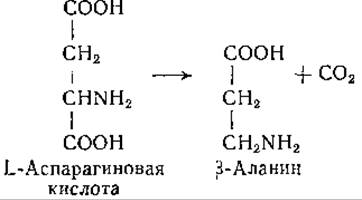
This enzymatic reaction is also characteristic of certain other microorganisms; however, its rate is often so low that the Determination of the resulting Carbon dioxide is technically difficult. The formation of ß-alanine in this reaction was confirmed using a microbiological method [235, 236].
The decarboxylation of L-aspartic acid to form L-alanine has been detected in Clostridium welchii [237] and other microorganisms [238]. This reaction is unique in that it involves the Cleavage of the ß-carboxyl group rather than the α-carboxyl group:
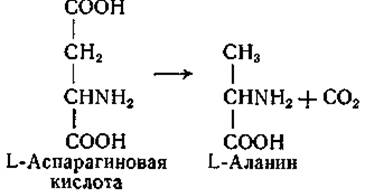
Aspartate ß-decarboxylase from Cl. welchii differs from other decarboxylases also in that it is activated not only by pyridoxal phosphate, but also by very small amounts of α-keto acids. This phenomenon cannot be attributed to the decarboxylation of oxaloacetic acid arising from Transamination between the added α-keto acid and aspartic acid, because the α-Alanine formed during the enzymatic carboxylation of aspartic acid in the presence of isotopically labeled pyruvic acid contains no isotopic label. In all probability, the activating effect of the added α-keto acid is associated with the formation of pyridoxal phosphate via a transamination reaction between the α-keto acid and pyridoxamine phosphate present in the enzyme preparation.
Another bacterial decarboxylase that yields an α-amino acid—namely, meso-α,ε-diaminopimelic acid decarboxylase—was discovered by Work and her colleagues. This enzyme was found in A number of microorganisms, including Escherichia coli, Aerobacter aerogenes, and Sarcina lutea; it catalyzes the following reaction [239—242]:
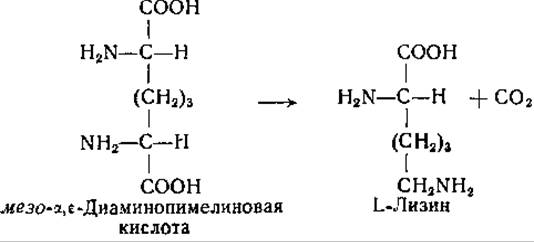
Crude preparations of diaminopimelate decarboxylase decarboxylate both the meso- and LL-forms of this amino acid to yield L-lysine. However, in purified form, the enzyme converts the meso-form much more actively than the LL-form. In fact, the true substrate for this decarboxylase is meso-α,ε-diaminopimelic acid; the decarboxylation of the LL-form by crude enzyme preparations is apparently explained by the preliminary Conversion of the LL-form into the meso-form. The interconversion of the LL- and meso-forms of α,ε-diaminopimelic acid is presumably catalyzed by a specific racemase (p. 244). In certain microorganisms containing diaminopimelate racemase and decarboxylase alongside L-lysine decarboxylase, the following sequential transformations take place:

Unlike lysine decarboxylase and most other bacterial amino acid decarboxylases, diaminopimelate decarboxylase has a neutral pH optimum. Its coenzyme has been established as pyridoxal phosphate. The Role of diaminopimelate decarboxylase in The Biosynthesis of lysine is discussed further on (p. 428). The diaminopimelate decarboxylation reaction is unique in that the cleaved carboxyl group is attached to an asymmetric center having the D-configuration. All other known amino acid decarboxylases act on L-amino acids. Early work mentions the decarboxylation of D-lysine [233, 243], but this amino acid is now recognized as L-lysine.
Earlier attempts were made to demonstrate the reversibility of amino acid decarboxylation reactions; however, no appreciable formation of amino acid from amine and carbon dioxide was observed. The reversibility of the reaction was later proven using isotopic Methods [244, 245]. In particular, it was shown that for the glutamic acid decarboxylation reaction, the Equilibrium Constant  is 70; thus, decarboxylation of glutamate strongly predominates at equilibrium. The equilibrium constants for other enzymatic amino acid decarboxylation reactions have not yet been studied, and the possibility cannot be ruled out that, under certain conditions, Amino acid synthesis might occur via The addition of CO2 to the corresponding amine.
The participation of vitamin B6 in the form of pyridoxal phosphate has been proven in the majority of known amino acid decarboxylation reactions in animals, plants, and microorganisms (see Table 20). The role of pyridoxal phosphate in amino acid decarboxylation is discussed below (p. 248).
Interesting data on The Mechanism of amino acid decarboxylation have been obtained using D2O [246]. It was discovered that during the enzymatic decarboxylation of lysine, tyrosine, and glutamic acid, only a single deuterium atom is incorporated into the amine molecule at the carbon atom bearing the amine group. From this, it follows that no amino acid imino derivative is formed as an intermediate during decarboxylation, since a single hydrogen atom (the α-hydrogen of the starting amino acid) is retained at the α-carbon atom. These observations are consistent with the amino acid decarboxylation mechanism discussed on page 257, which is based on the formation of a Schiff base resulting from the Condensation of the amino group of the amino acid with the aldehyde group of pyridoxal phosphate.
It is quite probable that enzymatic decarboxylation undergoes not only the amino acids mentioned above, but others as well. A number of amines whose structures correspond to decarboxylation products of Natural Amino Acids have been discovered in natural sources (for example, tryptamine and amines corresponding to leucine, isoleucine, and valine) [247]. The question of the existence of Serine decarboxylase remains unresolved. A brief report has been published stating that Proteus vulgaris Cells decarboxylate leucine and valine [248].
Last update: 06/08/2026
Editorial and Educational Adaptation: This material has been compiled based on the primary/original source text. The project team performed an editorial review, corrected technical inaccuracies, structured sections, and adapted the content for an educational format.
What was processed:
- elimination of formatting defects (OCR errors, structural breaks, corrupted characters);
- editorial organization of content;
- standardization of terminology in accordance with academic sources;
- verification of factual statements against the original source text.
All mentions of the author, publication year, and origin of the primary text have been preserved in accordance with the source.