Biochemistry of Amino Acids - A. Majster 1961
General Biochemistry and Physiology of Amino Acid Metabolism
Transamination
Evidence for the Existence of Various Transaminases
Once it was established that A wide variety of Amino acids participate in enzymatic Transamination, it became evident that many different transaminases exist in nature. However, efforts to isolate and purify these Enzymes have lagged behind the discovery of new transamination reactions. This is likely due both to the general complexity of developing Enzyme Purification Methods and to the fact that researchers' attention has been dispersed across the wide range of transamination substrates whose existence has been proven or hypothesized.
Methods for the Separation and partial purification of aspartate-glutamate and Alanine-glutamate transaminases from Heart Muscle have been described [208, 262–265]. It has been demonstrated that in the Liver, Transamination reactions between glutamine and a-keto acids [282], asparagine and a-keto acids [289], and Serine and alanine [297] are catalyzed by distinct enzymes. In rat liver Cells, the transaminases that catalyze the transamination of aromatic amino acids with a-ketoglutarate are localized within cytoplasmic granules [315].
Extracts from Escherichia coli cells were subjected to fractionation via selective adsorption on calcium triphosphate gel followed by fractional elution. This approach made it possible to separate fractions with transaminase activity toward three distinct groups of substrates [272].
Virtually all of the transamination activity of the initial extract between a-ketoglutaric acid and various amino acids was found to be concentrated in two fractions (Table 23). One of these, fraction A, was inactive toward isoleucine and valine and showed very weak activity with leucine. In contrast to fraction A, fraction B lacked transaminase activity toward Tryptophan and aspartic acid. Further investigation focused on a mutant strain of E. coli exhibiting an absolute requirement for isoleucine and a relative requirement for valine as growth factors; this strain is unable to grow on media containing the corresponding a-keto acids instead of isoleucine and valine. The Specificity range of a-ketoglutarate-dependent transamination reactions in this E. coli mutant was found to be very close to that of fraction A; in other words, this Organism lacks the transaminase activity characteristic of fraction B. These findings are consistent with the mutant's absolute nutritional requirement for isoleucine and the inability of the corresponding a-keto acid to support its growth.
Class="center">Table 23 Transamination Reactions between a-ketoglutaric acid and various amino acids in Escherichia coli [272]
|
Amino acid |
Transaminase activity toward the corresponding amino acid * |
|||
|
wild-type Cell extract |
Fraction A |
Fraction B |
mutant strain extract |
|
|
Aspartic acid |
100 |
100 |
0 |
100 |
|
Valine |
37 |
0 |
58 |
0 |
|
Isoleucine |
40 |
0 |
84 |
0 |
|
Leucine |
41 |
3 |
100 |
3 |
|
31 |
10 |
32 |
19 |
|
|
25 |
25 |
6 |
18 |
|
|
Tryptophan |
73 |
59 |
0 |
72 |
|
Phenylalanine |
37 |
44 |
26 |
29 |
* Maximum activity is taken as 100%.
As can be seen from Table 23, the transaminase activity spectra of fractions A and B partially overlap. However, assuming that the genetic alteration in the mutant involves the loss of a single enzyme, it can be concluded that fraction B contains essentially only one enzyme. Fraction A apparently contains several transaminases, which could not be separated by further fractionation. As noted below (p. 353), this mutant strain of E. coli, capable of slow growth on a valine-free medium, synthesizes valine via a transamination reaction between alanine or a-aminobutyric acid and a-ketoisovaleric acid.
Fractions A and B isolated from the E. coli extract apparently catalyze amino group transfer reactions other than those involving glutamic or a-ketoglutaric acids. A mixture of fractions A and B (as well as the dialyzed starting cell-free extract) was found to catalyze the following reactions at comparable rates:
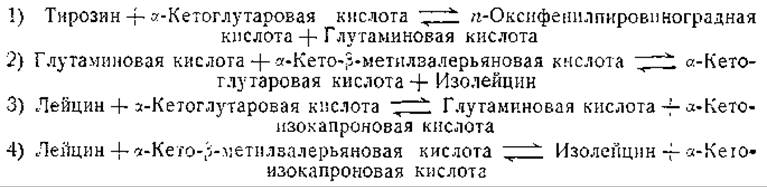
Meanwhile, the tyrosine ⇄ isoleucine reaction did not take place under the same conditions. It is reasonable to assume that this reaction would proceed at a noticeable rate if the reaction mixture contained glutamic or a-ketoglutaric acid in quantities sufficient to drive coupled transamination reactions. Reaction (4) may represent a direct conversion or, provided that a-ketoglutarate or glutamate is present in the reaction mixture, the result of coupling reactions (2) and (3). The absence of the tyrosine-isoleucine reaction indicates that the system lacks the concentrations of a-ketoglutaric and glutamic acids required to support such coupled pathways. It was found that fraction A catalyzes transamination between all amino acids belonging to its substrate pool and their corresponding a-keto acids; fraction B exhibits a similar property. These facts suggest that a single individual transaminase can catalyze reactions between any amino acid within the specified group and its corresponding a-keto analogue. This Conclusion, based on studies of E. coli enzymes, is supported by later data on a transaminase isolated from Neurospora mycelium [273, 316, 317], which catalyzes the following reaction:
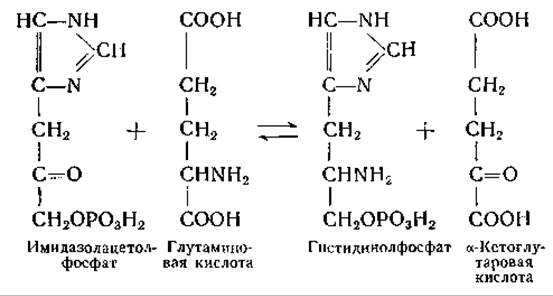
The enzyme responsible for this reaction has been obtained in purified form; it was found that in the reaction above, glutamic acid can be replaced by L-a-aminoadipic acid, L-Arginine, or L-Histidine, while histidinol phosphate can be replaced by a-ketoadipic acid or a-keto-δ-guanidinovaleric acid. This enzyme preparation catalyzes the following transaminations: a-aminoadipic acid-glutamic acid, glutamate-arginine, glutamate-histidine, a-aminoadipic acid-arginine, and a-aminoadipic acid-histidine. It is highly probable that all these reactions are carried out by the same enzyme; furthermore, the enzyme preparation appears to be free of glutamic and a-ketoglutaric acids, ruling out the possibility of coupled transaminations mediated by glutamic acid as an NH2 carrier.
The reaction between histidinol phosphate and a-ketoglutaric acid is of interest as an example of transamination involving a phosphoric acid ester. A certain analogy to this reaction is found in the interconversion of Pyridoxal phosphate and pyridoxamine phosphate bound to transaminase apoenzymes (p. 251 and footnote on p. 214). Reactions described by several authors, presumed to involve transamination between pyridoxamine phosphate and a-keto acids [237, 318], provide another example of processes involving a compound that bears a phosphate residue instead of a carboxyl group1. It is possible that other phosphate esters (e.g., ethanolamine phosphate, phosphono-β-hydroxypyruvate) may also participate in transamination reactions.
The synthesis of certain transaminases appears to be adaptive in nature. In E. coli, The activity of valine-alanine transaminase increases significantly when the culture is grown on a valine-free medium [319]. In N. crassa, the activity of transaminases catalyzing the alanine-glutamate and aspartate-glutamate reactions (in contrast to Ornithine-glutamate transaminase and certain others) is independent of the presence of exogenous amino acids in the growth medium [320].
Last update: 06/08/2026
Editorial and Educational Adaptation: This material has been compiled based on the primary/original source text. The project team performed an editorial review, corrected technical inaccuracies, structured sections, and adapted the content for an educational format.
What was processed:
- elimination of formatting defects (OCR errors, structural breaks, corrupted characters);
- editorial organization of content;
- standardization of terminology in accordance with academic sources;
- verification of factual statements against the original source text.
All mentions of the author, publication year, and origin of the primary text have been preserved in accordance with the source.