Biochemistry of Amino Acids - A. Majster 1961
General Biochemistry and Physiology of Amino Acid Metabolism
Perreamination
Reactions between a-ketoglutaric acid and amino acids
Preparations derived from A wide variety of biological sources catalyze reversible Transamination reactions between a-ketoglutaric acid and Alanine, as well as between a-ketoglutaric and aspartic acids. That these two reactions are catalyzed by distinct Enzymes was proven through their Separation and partial purification; both enzymes were isolated from pig Heart Muscle. Considerable effort has been devoted to developing purification Procedures for glutamate-aspartate transaminase [208, 262—264] and glutamate-alanine transaminase [208, 265], but until recently these enzymes had not been obtained in homogeneous form. Pig heart glutamate-aspartate transaminase exhibits activity toward mesoxalic acid (in place of oxaloacetic acid) and cysteic acid (in place of aspartic acid); however, the reaction rates with these substrates are significantly lower. At the same time, the transamination reaction between cysteinesulfinic acid and a-ketoglutarate proceeds in the presence of purified glutamate-aspartate transaminase preparations at a considerably higher rate than the reaction between aspartic and a-ketoglutaric acids [266, 267]. Pig heart glutamate-aspartate transaminase also catalyzes transamination between y-methylglutamic (but not ß-methylglutamic) and oxaloacetic acids at approximately the same rate as the reaction between glutamic and oxaloacetic acids [268]. Apparently, these reactions are catalyzed by the same enzyme. The structural formulas of the aforementioned substrates provide insight into the similarities between their molecules:
Class="center">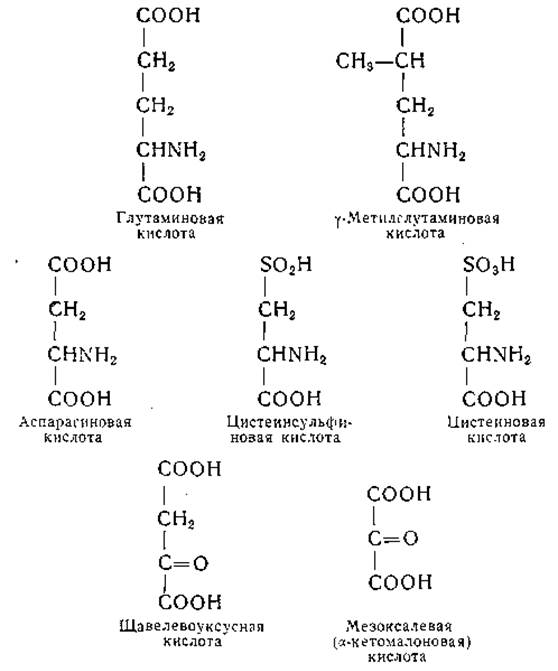
Purified preparations of pig heart glutamate-alanine transaminase exhibit some activity when pyruvic acid is replaced by a-ketobutyric or mesoxalic acid [208, 269]; however, this enzyme does not catalyze transamination reactions involving y-methylglutamic or ß-methylglutamic acid [268].
Table 21 Transamination reaction between a-ketoglutaric acid and Amino acids

1) Number of microliters of CO2 released by glutamate decarboxylase from the glutamic acid formed.
2) Number of micromoles of glutamic acid formed according to colorimetric determinations.
3) Number of micromoles of glutamic acid formed according to paper Chromatography data with visual comparison of test and standard spots; amino acid configurations not specified.
4) Number of micromoles of glutamate found upon determination using L-glutamate decarboxylase.
5) Activity of the glutamic acid spot on the chromatogram (number of C14 counts per min.). The lupine cytoplasmic granule preparation was incubated with The amino acid and C14-a-ketoglutarate; amino acid configuration not specified. The number of counts in the control (without amino acid addition) was 16.
6) The D-isomer is inactive.
7) Amino acid in racemic form.
8) The values for D-leucine and D-phenylalanine are 9 and 7 ml, respectively [277].
Table 22 Transamination reactions described in the literature*


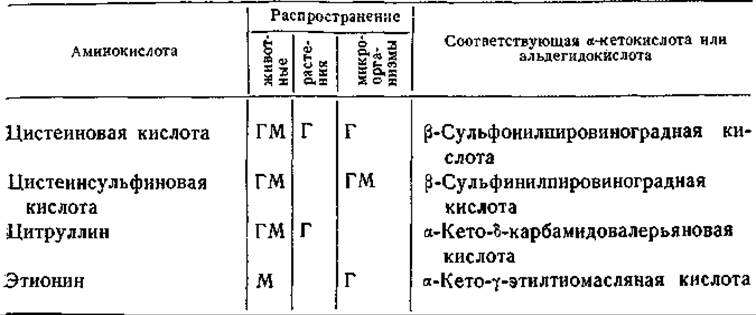
* G — reactions involving L-glutamic or a-ketoglutaric acids; M — reactions involving monocarboxylic a-amino or a-keto acids. All Amino acids are of the L-configuration unless otherwise specified; in A number of microorganisms, the D-isomer of Certain amino acids may also participate in the transamination reaction (indicated in parentheses).
The question of the existence of a distinct aspartate-alanine transaminase remains unresolved. In pig heart muscle, the reaction between aspartate and alanine appears to result from the coupling of reactions between alanine and glutamic acid, on the one hand, and between glutamic and aspartic acids, on the other [258]. The isolation of aspartate-alanine transaminase from pigeon Liver has been reported [270], but these findings were not confirmed by another laboratory [271]. There is no doubt that many preparations from animal and plant Tissues, as well as microorganisms, are capable of carrying out the transamination reaction between aspartic acid and alanine. However, glutamate-alanine and glutamate-aspartate transaminases are also present in almost all of these preparations. The existence of a single glutamate-aspartate-alanine transaminase—that is, an enzyme catalyzing reactions between any of these Three amino acids and each of the corresponding a-keto acids—is quite possible. Enzyme systems of this type have been discovered in Escherichia coli [272] and Neurospora crassa [273].
Reversible transamination reactions between many Amino Acids and a-ketoglutaric acid have been demonstrated in experiments using enzyme preparations from animal and Plant Tissues and microorganisms. Early studies already provided data on transamination reactions involving valine [256], a-aminoadipic acid [257, 274], a-aminomalonic acid [257, 274], cysteic [257, 274] and homocysteic acids [257, 274], leucine [275, 276], and isoleucine [275]. However, these reactions generally proceeded at a much lower rate compared to the transamination reactions of glutamic and aspartic acids and alanine. Later studies, conducted using more advanced Methods for the identification and quantification of amino acids and utilizing purified enzyme preparations, have proven the existence of transamination reactions between a-ketoglutarate and a wide variety of amino acids. Some of these reactions described in the literature are presented in Table 21, and a comprehensive list of substrates participating in enzymatic transamination reactions is given in Table 22.
Last update: 06/08/2026
Editorial and Educational Adaptation: This material has been compiled based on the primary/original source text. The project team performed an editorial review, corrected technical inaccuracies, structured sections, and adapted the content for an educational format.
What was processed:
- elimination of formatting defects (OCR errors, structural breaks, corrupted characters);
- editorial organization of content;
- standardization of terminology in accordance with academic sources;
- verification of factual statements against the original source text.
All mentions of the author, publication year, and origin of the primary text have been preserved in accordance with the source.