Harper's Illustrated Biochemistry, Volume 1 - Murray R. 1993
Metabolism of Proteins and Amino Acids
Conversion of Amino Acids to Specialized Products
Creatine and Creatinine
Creatine is present in Muscles, the Brain, and Blood in both free and phosphocreatine forms. Trace amounts of creatine are also normally found in urine. Creatinine, the anhydride of creatine, is formed primarily in muscles through the irreversible non-enzymatic dehydration and dephosphorylation of phosphocreatine (Fig. 32.11).
The daily urinary excretion of creatinine in any given individual is strikingly constant and proportional to total Muscle mass.
Three Amino Acids—Glycine, Arginine, and Methionine—participate in the synthesis of creatine. The first reaction is transamidination (with arginine as the donor and glycine as the acceptor) yielding guanidoacetate (glycocyamine). This process takes place in the Kidneys (rather than in the Liver or Heart muscle). Creatine synthesis is completed in the liver via the methylation of glycocyamine by "active methionine".
y-aminobutyrate
y-Aminobutyrate is formed via the decarboxylation of L-glutamate; the reaction is catalyzed by the Pyridoxal phosphate-dependent enzyme L-glutamate decarboxylase (Fig. 32.12). This decarboxylase is located in the Tissues of the Central Nervous system, predominantly in the Gray matter. Although the decarboxylation of L-glutamate is the primary pathway for y-aminobutyrate biosynthesis, two alternative pathways are known in which putrescine serves as the starting compound for y-aminobutyrate formation (Fig. 32.5). One of these pathways involves the deamination of putrescine mediated by diamine oxidase; the other involves The formation of N-acetylated intermediates. The relative importance of these three biosynthetic pathways for y-aminobutyrate varies across different tissues and at various stages of Organism development. For example, the polyamine precursor Ornithine (Fig. 32.6) is efficiently converted into y-aminobutyrate in the retina of chick embryos as well as in adult human nerve terminals.
Catabolism of y-aminobutyrate (Fig. 32.12) begins with a Transamination reaction catalyzed by y-aminobutyrate transaminase, yielding succinate semialdehyde. The latter can either be reduced to form y-hydroxybutyrate via a reaction catalyzed by L-Lactate dehydrogenase, or oxidized to succinate (an intermediate of The Citric Acid Cycle) and subsequently to СО2 and Н2О.
Class="center">
Fig. 32.11. Biosynthesis of creatine and creatinine.
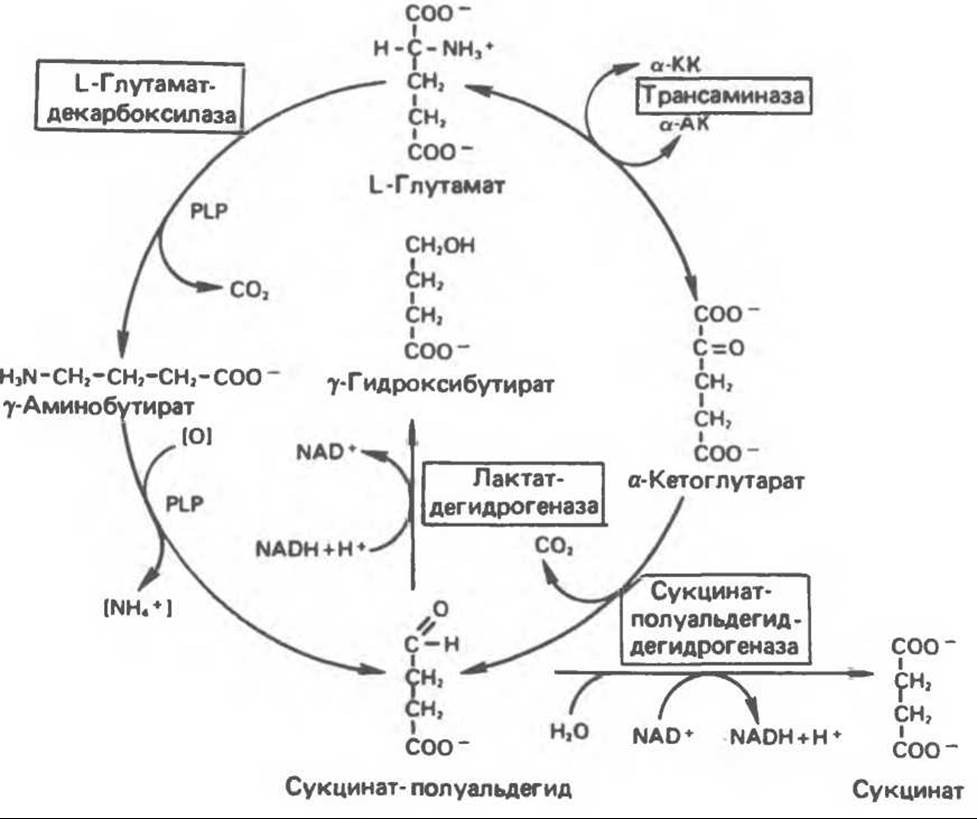
Fig. 32.12. METABOLISM of y-aminobutyrate. а-КК — а-keto acid, а-АК — а-amino acid, PLP — pyridoxal phosphate.
Aminobutyric acidemia
y-Aminobutyrate, like other ω-amino acid anions, is transported slowly across plasma Cell membranes. The level of y-aminobutyrate in urine varies synchronously with its concentration in serum. The biochemical abnormalities leading to aminobutyric acidemia remain unclear; it is possible that the transamination process responsible for converting y-aminobutyrate into succinate semialdehyde is impaired.
Stanbury J. В. et al. (eds), The Metabolic Basis of Inherited Disease, 5th ed., McGraw-Hill, 1983.
Tabor C. W., Tabor H. Polyamines, Annu. Rev. Biochem., 1984, 53, 749.
Last update: 06/08/2026
Editorial and Educational Adaptation: This material has been compiled based on the primary/original source text. The project team performed an editorial review, corrected technical inaccuracies, structured sections, and adapted the content for an educational format.
What was processed:
- elimination of formatting defects (OCR errors, structural breaks, corrupted characters);
- editorial organization of content;
- standardization of terminology in accordance with academic sources;
- verification of factual statements against the original source text.
All mentions of the author, publication year, and origin of the primary text have been preserved in accordance with the source.