Biochemistry - The Chemical Reactions of Living Cells, Volume 3 - D. Metzler 1980
Metabolism of Nitrogen-Containing Compounds
Synthesis and Catabolism of Compounds Belonging to the Glutamic Acid Family
Polyamines
Polyamines comprise a group of related compounds, partially derived from Arginine, that are present in all Cells in relatively large quantities (often at millimolar concentrations). Their cellular content frequently exhibits a stoichiometric relationship with RNA levels. However, in T-even Bacteriophages and most Bacteria, polyamine content is associated with DNA. A wide array of Functions has been attributed to polyamines. They can, to some extent, substitute for cellular K+ and Mg2+ and apparently play a vital regulatory role in nucleic acid and METABOLISM/35.html">Protein Biosynthesis [36]. Spermidine likely fulfills a specific function in Cell Division [40a]. Polyamines can interact with the nucleic acid double helix, forming bridges between polynucleotide chains; in this process, positively charged amino groups interact with negatively charged phosphate groups of the nucleic acid backbone [40]. In one model (proposed by Tsuboi [40b]), the tetramethylene portion of the polyamine molecule nestles in the minor groove, linking three Base Pairs, whereas the trimethylene groups (one in spermidine and two in spermine) form bridges between adjacent phosphate groups on a single strand. Polyamines may also stabilize the supercoiled or folded Structure of DNA.
Class="center">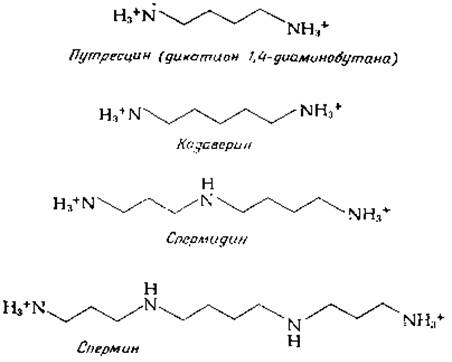
Putrescine, which consists of four carbon atoms, is most readily obtained through the decarboxylation of Ornithine. However, it can also be formed via the decarboxylation of arginine to agmatine, followed by the Hydrolysis of agmatine [37]:

Putrescine is present in all cells, and all cells are capable of converting it into spermidine. This is accomplished by the decarboxylation of S-adenosylmethionine (SAM) [equation (14-20), step a] followed by The transfer of the propylamine group from the decarboxylation product to the amino group of putrescine [equation (14-20), step b] [41].

When E. coli cells enter the stationary growth phase (Chapter 6, Section B), a large portion of spermidine is converted into glutathionylspermidine (alpha-glutamylcysteinylglycylspermidine) [42]. Concurrently, Acetylation of spermidine takes place.
Spermine, which has a more complex structure, has been found exclusively in eukaryotes. An interesting historical note is that Antoni van Leeuwenhoek, as early as 1678, used one of his early microscopes to observe crystals of spermine phosphate in human semen. The five-carbon diamine cadaverine is produced by the decarboxylation of Lysine.
The functions of polyamines and their further metabolism have only recently become the subject of intensive research. In E. coli cells, 1,4-diaminobutane undergoes Transamination to yield alpha-aminobutyraldehyde, which subsequently cyclizes [equation (14-21)]. Diamine oxidizes from animal Tissues oxidize 1,4-diaminobutane to yield the same products. A copper-containing oxidase from bovine Blood serum oxidizes spermidine to a monoaldehyde and spermine to a dialdehyde [38]. Although both of these compounds are highly toxic, it has been suggested that they play an essential role in The regulation of intranuclear metabolism.

In animal organisms, the oxidative degradation of spermine also appears to occur, yielding spermidine; the latter is then oxidized to 1,4-diaminobutane, which is excreted in the urine in significant quantities [38].
Last update: 06/08/2026
Editorial and Educational Adaptation: This material has been compiled based on the primary/original source text. The project team performed an editorial review, corrected technical inaccuracies, structured sections, and adapted the content for an educational format.
What was processed:
- elimination of formatting defects (OCR errors, structural breaks, corrupted characters);
- editorial organization of content;
- standardization of terminology in accordance with academic sources;
- verification of factual statements against the original source text.
All mentions of the author, publication year, and origin of the primary text have been preserved in accordance with the source.