Biochemistry, Vol. 1 - A. Lehninger 1985
Biomolecules
Water
Chemical reactions characteristic of peptides
Like other Organic compounds, Peptides can participate in Chemical Reactions determined by the presence not only of functional groups—such as free amino and carboxyl groups—but also of R-groups.
Two particularly important reactions characteristic of peptides should be noted. First and foremost is the Hydrolysis of peptide bonds by boiling peptide solutions in the presence of a strong acid or base, which results in The formation of free Amino Acids.
Class="center">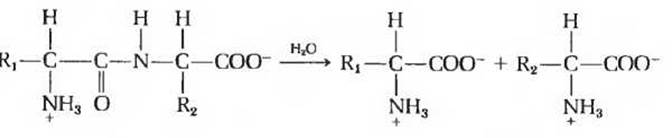
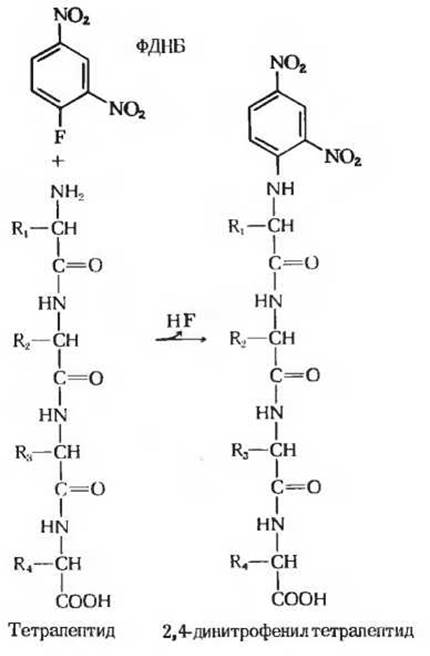
Fig. 5-22. Introduction of a label into the amino-terminal residue of a tetrapeptide. The labeling agent is 1-fluoro-2,4-dinitrobenzene (FDNB).
Hydrolysis of peptide bonds carried out in this manner is an essential step in determining the Amino Acid Composition of Proteins and The sequence of their constituent amino acid residues. Peptide bonds can also be hydrolyzed by the Action of Certain Enzymes, such as Trypsin and Chymotrypsin, which are proteolytic (protein-cleaving) enzymes secreted into the intestine to facilitate the Digestion—that is, the hydrolytic Cleavage—of dietary proteins. While boiling peptides with an acid or base leads to the hydrolysis of all peptide bonds regardless of The Nature and sequence of the linked amino acid units, trypsin and chymotrypsin catalyze the cleavage of peptides in a selective manner. Trypsin hydrolyzes only those peptide bonds formed by the carboxyl groups of Lysine or Arginine. Chymotrypsin, on the other hand, attacks only those peptide bonds formed involving the carboxyl groups of phenylalanine, Tryptophan, and Tyrosine. As we will see later, such selective Enzymatic hydrolysis proves extremely useful in analyzing the Amino acid sequences of PROTEINS AND PEPTIDES.
Another important chemical reaction undergone by peptides, which is also used to determine amino acid sequences, is the reaction with 1-fluoro-2,4-dinitrobenzene. We have already seen (see Fig. 5-17) that this compound reacts with the α-amino group of a free amino acid to yield a 2,4-dinitrophenyl amino acid. This reagent also reacts with the α-amino group of the amino-terminal residue of any peptide, regardless of the peptide chain length, leading to the formation of a dinitrophenyl peptide. This reaction makes it possible to label the amino-terminal residue of a peptide (Fig. 5-22). In Chapter 6, we will see how this and other reactions allowing the labeling of the amino-terminal residue of a peptide are employed to determine The amino acid sequences of polypeptide chains.
Last update: 06/08/2026
Editorial and Educational Adaptation: This material has been compiled based on the primary/original source text. The project team performed an editorial review, corrected technical inaccuracies, structured sections, and adapted the content for an educational format.
What was processed:
- elimination of formatting defects (OCR errors, structural breaks, corrupted characters);
- editorial organization of content;
- standardization of terminology in accordance with academic sources;
- verification of factual statements against the original source text.
All mentions of the author, publication year, and origin of the primary text have been preserved in accordance with the source.