Principles of Biochemistry Volume 1 - A. Lehninger 1985
Biomolecules
Water
Peptide separation can be based on differences in their ionization properties
Partial Hydrolysis of Proteins yields a vast multitude of different Peptides. For example, a given amino acid can form dipeptides with each of the 20 common Amino Acids; given that the Amino acids can be arranged in either order within each dipeptide, a total of 39 different dipeptides can be formed (Fig. 5-20). Any of the other 19 amino acids can yield the exact same number of peptides. If we calculate the total number of dipeptides that can be assembled from 20 amino acids, we get 20 x 20 = 400. The number of possible tripeptides and tetrapeptides with different amino acid compositions and sequences is vastly greater. Consequently, the quantitative Separation of short peptides is a significantly more complex task than the separation of 20 amino acids. Nevertheless, complex peptide mixtures can be successfully separated by exploiting differences in their acid-base properties and polarity.
Class="center">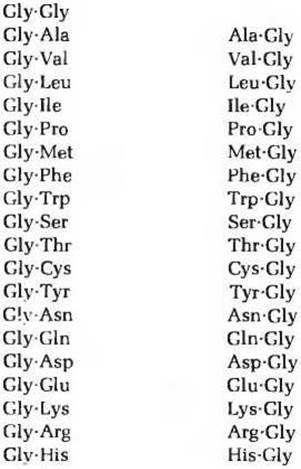
Fig. 5-20. The 39 possible dipeptides containing Glycine. For convenience, standard three-letter amino acid Abbreviations are used. The amino-terminal residues are on the left.
Each peptide contains only one free α-amino group and one free α-carboxyl group, which reside at the terminal residues (Fig. 5-21). These groups ionize in peptides just as they do in free amino acids. As for the α-amino and α-carboxyl groups of the internal amino acid residues, they do not contribute to the acid-base Properties of the peptide because they are tied up in covalent peptide bonds and are no longer ionizable. However, the R groups of Certain amino acids can be ionized (see Table 5-4). When such Amino acids are incorporated into a peptide, their R groups contribute to its overall acid-base properties (Fig. 5-21). Thus, the acid-base behavior of a peptide as a whole can be predicted from the presence of a single free α-amino group and a single free α-carboxyl group at the chain termini, along with The Nature and number of ionizable R groups. Like free amino acids, peptides exhibit characteristic titration curves and specific isoelectric points—that is, pH values at which they do not migrate in an electric field.

Fig. 5-21. Ionization and electrical charges of peptides. Groups that ionize at pH 6.0 are highlighted in red. The cationic, isoelectric, and anionic forms of the alanyl-Alanine dipeptides are shown, with the structural formula of a tetrapeptide displayed on the right.
Although partial Protein Hydrolysis produces a massive variety of different peptides, these complex mixtures can be resolved using Ion-exchange Chromatography, Electrophoresis, or a combination of both, because peptides exhibit distinct acid-base properties and varying polarities at different pH values.
Last update: 06/08/2026
Editorial and Educational Adaptation: This material has been compiled based on the primary/original source text. The project team performed an editorial review, corrected technical inaccuracies, structured sections, and adapted the content for an educational format.
What was processed:
- elimination of formatting defects (OCR errors, structural breaks, corrupted characters);
- editorial organization of content;
- standardization of terminology in accordance with academic sources;
- verification of factual statements against the original source text.
All mentions of the author, publication year, and origin of the primary text have been preserved in accordance with the source.