Chemistry and Biology of Proteins - F. Haurowitz 1953
Internal Structure of Globular Proteins
Terminal Groups of Peptide Chains
The question of whether a peptide chain is straight or branched can be resolved by determining the number of terminal α-amino and α-carboxyl groups (formulas A and D).
Class="center">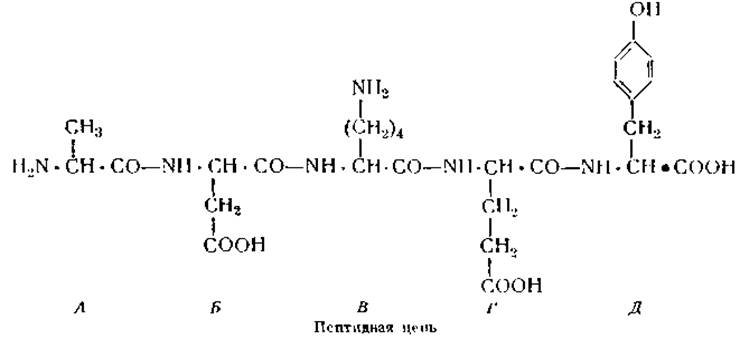
Unbranched peptide chains possess only one α-amino and one α-carboxyl terminal group, whereas branched chains, unless they form rings, contain multiple such terminal groups. When determining the number of terminal α-amino groups, however, one must always keep in mind that free ε-Amino groups are present in the side chains formed by Lysine (formula B), and that determining free amino groups via the Van Slyke method yields both α-amino and ε-amino groups.
If The amount of lysine in a protein is determined separately, the number of terminal α-amino groups can be found by subtracting the corresponding number of ε-amino groups from the total number of amino groups determined by the Van Slyke method. Such determinations performed on lactoglobulin and Insulin [5], cytochrome c [6], and other Proteins have shown that these proteins contain a significant excess of α-amino groups. Data obtained by this indirect method, however, are not entirely accurate, since Amino Acids such as Glycine or Cysteine, when treated with nitrous acid According to the Van Slyke method, yield more nitrogen than theoretically expected.
Electrometric titration of proteins cannot be used to determine the number of terminal amino groups because such titration lacks a distinct inflection point on the curve where the titration of amino groups ends and the neutralization of the imidazole groups of Histidine begins [7]. Carefully executed electrometric titration of Ovalbumin and lactoglobulin revealed an excess of only 1–2 free amino groups when accounting for the ε-amino groups of lysine [8].
Similar difficulties arise when determining the number of free terminal carboxyl groups. In these cases as well, it is necessary to distinguish terminal α-carboxyl groups from the β-carboxyl groups of aspartic acid and the γ-carboxyl groups of glutamic acid (groups B and G in the formula on p. 122). A significant portion of the carboxyl groups of the latter two types is incorporated into CONH2 amide groupings (see Table 1). The remainder, however, exists as free carboxyl groups and is electrometrically titrated alongside terminal α-carboxyl groups. Attempts to determine the number of terminal α-carboxyl groups by subtracting the separately determined β- and γ-carboxyl groups from the total number of carboxyl groups measured electrometrically encounter certain obstacles. These difficulties stem from the fact that the number of terminal α-carboxyl groups is very small compared to the total number of carboxyl groups; therefore, even a slight error in determining dicarboxylic acids can lead to major inaccuracies in establishing the number of terminal α-carboxyl groups. From the foregoing, it is clear that the crucial question of whether a peptide chain is branched cannot be definitively resolved using these direct Methods of terminal group determination. Consequently, an alternative approach has been proposed, namely: labeling the terminal groups with suitable Amino Acid Derivatives and identifying the latter following Protein Hydrolysis. The greatest challenge encountered along this path is finding amino acid compounds that do not cleave during protein hydrolysis.
Last update: 06/08/2026
Editorial and Educational Adaptation: This material has been compiled based on the primary/original source text. The project team performed an editorial review, corrected technical inaccuracies, structured sections, and adapted the content for an educational format.
What was processed:
- elimination of formatting defects (OCR errors, structural breaks, corrupted characters);
- editorial organization of content;
- standardization of terminology in accordance with academic sources;
- verification of factual statements against the original source text.
All mentions of the author, publication year, and origin of the primary text have been preserved in accordance with the source.