Molecular Biology: Protein Structure and Functions - Stepanov V.M. 2005
Tertiary protein structure
Protein denaturation
Denaturation refers to a significant change in the secondary and Tertiary Structure of a protein—namely, the disruption and unravelling of the network of non-covalent interactions without affecting its Covalent Structure. As a rule, denaturation is accompanied by the loss of a protein's functional properties and its inactivation. However, inactivation by itself cannot serve as a reliable criterion for denaturation. Conformational transitions in a protein, wherein one cooperative system of non-covalent interactions rearranges into another, should not be classified as denaturation. The fundamental difference is that in the latter case, both states are ordered, whereas the hallmark of denaturation is precisely the loss of order, leading to an increase in the system's Entropy.
METABOLISM/2.html">THE CONCEPT OF a "significant" change in Spatial Structure in the definition of denaturation given above does not lend itself to quantitative assessment. Most often, one has to deal with a rather sharp, stepwise transition from the Native State to the denatured one, which is dictated by the cooperativity of the protein's tertiary structure. However, cases apparently do occur where a protein undergoes partial denaturation, for instance, due to the loss of spatial Organization in one of its constituent domains or the disruption of the non-covalent interaction network in some region of supersecondary structure.
A qualitative analysis shows that Protein Denaturation can be triggered by a variety of factors. For example, an increase in Temperature leads to an increased contribution from the entropy factor, resulting in thermal denaturation, which typically occurs abruptly. The denaturation temperature of Proteins varies widely and depends significantly on other conditions; for instance, many proteins are markedly stabilized by Calcium Ions. Some proteins are exceptionally thermostable. This is particularly characteristic of proteins from thermophilic organisms adapted to life at elevated temperatures. For example, the proteolytic enzyme Thermolysin, secreted by thermophilic bacilli, retains its activity up to 80°C.
Denaturation is facilitated by exposure of the protein to Reagents that disrupt non-covalent interactions, primarily the Hydrogen bond network. As already noted, the stability of a protein's spatial structure requires The formation of at least 90% of possible Hydrogen Bonds within the protein globule. Understandably, the Cleavage of a significant fraction of these bonds will trigger a cooperative transition from the native structure to the denatured state. Concentrated (6-8 M) urea solutions are most commonly used to denature proteins. The urea molecule mimics the peptide bond, so to speak, and is capable of acting as both a donor and an acceptor of hydrogen bonds, competing with peptide groups and other Functional groups of the protein that form intramolecular hydrogen bonds in the native structure:
Class="center">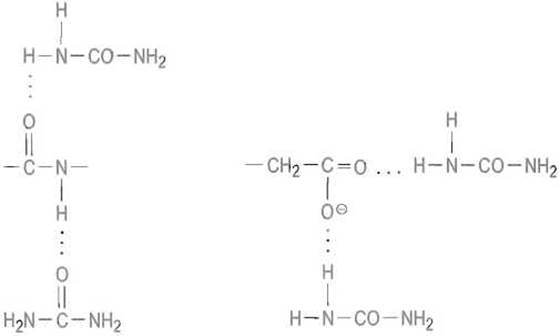
Protein denaturation upon increasing the urea concentration in solution occurs abruptly, typically within a narrow concentration range. For example, the denaturation of Lysozyme is observed during the transition from a 3.2 M to a 4.0 M urea solution. It should be noted that the denaturing effect of high urea concentrations may also be linked to the disruption of Water structure, again due to its formation of hydrogen bonds with urea molecules. This leads to a sharp weakening of the stabilizing role of hydrophobic contacts.
An even stronger denaturing agent is guanidine hydrochloride (typically a 6 M solution).
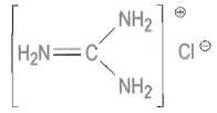
In this case, the same factors operate as with urea: competition with the protein's peptide and functional groups for Hydrogen bonds and the disruption of water structure. In addition to these, the very high Ionic strength also plays a role—guanidine is a very strong base and is almost always fully protonated; therefore, in its concentrated solutions, intraprotein Electrostatic Interactions are ruled out, thereby eliminating yet another factor capable of stabilizing the spatial structure.
Organic Solvents also exhibit denaturing effects on proteins. They are capable of establishing contacts with hydrophobic amino acid residues of the protein, stripping the Hydrophobic core of its stabilizing role. Simultaneously, many solvents—such as alcohols, formamide, and formic acid—effectively hijack the hydrogen bonds that maintain the tertiary structure. With a further increase in solvent concentration, The structure of water may also be disrupted, eliminating the factor upon which the formation of intramolecular hydrophobic contacts within the protein globule depends.
The denaturing action of organic solvents is highly individualized and depends on The Nature of the solvent, the protein, and other conditions (such as temperature). Accounting for these factors makes it possible in A number of cases to avoid denaturation and to use organic solvents in protein fractionation, Chromatography, and sometimes even to conduct enzyme-catalyzed reactions in organic media. In such instances, it is apparently crucial for the protein to retain the water molecules hydrogen-bonded to functional groups on its surface, i.e., its Hydration shell. Certain proteins are also known to easily tolerate high concentrations of organic solvents.
Ionic detergents are also effective Denaturing Agents, among which the anionic detergent sodium dodecyl sulfate is most frequently used: СH3—(СН2)11—OSO-3Na+.
Its long hydrophobic chain forms contacts with the hydrophobic residues of the protein, which, at a detergent concentration of about 0.5 mM, leads to the complete unfolding of the tertiary structure. The mutual repulsion of the nearly universally negatively charged sulfate groups causes the sodium dodecyl sulfate–protein complex to stretch into a rod-like structure bearing such A large number of negative dodecyl sulfate charges that THE CONTRIBUTION OF the protein's own ionic groups proves to be (usually, but not always!) negligible. This method of denaturation has found widespread application in Polyacrylamide gel Electrophoresis studies of proteins.
As with the action of other denaturing agents, the unfolding of a protein in the presence of sodium dodecyl sulfate occurs abruptly. For example, bacterial Ribonuclease (barnase), at 0.65 mM detergent and 37°C, simultaneously binds 14 molecules of sodium dodecyl sulfate per protein molecule consisting of 110 amino acid residues. At lower reagent concentrations, the protein remains stable and virtually forms no complex with the detergent.
Due to the roughly uniform charge density (as a rule, a nearly constant amount of sodium dodecyl sulfate is bound: approximately 0.4 g per 1 g of protein) and the uniform (rod-like) shape of the complexes, the electrophoretic mobility of negatively charged sodium dodecyl sulfate–Protein Complexes is determined solely by the length of the polypeptide chain. This has made sodium dodecyl sulfate electrophoresis the most prevalent METHOD FOR DETERMINING the Molecular Weight of polypeptide chains. This holds true provided the protein lacks Disulfide Bonds that would prevent the chain from unfolding into a linear structure. Consequently, denaturation by sodium dodecyl sulfate is usually complemented by the reduction of disulfide bonds using mercaptoethanol or dithioerythritol. Sometimes detergent Treatment is carried out at 100°C with The addition of concentrated urea to ensure the most complete protein denaturation.
Protein denaturation can also occur at extreme pH values. Thus, in strongly acidic solutions, the negatively charged carboxyl groups of glutamic and aspartic acid residues are fully protonated. This results in only positive charges of cationic groups being retained on the protein surface; their mutual repulsion leads to the unfolding of the globule, while protons simultaneously disrupt a number of hydrogen bonds. In alkaline solutions (at pH 11 and above), the amino groups of Lysine lose their positive charges, whereas the phenolic groups of Tyrosine acquire negative ones, once again leading to a sharp predominance of negative charges and the unfolding of the globule. This is further facilitated by the disruption of several hydrogen bonds, including those formed by the hydrogen atoms of tyrosine phenolic groups. However, proteins are known that are adapted, for instance, to high acidity. Thus, Pepsin maintains its structure and activity at pH 1–2, which is presumably favored by the almost complete absence of cationic groups in this protein.
Determining the completeness of denaturation—that is, the total disappearance of the network of non-covalent interactions characteristic of the native structure—is quite difficult. Researchers usually limit themselves to monitoring changes in a physical parameter characteristic of the protein's spatial structure, such as optical rotatory dispersion or fluorescence spectra, under increasingly harsh denaturation conditions (increasing urea concentration, rising temperature, etc.). Denaturation is considered complete when the observed parameter reaches a certain limiting value; for example, if the fluorescence spectrum ceases to change once it adopts a shape typical of a protein in which all Tryptophan and tyrosine residues are equally accessible to the solvent. Of course, this does not provide an absolute guarantee of the disappearance of all non-covalent contacts, but one can reasonably assume the absence of extended tertiary structure elements that retain cooperativity.
Protein denaturation is frequently complicated by damage to its covalent structure. For instance, prolonged exposure to urea at elevated temperatures can be accompanied by the carbamylation of lysine amino groups:

(In reality, the reaction presumably proceeds via cyanic acid, HNCO, which exists in equilibrium with urea.)
Quite often, Hydrolysis of the amide groups of asparagine and glutamine (deamidation) is observed, especially if the protein contains an Asn–Gly sequence. Alkaline treatment of proteins leads to a whole range of damages, including the cleavage of cystine residues with the formation of dehydroalanine. All these factors must be controlled, which becomes critically important if Protein renaturation—The conversion of a denatured protein back into its native state—is intended.
Last update: 13/08/2026
Editorial and Educational Adaptation: This material has been compiled based on the primary/original source text. The project team performed an editorial review, corrected technical inaccuracies, structured sections, and adapted the content for an educational format.
What was processed:
- elimination of formatting defects (OCR errors, structural breaks, corrupted characters);
- editorial organization of content;
- standardization of terminology in accordance with academic sources;
- verification of factual statements against the original source text.
All mentions of the author, publication year, and origin of the primary text have been preserved in accordance with the source.