Chemistry and Biology of Proteins - F. Haurowitz 1953
Size and Shape of Protein Molecules
Sedimentation Rate of Proteins
If protein solutions are centrifuged in an ultracentrifuge at a very high speed capable of generating a centrifugal force approximately 500,000 times greater than gravity, protein particles will sediment much faster than in the Sedimentation Equilibrium method. When the Molecular Weight of protein molecules is high, The rate of diffusion can be neglected because, as the molecular weight of the solute increases, the sedimentation rate increases while the diffusion rate decreases significantly. The molecular weight is calculated by the formula:
Class="center">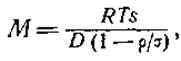
where R, T, p, and σ are the same quantities as in the previous formulas, D is the diffusion coefficient, and s is the sedimentation constant. The sedimentation constant is defined as the sedimentation velocity in a centrifugal field of unit force.
s = (dx/dt)(1/w2x),
where x is the distance of the moving boundary from the center of rotation at time t, and w is the angular velocity of rotation. Proteins have a sedimentation constant of the order of 10-12—10-13 sec. When calculating M using the equation given above, it is clear that D must be known. The diffusion coefficient is usually determined by the diffusion method described in the previous section. Although the sedimentation rate depends on the electrical charge of the protein molecules, METABOLISM/18.html">The Influence of this factor can be minimized to some extent by The addition of salts [26].
Svedberg and his coworkers applied the sedimentation equilibrium and sedimentation velocity Methods to investigate the molecular weights of A large number of different proteins. It was found that the molecular weights of proteins In aqueous solutions range from 12,000 to several millions. Some of the obtained molecular weights are listed in Table 2.
Table 2 Molecular weights determined by sedimentation velocity
|
Protein |
Molecular weight |
Reference |
|
12 700 |
[27] |
|
|
17 000 |
[20] |
|
|
Cytochrome c |
17 000 |
[20] |
|
Bence-Jones protein |
35 000 |
[20] |
|
ß-Lactoglobulin |
35 400 |
[27] |
|
Egg albumin |
45 000 |
[14] |
|
Serum albumin |
68 000 |
[20] |
|
Human Hemoglobin |
63 000 |
[20] |
|
Pig thyroglobulin |
630 000 |
[20] |
|
Apoferritin |
465 000 |
[29] |
|
Jack bean urease |
473 000 |
[30] |
|
Hemocyanin (Helix pomatia) |
6700000 |
[20] |
|
Tobacco mosaic virus |
~ 40 000 000 |
[38] |
Edestin from hemp seeds, excelsin from Brazil nuts, phycocyanin, and phycoerythrin from Algae have molecular weights of the order of 280,000—310,000 [20].
In a solution containing a mixture of several proteins, not one but multiple boundaries appear. Thus, this method makes it possible to determine whether a given protein is homogeneous or not. For instance, it was found that gelatin is heterogeneous and consists of particles with molecular weights ranging from 10,000 to 70,000 [31].
Casein, zein, and serum globulin have also proven to be mixtures.
The Structure/127.html">Interpretation of Results obtained from studying solutions of homogeneous proteins is usually straightforward; however, investigating protein mixtures presents difficulties associated with The formation of complex compounds between proteins [32].
Initially, Svedberg hypothesized that all protein molecular weights were multiples of 17,000. Later, however, it was found that some values required correction (see Table 2); therefore, it is currently difficult to say whether the figures given in the table (68,000; 35,000, and 17,000) are of interest from this specific perspective. Higher molecular weights, on the order of 200,000, cannot shed light on this important problem because the experimental error increases with molecular weight. This error can reach 17,000 when the molecular weight exceeds 200,000 [33].
Last update: 06/08/2026
Editorial and Educational Adaptation: This material has been compiled based on the primary/original source text. The project team performed an editorial review, corrected technical inaccuracies, structured sections, and adapted the content for an educational format.
What was processed:
- elimination of formatting defects (OCR errors, structural breaks, corrupted characters);
- editorial organization of content;
- standardization of terminology in accordance with academic sources;
- verification of factual statements against the original source text.
All mentions of the author, publication year, and origin of the primary text have been preserved in accordance with the source.