Chemistry and Biology of Proteins - F. Haurowitz 1953
Size and Shape of Protein Molecules
Protein Diffusion Rate
When a protein solution is in contact with a protein-free solvent, diffusion of protein molecules into the solvent takes place. According to Fick's law, the amount dS of protein that has diffused through an area Q in a time dt is given by
Class="center">dS = - DQ(dc/dx)dt,
where dc is The change in protein concentration over a distance dx, dc/dx is the concentration gradient, and D is the diffusion coefficient. The order of magnitude of the diffusion coefficient is 10-5 cm2∙sec-1 for Amino Acids, and ranges from 10-6 to 10-7 cm2∙ sec-1 for Proteins. The rate of diffusion is directly proportional to the absolute Temperature and inversely proportional to the drag of the medium, known as the frictional coefficient f. This can be expressed by the following equation:
D = RT/Nf,
where R and T are the gas constant and the absolute temperature, respectively, and N is Avogadro's number (6.02 ∙ 1023). For spherical molecules of radius r, the frictional coefficient is proportional to the molecular radius r and the solvent viscosity η:
f = 6пηr, (1)
D = RT/Nf = RT/6пηrN. (2)
Since the volume of a sphere of radius r is 4r3п/3, the Molecular Weight of a spherical protein molecule can be calculated using the formula
М = 4rпNσ/3,
where σ is the density of the dissolved protein particles. Substituting r from formula (2), we obtain
М = (4пNσ/3) (RT/6DпηN)3. (3)
Since protein molecules are largely non-spherical, their frictional coefficient f is greater than f0, the frictional coefficient of a spherical molecule of the same molecular weight. The ratio f/f0 is thus greater than one. This value of f/f0 can be calculated for regular shapes such as cylinders, rods, and ellipsoids. However, if the molecular shape is unknown, calculating the molecular weight from the diffusion rate becomes impossible.
It is generally assumed that a protein molecule approximates an ellipsoid of revolution with a major axis a and minor axes b; axis a may also be smaller than axis b. For a prolate ellipsoid, the axial ratio a/b is greater than one, while for an oblate ellipsoid, it is less than one. The axial ratio can be calculated if M and f/f0 are known. Nevertheless, the frictional coefficient of a protein depends not only on its molecular weight and shape, but also on its Hydration, since the Swelling of a dissolved particle As a result of binding hydration Water naturally leads to an increase in medium resistance [23].
If a protein molecule has a spherical shape, the ratio f/f0 depends solely on the degree of hydration, which can be calculated by the formula
w = (f/f0 — 1)р/σ,
where w is the weight of water bound per gram of protein, and ρ and σ are the densities of the solution and the dissolved protein, respectively. When calculating the molecular weight of non-spherical molecules, w is generally assumed to range from 0.3 to 0.5.
Experimentally, the diffusion coefficient is determined by measuring the rate at which a sharp horizontal boundary, formed in a vertical tube between a protein solution and a solvent, spreads out. This measurement can be performed using one of the optical techniques employed in sedimentation and Electrophoresis (see Chapter V) [22, 23]. If the studied protein is homogeneous, the concentration gradient curve dc/dx will follow a Gaussian distribution curve, whereas the concentration gradient of a protein mixture will deviate from this curve.
Because establishing a sharp boundary between a protein solution and a solvent experimentally is difficult, the two solutions are often studied by separating them with a porous Glass disc [25]. The rate of diffusion is then measured by determining The amount of protein that has passed through the disc into the water (Fig. 5). When a denser protein solution is placed above the solvent, diffusion is accelerated by gravity. The diffusion Cell is calibrated using a solution with a known diffusion coefficient. If a protein of known molecular weight M1 with a diffusion coefficient D1 is used for calibration, the molecular weight of the unknown protein M2, according to formula (3), will be equal to
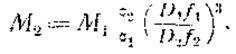
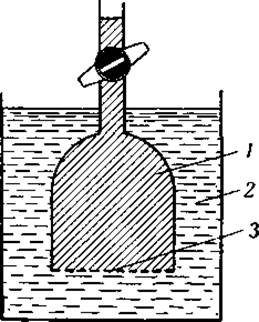
Fig. 5. Diffusion apparatus. 1 — colloidal solution; 2 — solvent; 3 — porous disc.
If the f/f0 values and densities of both proteins are equal, then
M2 = M1(D1/D2)3.
Results obtained by this method are nonetheless less reliable than those obtained using the free boundary method.
Molecular weights calculated from diffusion rates yield values of the same order of magnitude as those obtained for molecular weights by other Methods.
Due to the Variability of conditions introduced by hydration and deviation of molecules from a spherical shape, diffusion coefficient determinations are rarely used for the direct calculation of molecular weights. More frequently, they are combined with the Sedimentation Velocity Method.
Last update: 06/08/2026
Editorial and Educational Adaptation: This material has been compiled based on the primary/original source text. The project team performed an editorial review, corrected technical inaccuracies, structured sections, and adapted the content for an educational format.
What was processed:
- elimination of formatting defects (OCR errors, structural breaks, corrupted characters);
- editorial organization of content;
- standardization of terminology in accordance with academic sources;
- verification of factual statements against the original source text.
All mentions of the author, publication year, and origin of the primary text have been preserved in accordance with the source.