Chemistry and Biology of Proteins - F. Haurowitz 1953
Size and Shape of Protein Molecules
Sedimentation Equilibrium
If a protein solution is centrifuged at high speed, the protein molecules, due to their high specific gravity, will tend to sediment, resulting in an increasing concentration from the center to the periphery of the centrifuge. However, the centrifugal force pulling the protein molecules outward is counteracted by the higher protein concentration at the periphery, which causes the protein molecules to diffuse back toward the more dilute central part of the system. At equilibrium, the molecular weight M is given by:
Class="center">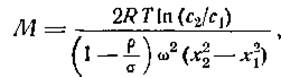
where R is the gas constant, T is the absolute Temperature, c2 and c1 are the protein concentrations at distances x1 and x2 from the center of rotation, w is the angular velocity, and p and σ are the densities of the solvent and the sedimenting particles, respectively.
High speeds required for experiments of this type were successfully achieved by Svedberg, who designed an ultracentrifuge utilizing an oil turbine with a stainless steel rotor. Because the established sedimentation equilibrium is disrupted when the centrifuge stops, observations must be made while centrifugation is underway. For this purpose, protein solutions are placed in transparent Cells, and the protein concentration gradient is measured in the same manner as in Electrophoresis (see Chapter V)—that is, by recording the refractive index gradient or by means of other optical devices [20]. The extremely expensive oil-driven ultracentrifuge with a steel rotor was later replaced by cheaper air-driven ultracentrifuges featuring duralumin rotors and magnetic suspension in a vacuum [21], or employing an electric drive system.
A major drawback of this method is that reaching equilibrium requires a very long time, sometimes taking several days. Unlike the osmometric method, the sedimentation method makes it possible to address the question of the homogeneity of the studied protein, since protein mixtures form more than one boundary during solution centrifugation. Using this method, Svedberg and his coworkers investigated A large number of Proteins. The results of these studies will be discussed after we become familiar with the second ultracentrifugal method, which measures the sedimentation velocity (see p. 55).
Last update: 06/08/2026
Editorial and Educational Adaptation: This material has been compiled based on the primary/original source text. The project team performed an editorial review, corrected technical inaccuracies, structured sections, and adapted the content for an educational format.
What was processed:
- elimination of formatting defects (OCR errors, structural breaks, corrupted characters);
- editorial organization of content;
- standardization of terminology in accordance with academic sources;
- verification of factual statements against the original source text.
All mentions of the author, publication year, and origin of the primary text have been preserved in accordance with the source.