Chemistry and Biology of Proteins - F. Haurowitz 1953
Size and Shape of Protein Molecules
Osmotic Pressure of Proteins
Osmotic pressure is determined using an osmometer, which consists essentially of a semipermeable membrane containing a protein solution and a capillary acting as a manometer (Fig. 4). When the semipermeable membrane filled with a protein solution is immersed in Water, water begins to flow into the protein solution, and the liquid level in the capillary rises until the hydrostatic pressure p equals the osmotic pressure of the protein solution. Osmotic pressure is approximately proportional to the molar concentration of the protein C and the absolute Temperature T, or mathematically expressed as p = KCT, where K is a constant.
Van 't Hoff found that K is identical to the gas constant R, the value of which is 0.08207 L ∙ atm/(g ∙ K). The molar concentration C is equal to c/M, where c is the concentration in grams per liter and M is the Molecular Weight of the protein. Substituting these values into the equation given above yields p = RTc/M and M = RTc/p, which is the well-known Van 't Hoff equation for osmotic pressure. It is identical to the Gay-Lussac law for gases.
Obviously, osmotic pressure is equal to the pressure that the solute would exert if it were in a gaseous state at the same molecular concentration as in the solution. Indeed, osmotic pressure was earlier regarded as a consequence of solute particles colliding with the membrane walls.
Precise measurements of the osmotic pressure of Proteins have shown, however, that proportionality between pressure and concentration is observed only in very dilute solutions whose concentration lies below a certain limit [3, 5]. Deviations from ideal behavior are accounted for by the following equation:
Class="center">М = RTc/(p — Кс2),
where K is a constant for the system under study [6]. If K is replaced by the expression BRT and the dependence of p/c on c is plotted graphically, the slope of the straight line yields the factor B, and the intercept on the ordinate axis is proportional to 1/M [7, 8]. At very low solute concentrations, the value of c2 becomes so small that the term Kc2 can be neglected. In this case, the molecular weight can be determined by plotting the osmotic pressure p against the concentration c and extrapolating the curve to c = 0; the intercept on the ordinate axis is regarded as the osmotic pressure of an ideal solution and is used to calculate M according to Van 't Hoff's law.
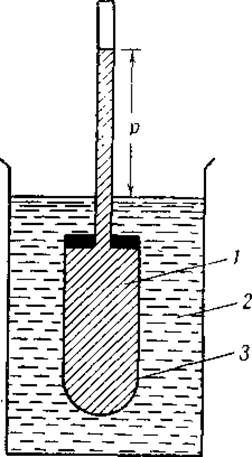
Fig. 4. Osmometer. 1 — solution; 2 — solvent; 3 — membrane.
The constant K in the equation above provides a correction for the volume occupied by the protein molecules themselves. Deviations from ideal solution behavior are especially pronounced in solutions containing thread-like (fibrous) molecules, as they hinder the movement of solvent molecules [9]. It is clear that osmotic pressure cannot arise simply from collisions of protein molecules with the membrane.
A concept that is closer to reality is that [10] osmotic pressure is determined by the difference in The activity of water molecules on both sides of the membrane. Whereas the water in which the osmometer is immersed possesses the full activity of free water, the activity of water on the inner side of the membrane is reduced by protein Hydration as well as by the immobilizing effect of the fibrous protein molecules. From a thermodynamic perspective, the flow of water toward the protein solution can be viewed As a result of the Entropy's tendency to increase. At high hydrostatic pressure, intermolecular distances and entropy decrease [6].
The Osmotic Pressure of Protein Solutions is influenced by the pH of the solution, since the number of anionic or cationic groups on a protein molecule depends on pH. In acidic solutions, proteins exist as cations, and in alkaline solutions, as anions; consequently, neutralizing the charge of the protein ions requires the penetration of a certain number of dialyzable anions or cations through the membrane. This leads to an uneven distribution of dialyzable ions between the outer and inner sides of the membrane (the Donnan effect). Therefore, the osmotic pressure of an acidic or alkaline protein solution is higher than that of isoelectric solutions. For example, it has been found that the osmotic pressure of a 1.2% Hemoglobin solution at pH 5.4, 6.5, 7.2, and 10.2 is 13.4, 3.2, 5.0, and 21.4 mm Hg, respectively [4]. Consequently, the osmotic pressure is minimal near the isoelectric point of hemoglobin (pH 6.9).
Although the equipment required for osmometry is quite simple (Fig. 4), precise determinations are very difficult. To prevent bacterial degradation of the protein, measurements should be carried out at low temperatures and within short time intervals. A capillary tube is often used as a manometer to accelerate the attainment of equilibrium. Capillary phenomena [11] can be avoided in this setup by replacing the water in the capillary with toluene. To minimize the Donnan effect and eliminate errors caused by trace salts present in protein solutions, a concentrated salt solution is used as the solvent, and the osmometer membrane is immersed in it as well. Measuring membrane potentials makes it possible to calculate that portion of the pressure p caused by differences in ion activity.
The molecular weight of Ovalbumin found by this method turned out to be 45,000 [12–14], that of serum albumin 69,000 [15], and that of hemoglobin 72,000 [16]. These values are in good agreement with data obtained by other Methods.
However, lower values of p were obtained when determining molecular weights in protein mixtures [17], which apparently indicates The formation of Structure/178.html">Protein Complexes in such mixtures.
Since proteins dissolve more readily in concentrated urea solutions than in water, a 6.66 M urea solution is often used as a solvent for determining protein molecular weights [5]. It turned out, however, that the molecular weights of amandin and excelsin in a urea solution are 30,300 and 35,700, whereas in native aqueous solutions they are 206,000 and 214,000, respectively [18]. True, the molecular weights of egg albumin, serum albumin, gliadin, and certain other proteins are the same in water and in urea solution [19]. Many other proteins undergo aggregation after Denaturation by urea and similar agents [19].
Osmometric determinations of molecular weights for compounds with a molecular weight below 150,000 are more accurate than determinations by other methods, since their results are less dependent on the shape and hydration of the protein molecules. However, osmometric determinations do not make it possible to judge whether the protein in the test solution is homogeneous or whether it is a mixture of proteins with different molecular weights. If a solution contains more than one type of protein, the molecular weight calculated from the osmotic pressure is an average value equal to the sum of the molecular weights of all protein molecules divided by the total number of protein molecules.
Last update: 06/08/2026
Editorial and Educational Adaptation: This material has been compiled based on the primary/original source text. The project team performed an editorial review, corrected technical inaccuracies, structured sections, and adapted the content for an educational format.
What was processed:
- elimination of formatting defects (OCR errors, structural breaks, corrupted characters);
- editorial organization of content;
- standardization of terminology in accordance with academic sources;
- verification of factual statements against the original source text.
All mentions of the author, publication year, and origin of the primary text have been preserved in accordance with the source.